A reflective essay outline is a plan that helps you organize a personal experience before you write the full essay. It gives your thoughts a clear order, so the paper does not turn into a random mix of memories, emotional reactions, and lesson talk. The purpose, simply put, is to keep the essay focused. A good outline for reflective essay writing helps you get unstuck when you need to connect the event you’re describing with the analysis.
In this article, we will break down the structure, give you an outline template, and then move into real examples that show how the whole thing works in practice.
Let Experts Step In
Get help from our experienced professionals with planning, writing, editing, and polishing.

Structure of a Reflective Essay Outline
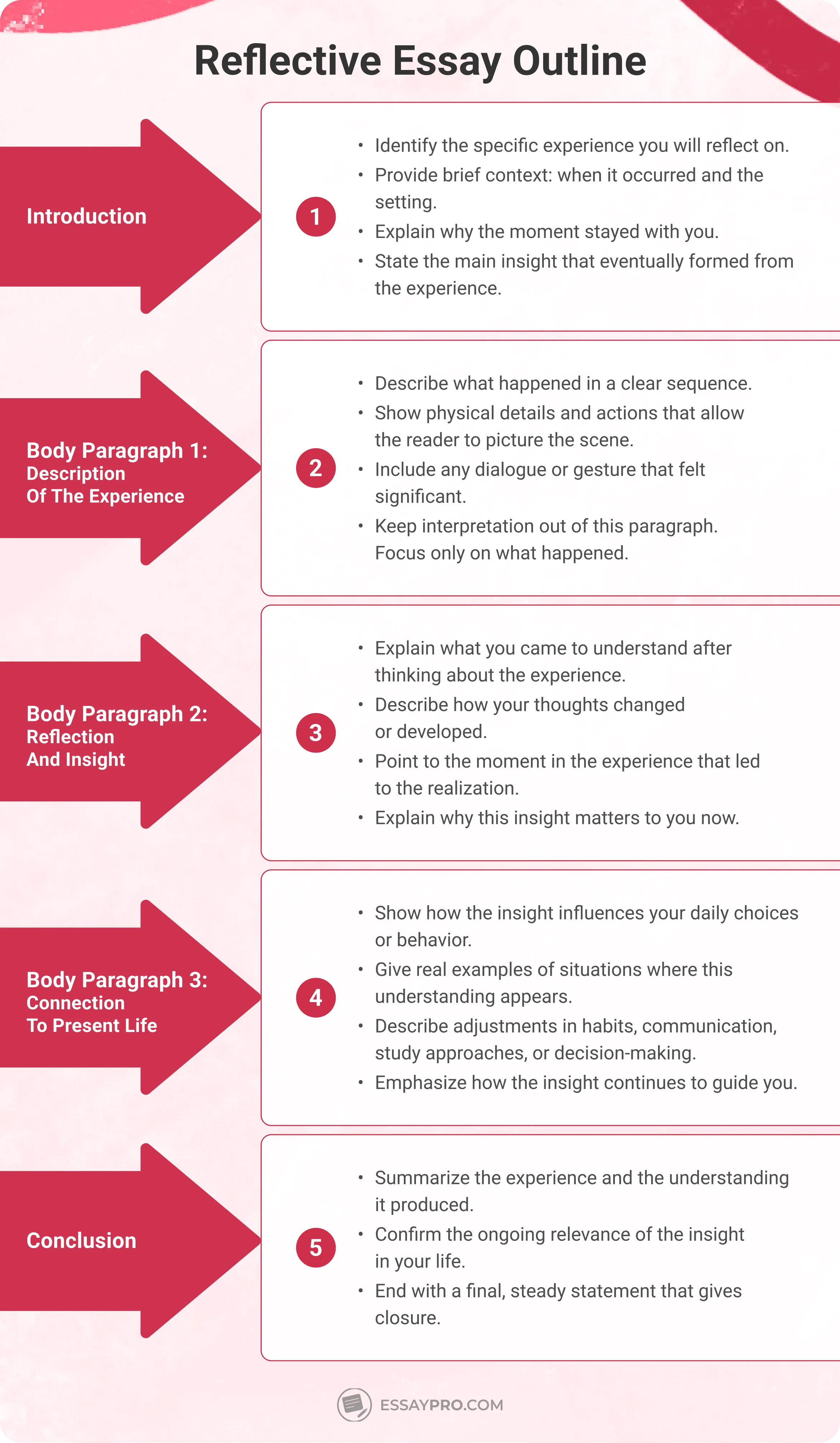
A reflective essay usually has five main parts: an introduction, three body paragraphs, and a conclusion. The introduction sets up what will happen in the paper, the body paragraphs, one by one, describe the situation in detail, followed by analyzing what mattered and what the takeaway was, and the conclusion brings it all back in focus.
Introduction
The introduction names the experience and gives the reader enough context to understand why this specific moment warrants reflection in the first place. If you’ve written an introduction for any kind of academic essay, you know that you shouldn’t give away too many details here. Reflective writing specifically asks you to only state what happened and the basic focus of your response. And, of course, don’t forget to lead into the thesis statement.
Body Paragraph 1: Objective Description
Right after the introduction, you are explaining the event you’re reflecting on in factual order. This is where you can already give out the details of what happened, who was involved, where the thing took place, and generally anything the reader needs before the deeper thoughts make sense.
Body Paragraph 2: Analyzing Feelings
You are writing about this particular event because it made you feel something. Deal with that feeling in this paragraph. Did the experience match what you expected at first? Was there something that confused you, or made you feel uncomfortable? Of course, the point of this section is never to retell the event, but rather reveal your inner response to it.
Body Paragraph 3: Lesson Learned & Evaluation
The experience taught you something once you had time to think it over. This paragraph asks you to revisit your emotional response but look at it critically by evaluating your own decisions and reflecting on what you have handled differently. At last, you should connect it with a larger insight so it’s clear why this experience stayed with you.
Conclusion
The conclusion pulls everything you wrote about together without copying anything. At the very start, you restate the main lesson in a more developed way, then briefly explain how the experience changed your behavior and thinking. A good ending feels earned because it shows clearly the path before and after the event.
Reflective Essay Outline Template
A reflective essay outline template should give you direction without making the writing feel stiff. I’d use it as a planning sheet before the draft, especially when the experience feels clear in your head but messy on the page.
Introduction
- Name the experience you will reflect on.
- Give a brief context about the time, place, and situation.
- End with a thesis that points to the main lesson or personal change.
Body Paragraph 1: Objective Description
- Describe what happened in a clear order.
- Mention the people, setting, actions, and important details.
- Keep this part factual, so the reader understands the situation first.
Body Paragraph 2: Analyzing Feelings
- Explain what you thought and felt during the experience.
- Include honest reactions, such as confusion, pressure, pride, discomfort, or doubt.
- Connect those feelings to specific moments.
Body Paragraph 3: Lesson Learned & Evaluation
- Explain what the experience taught you.
- Evaluate your own choices and reactions.
- Show how your perspective changed.
Conclusion
- Return to the main lesson.
- Explain how the experience affects your current choices, habits, or thinking.
A fast essay writing service will help you structure your scattered draft according to the default outline.
Reflective Essay Outline Format
A reflective essay outline format usually refers to the academic style your instructor requires, most often APA or MLA. The outline still follows the same basic essay plan, with an introduction, body sections, and conclusion. The difference when you’re writing a reflective essay outline in different styles is in the page setup, heading style, and source details, so check the assignment sheet before you format anything.
APA style appears most often in psychology, education, nursing, and social science courses. It gives the outline a formal, clean layout.
- Use one-inch margins on all sides.
- Set the text in a readable 12-point font, usually Times New Roman.
- Double-space the outline.
- Add a title page when the assignment asks for one.
- Use Roman numerals, capital letters, Arabic numbers, and lowercase letters for outline levels.
- Format the reference list in APA style if sources are used.
MLA style is common in composition, literature, and humanities classes. It keeps the outline simple and easy to scan.
- Add your name, instructor, course, and date in the upper-left corner.
- Center the outline title.
- Use one-inch margins and double spacing.
- Keep the same outline hierarchy throughout the page.
- Add a Works Cited page if the outline includes sources.
Reflective Essay Outline Examples
A reflective essay outline sample becomes much easier to understand once you see it turned into actual paragraphs. Take a look at three examples below:
Reflective Essay Outline Example 1
Topic: Ignoring a friend’s message during a difficult week
Introduction
- Introduce the situation: a close friend sent several messages while the writer was overwhelmed.
- Explain that the writer avoided replying because they did not have the energy to explain anything.
- Mention that the silence lasted long enough to create tension.
- End with a thesis about learning that avoidance can feel easier in the moment, yet it often creates more emotional damage than a brief honest response.
Body Paragraph 1: Objective Description
- Describe the week without overloading the essay with unrelated problems.
- Explain when the friend reached out and what kind of message they sent.
- Mention that the writer saw the message, planned to answer later, and then kept delaying it.
- Include the moment when the friend stopped reaching out or asked directly what was wrong.
- Keep this section focused on what happened, not on excuses.
Body Paragraph 2: Analyzing Feelings
- Describe the writer’s emotional state: tired, embarrassed, guilty, and irritated with themselves.
- Explain why replying felt difficult at the time.
- Mention the uncomfortable thought that the friend might take the silence personally.
- Show the conflict between needing space and knowing the silence was unfair.
- Include the moment when guilt became stronger than the original stress.
Body Paragraph 3: Lesson Learned & Evaluation
- Explain that emotional withdrawal still affects other people.
- Evaluate the writer’s assumption that silence was harmless because they “didn’t mean anything bad.”
- Discuss what the writer should have done differently, such as sending a short message instead of disappearing.
- Connect the experience to communication, boundaries, and responsibility in friendships.
- Show that the lesson is not about constant availability, but about basic honesty.
Conclusion
- Return to the lesson about silence and emotional responsibility.
- Explain how the writer now handles overwhelmed periods differently.
- Mention a practical change, such as sending a brief message when they cannot talk properly.
- End by showing that the experience changed how the writer understands care in close relationships.
Reflective Essay Outline Example 2
Topic: Losing patience with an elderly neighbor
Introduction
- Introduce the moment: the writer became impatient while helping an elderly neighbor carry groceries or handle a small errand.
- Explain that the task itself was simple, but the writer’s reaction was not.
- Mention that the writer later felt embarrassed by how little patience they had shown.
- End with a thesis about learning that kindness loses meaning when it is done with visible irritation.
Body Paragraph 1: Objective Description
- Describe where the situation happened, such as an apartment hallway, elevator, grocery entrance, or parking area.
- Explain what the neighbor needed help with.
- Mention the slow pace, repeated questions, or small delays that tested the writer’s patience.
- Include the moment when the writer’s tone, face, or body language showed irritation.
- Keep the description specific and controlled.
Body Paragraph 2: Analyzing Feelings
- Describe the writer’s first reaction: impatience, restlessness, and annoyance.
- Explain what the writer was focused on at the time, such as being late, tired, or distracted.
- Mention the moment when the neighbor noticed the impatience.
- Show the writer’s discomfort after realizing that the help may have felt cold or rushed.
- Include the difference between intending to be helpful and actually making someone feel like a burden.
Body Paragraph 3: Lesson Learned & Evaluation
- Explain that helpful actions still need respect behind them.
- Evaluate the writer’s habit of treating small delays as personal inconveniences.
- Discuss how the situation revealed a lack of patience, not a lack of time.
- Connect the experience to aging, dignity, and everyday manners.
- Explain what the writer would do differently, such as slowing down and paying attention to tone.
Conclusion
- Return to the lesson about patience and respectful help.
- Explain how the writer now notices their tone during small acts of assistance.
- Mention that the experience changed their understanding of kindness in ordinary situations.
- End with a clear reflection on how rushed behavior can make good intentions feel careless.
Reflective Essay Outline Example 3
Topic: Almost posting an angry response online
Introduction
- Introduce the situation: the writer felt insulted, misunderstood, or unfairly criticized online.
- Explain that they drafted an angry response and nearly posted it.
- Mention that the pause before posting became the most important part of the experience.
- End with a thesis about learning to question the real purpose behind public reactions.
Body Paragraph 1: Objective Description
- Describe the online situation without turning it into a long argument summary.
- Explain what triggered the writer’s anger.
- Mention the response the writer typed and what tone it had.
- Include the exact moment of hesitation before posting.
- Explain what stopped the writer, such as rereading the message, imagining the replies, or noticing how harsh it sounded.
Body Paragraph 2: Analyzing Feelings
- Describe the writer’s anger, embarrassment, and need to defend themselves.
- Explain why posting the response felt satisfying at first.
- Mention the uncomfortable realization that the response was partly written for other people to see.
- Show how the writer recognized the desire to win the moment, not solve the issue.
- Include the tension between wanting to be right and wanting to act with self-control.
Body Paragraph 3: Lesson Learned & Evaluation
- Explain that public reactions can make conflict larger than it needs to be.
- Evaluate the writer’s original motive for replying.
- Discuss how anger changed the tone of the message and reduced the chance of a useful conversation.
- Connect the experience to self-control, privacy, and digital behavior.
- Explain what the writer would do differently, such as waiting before responding or handling the issue privately.
Conclusion
- Return to the lesson about impulse and public attention.
- Explain how the writer now handles anger online with more caution.
- Mention a practical habit, such as drafting a response and leaving it unsent for a while.
- End by showing that the experience changed how the writer thinks about being seen, being right, and being responsible.
We also have separate guides for other paper samples, so feel free to check out our article on definition essay examples.
Types of Reflective Essay Outlines
There are many different ways to outline reflective essays, and the best style is determined by the assignment. When writing a reflective essay, compose an outline that fits the way your thoughts will be structured, not the number of paragraphs you have.
Event-Based Outline
There is a reason why the event-based outline is the most common one. It focuses on a single experience by describing it and the feelings that developed after the event, providing objective analysis, and concluding with the lesson(s) learned from the experience.
Personal Growth Outline
A personal growth outline for a reflective essay is appropriate for reflective essays in which you follow changes over time, rather than reflecting on one particular event. In general, self-reflection is getting weak fast when it take place over a long period of time, unless there are concrete examples to support your development. A personal growth outline could be used if you are writing about the sense of confidence, improving communication behaviors, gaining professional awareness, or bettering study habits.
Model-Based Outline
A model-based outline uses an established reflection framework. This format is useful when the instructor wants more structured analysis.
- Gibbs’ Reflective Cycle: (1) description of the experience, (2) feelings, (3) evaluation, (4) analysis, (5) conclusion, (6) action plan.
- Driscoll’s Model: With Driscoll’s models, you focus on answering these questions: (1) What happened?; (2) So what?; and (3) What now?
- Kolb’s Experiential Learning Cycle: (1) experience, (2) reflection, (3) concept building, (4) future use.
How to Write a Reflective Essay Outline?
A reflective essay outline is a planning document, not a shortened version of the essay. Without proper separation between sections, the draft often turns into one long retelling of what happened. The outline should give the reflection a clear order before the writing starts.
Start With the Assignment Requirements
Begin with the instructions. Trust me, missing a crucial detail at this point will waste more of your time than not reading the requirements will save. Here’s a brief checklist:
- Check all requirements
- Note if you should use the first person
- Look for required sections
- Mark any citation rules in detail
Choose the Main Reflective Focus
The outline needs one central point. Not five small lessons, not a full history of the experience, but one main change in understanding. For example, if the essay is about ignoring a friend’s message during a stressful week, the focus should not be on every unrelated problem from that week. Once you choose it, every section of the outline should support that idea in some way.
Divide the Outline Into Clear Sections
A useful outline separates the parts of reflection so the essay does not become confusing. Description comes first because the reader needs context. Feelings and reactions come next. Evaluation should appear after that, when there is enough information to explain what the experience meant.
Add Bullet Points Under Each Section
Do not draft full paragraphs yet. Use short, specific bullet points that tell you what each section must include. Under description, write the exact moment or situation you will explain. Under feelings, name the reactions honestly. Under evaluation, write the lesson in a direct sentence, even if it sounds plain at first.
Check The Outline For Balance
Before writing the essay, check the outline as a whole. Many reflective outlines become too factual because the description is easier to plan than the analysis. Keep enough room for what you thought, what you misunderstood, and what changed afterward.
- Remove unrelated details.
- Add reflection if the outline reads like a timeline.
- Make sure each body section has a different purpose.
- Keep the conclusion focused on current thinking or future behavior.
Buy an essay online from EssayPro if you’d rather have someone with more experience handle your papers.
Send Your Brief
We’ll help turn the assignment requirements into a clean, well-structured paper.
The Last Word
A reflective essay outline works best when it keeps personal writing organized without flattening the experience. Start with a specific moment, describe it clearly, examine your reaction, and explain what changed in your thinking. The strongest outlines separate description from reflection, give each body paragraph a clear job, and end with a lesson that feels earned, not forced.
FAQs
Can I Use the First Person in a Reflective Essay Outline?
How to Make an Outline for a Reflective Essay?
What Is the Most Common Mistake When Making a Reflective Essay Outline?

Daniel Parker
is a seasoned educational writer focusing on scholarship guidance, research papers, and various forms of academic essays including reflective and narrative essays. His expertise also extends to detailed case studies. A scholar with a background in English Literature and Education, Daniel’s work on EssayPro blog aims to support students in achieving academic excellence and securing scholarships. His hobbies include reading classic literature and participating in academic forums.