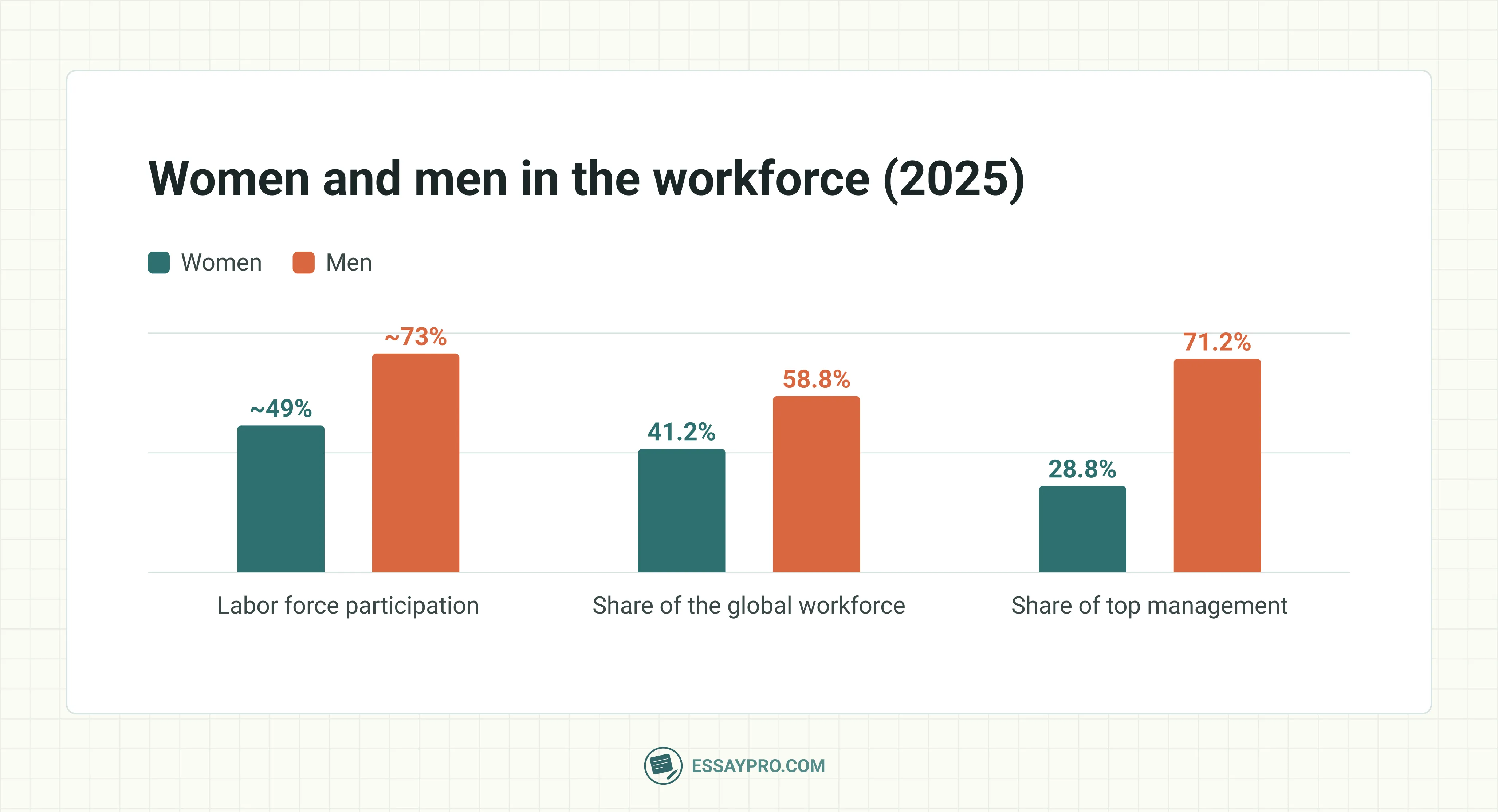
Women make up 41.2% of the global workforce in 2025. Paid participation runs lower: roughly 49% of working-age women work for pay worldwide, versus about 73% of men. The gap between those two rates has held near 24 percentage points for years. The headline numbers rise by a fraction, then flatten. By 2026, the global picture looks much like it did in 2021. Here is where women’s participation and the gender gap stand now.
Women’s labor force participation worldwide
The 2026 baseline is simple to state. Around 49% of working-age women take part in the labor force, versus roughly 73% of men. That gap has barely moved since 1990, when female participation stood near 51%.
Where a woman lives matters more than almost any other factor. Female participation reaches about 87% in North Korea and drops to under 5% in Yemen.
Three forces keep the gap stuck:
- Discriminatory laws. Women hold only about 2/3s of men’s legal workplace rights across 190 economies.
- Cultural norms that treat caregiving as a woman’s default role.
- A thin childcare supply, which ties directly to lower female participation.
Even when women get through the door, they cluster at the lower rungs. Only 28.8% of top management roles go to women, and the share thins further at the board and CEO level.
Unpaid care work and the gender gap
Unpaid care work drives most of the gap. Women do 76.2% of the world’s unpaid care, an average of 4 hours 25 minutes a day, against men’s 1 hour 23 minutes. That imbalance has a direct employment cost.
A few numbers show the stakes:
- 606 million women stay out of the labor force for care reasons, versus 41 million men.
- 45% of working-age women stay out of paid work for care duties, versus just 5% of men.
- Every extra hour of unpaid care cuts a woman’s odds of paid work by 38%.
Parenthood splits the two groups further. A young child in the home tends to reduce a mother’s paid hours and increase the same metric for a father. The care load is the first lever to check on any participation question. Ease it, and the employment numbers tend to climb.
Family support policies and paid leave
Policy decides how many women keep their jobs after a child arrives. The United States holds an awkward record here by being the only OECD member without national paid maternity leave for private-sector workers as of 2025. On the contrary, nearly 75% of OECD countries offer a paid caregiving benefit, and mothers across the OECD get about 19 weeks of paid maternity leave on average.
Paternity leave is where most countries fall short. It is usually shorter and lower-paid than maternity leave, so fathers take on less of the care, and the imbalance behind the participation gap stays in place. Enforcement is weak too: fewer than 20% of economies enforce equal pay at all.
The potential fixes could be as follows:
- Fund accessible childcare. The participation gains show up within five years.
- Mandate paid, well-compensated leave for both parents.
- Enforce equal-pay laws with real audits and accountability.
Women in leadership
Women make up 41.2% of the global workforce, but their numbers thin at every step up the ladder. By senior management, the share drops to 28.8% of top roles. At the very top it nearly disappears: in 2025, just 33 women ran Fortune Global 500 companies, 6.6% of the list. That is a record, and up from 13 (2.6%) in 2020, yet it still means 467 of the world’s largest firms are led by men. The United States accounts for 16 of those women-led companies, China for five, and France for four.
Corporate boards are the one level where progress has been real. Women held 23.3% of board seats worldwide in 2024, a 3.6-point rise in two years, though only 8.4% of boards had a woman chair. On the current trajectory, board parity arrives around 2038.
That boardroom gain is not an accident. It tracks closely with the countries that wrote quotas into law, each setting a minimum share of women on public-company boards:
- Norway: 40%
- France: 40%
- Italy: 40%
- Iceland: 40%
- Spain: 40%
- Netherlands: 33%
- Belgium: 33%
- Portugal: 33%
- Germany: 30%
The CEO numbers show the flip side of that lever. No quota reaches the chief executive’s office, and that is exactly where women remain scarcest. Rules moved the boardroom; the corner office, left to its own pace, has barely shifted.
The global gender pay gap
The pay gap has narrowed, and it has not closed. Women earn about 20% less than men worldwide, roughly 80 cents for every dollar. Across OECD countries the gap is smaller but persistent: the median full-time pay gap was near 11% in 2024, about 89 cents per dollar.
The range across richer economies is wide:
The informal economy deepens the problem. Around 60% of working women hold informal jobs, and women fill 70% of the global care workforce, much of it low-paid or unpaid. These roles sit outside pay-transparency rules and pension systems, so the earnings gap follows women into retirement as a pension gap.
Women and the future of work
Automation is landing harder on women’s jobs. Globally, 4.7% of women work in roles at the highest risk of generative-AI automation, against 2.4% of men; in high-income countries the split widens to 9.6% versus 3.5%. Clerical and administrative work, long female-dominated, faces the steepest exposure.
The scale is large. About one in four jobs worldwide is exposed to generative AI, rising to 34% in high-income countries. If the most exposed jobs disappeared, two women would be displaced for every man.
Skills decide who adapts. The STEM and AI fields that offer the safest ground remain male-heavy:
Closing the automation risk means moving women into higher-skilled roles and widening access to AI training.
Final thoughts
Women make up 41.2% of the global workforce, yet participation holds near 49% against men’s 73%, and the pay gap sits around 20%. Unpaid care keeps millions out of paid work. Leadership, boards, and STEM stay male-dominated, and AI threatens women’s jobs first. Progress is real, and slow.


Ana Ratishvili
Ana is a professional literary writer with a Master’s Degree in English literature. Through critical analysis and an understanding of storytelling techniques, she can craft insightful guides on how to write literary analysis essays and their structures so students can improve their writing skills.