
Health in the United States still divides along lines of race and ethnicity. No state has closed the gaps in access, quality, and outcomes between white residents and most other racial and ethnic groups. As of 2023, Black women died of pregnancy-related causes at more than three times the rate of white women, 49.4 versus 14.9 per 100,000 births. Roughly 27.5 million people, about one in ten residents, have limited English proficiency, a factor tied to measurably worse care. For students preparing to enter health and human services, these disparities define the professional terrain, and a working grasp of them is foundational to the job.
What is cultural competence?
Cultural competence is a set of matching behaviors, attitudes, and policies that allow a system, an agency, or a professional to operate effectively across cultures. The term was first defined in 1989 and split in two. “Culture” encompasses the language, beliefs, values, and customs of a group. “Competence” means the ability to function within those contexts rather than merely acknowledge them.
An organization that pursues this standard requires several things:
- A defined set of values, supported by behaviors and policies that reflect them
- The capacity to value diversity, assess its own performance honestly, and manage the tensions that difference produces
- Cultural knowledge embedded in hiring, training, and everyday practice rather than added as an afterthought
The payoff shows up in service quality. Teenagers miss appointments at a higher rate than any other group, a clinic finds, for example. A culturally competent response will adjust according to the cause:
- Weekend hours to serve the teens unable to visit during the school days.
- Providing a reminder call from a caseworker/assistance with transportation
Cultural competence vs. cultural awareness and sensitivity
Awareness and sensitivity end at understanding. A practitioner recognizes that cultural differences exist and respects them, and the process stops there. Competence adds the element that alters outcomes: the organization changes how it operates so that it reaches populations it previously underserved. Awareness is a matter of perspective. Competence is a matter of structural change to systems, policies, and service delivery.
The distinction breaks down as follows:
A related concept has gained standing in training programs and the research literature: cultural humility. It asks practitioners to treat learning about a patient’s culture as an ongoing professional commitment and to remain honest about the limits of their own knowledge. Many programs now teach it alongside competence, since the word “competence” can suggest a fixed endpoint that the work does not actually reach.
Why cultural competence matters for health and human services students
A patient who cannot follow a provider’s instructions will not follow the treatment. When communication fails across a cultural or language gap, the effect moves down a predictable chain:
- The patient misunderstands the diagnosis.
- Misunderstanding erodes trust in the provider and the plan.
- Low trust leads the patient to disengage from care.
- Disengagement produces the measurable harms seen in the disparity data: missed medications, skipped follow-ups, and worse outcomes.
Cultural competence interrupts that chain at the first link. A provider who communicates in terms the patient understands earns trust, and a patient who trusts the provider is more likely to disclose symptoms, accept treatment, and return.
Because the effect runs straight to patient safety, cultural competence has become a graded component of professional training across the field:
- Nursing, medical, and social work programs build it into coursework and grade it.
- Clinical placements test it with real patients from the communities a program serves.
- Accreditation bodies expect documented competency, which means the classroom standard follows the student into the field.
The federal benchmark is the National CLAS Standards, a set of 15 standards from the HHS Office of Minority Health that define what culturally and linguistically appropriate care looks like in practice. The principal standard calls for effective, equitable care responsive to each patient’s cultural beliefs, preferred language, and health literacy. Students who learn the framework early bring a shared professional vocabulary into any clinical setting.
How students can build cultural competence
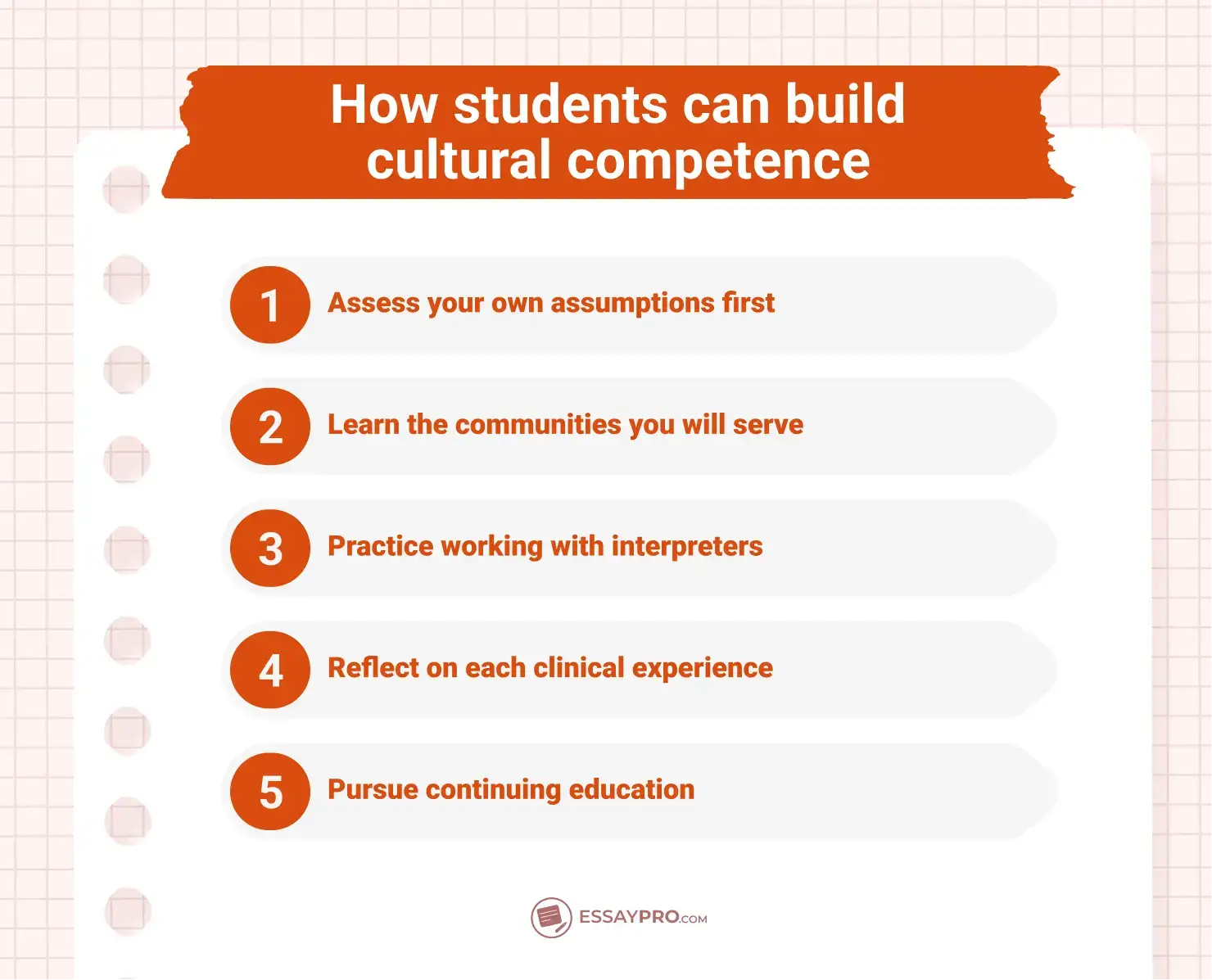
Cultural competence develops through deliberate practice over a career, and the habits that support it can start in school. The following approaches give students a concrete place to begin.
- Assess your own assumptions first. Honest self-assessment reveals the biases and blind spots that affect how you read a patient. A student who recognizes a personal discomfort with certain beliefs can address it before it reaches a clinical encounter.
- Learn the communities you will serve. Study the specific populations in your placement region, including their common health beliefs, languages, and barriers to care. General cultural knowledge matters far less than familiarity with the people at your actual clinic.
- Practice working with interpreters. Speak directly to the patient, allow time for interpretation, and avoid relying on family members for medical translation.
- Reflect on each clinical experience. Treat difficult cross-cultural encounters as material for structured reflection rather than events to move past.
- Pursue continuing education. Cultural competence has no endpoint, and formal training keeps knowledge current as communities change.
Suppose a nursing student works at a clinic serving a large Somali community. She begins by examining her own assumptions about immigrant patients and family dynamics. She then reads up on Somali health beliefs and the community’s history with the medical system. During a visit with a patient who speaks limited English, she requests a professional interpreter and addresses her questions to the patient rather than the patient’s son. Afterward, she writes a short reflection on what went well and where the visit stalled. Months later, she signs up for a continuing education module on refugee health to deepen what the placement started.
Final thoughts
Cultural competence means changing how care is delivered so it reaches every patient effectively, not simply respecting that differences exist. It improves communication, builds trust, and narrows documented health disparities. For students across nursing, medicine, and social work, it is a trained, assessed skill that develops through self-examination, community knowledge, and ongoing practice.


Ana Ratishvili
Ana is a professional literary writer with a Master’s Degree in English literature. Through critical analysis and an understanding of storytelling techniques, she can craft insightful guides on how to write literary analysis essays and their structures so students can improve their writing skills.