The ability to read and write opens doors to a career. Strong readers can reach skilled, well-paid jobs, and adults with low literacy often find even entry-level work hard to land. The global trend looks good. The adult literacy rate reached 88% in 2024, up from 86% in 2015, and 93% of 15-to-24-year-olds can read and write. A gender gap remains, though. Women are almost two-thirds of the 739 million adults who still cannot read, and that gap runs widest in the poorest nations of South and West Asia and sub-Saharan Africa.
Key US literacy statistics 2026
U.S. reading skills have slipped since 2017. The latest figures show how adults score, where students stand, and what the shortfall costs the country.
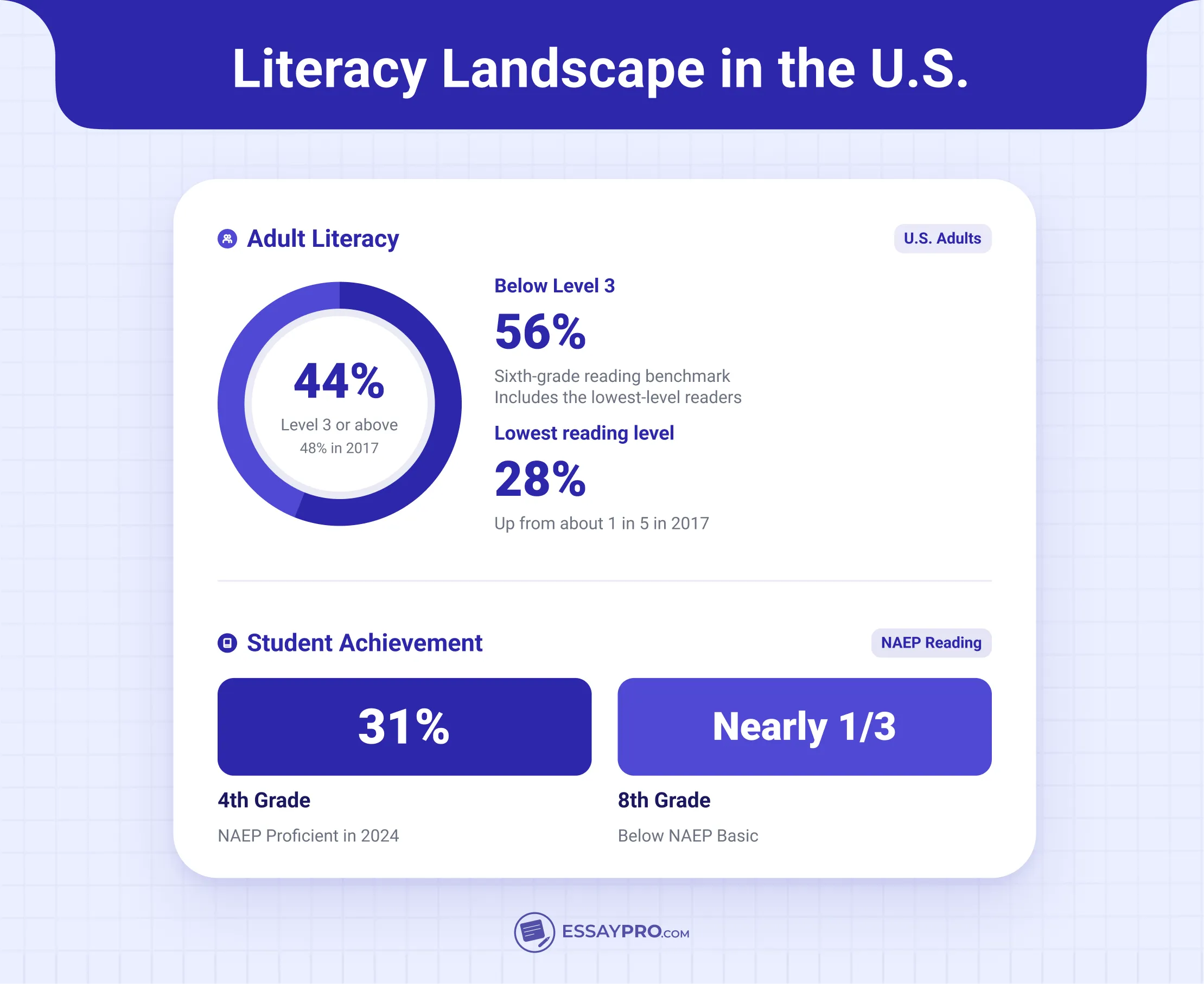
- More than 1 in 4 U.S. adults, 28%, now land at the bottom literacy tier, Level 1 or below, a jump from roughly 1 in 5 back in 2017.
- A solid working level of reading sits at Level 3, which researchers link to sixth-grade skills, and 56% of adults fall short of it.
- Just 44% of adults read at Level 3 or higher, down a few points from the 48% recorded in 2017.
- Reading scores for kids look no better: 31% of fourth graders hit NAEP Proficient in 2024, and close to a third of eighth graders dipped below NAEP Basic, the worst mark the test has ever logged.
- Lift every adult to a sixth-grade reading level and the payoff could reach $2.2 trillion a year for the economy.
Where does the US rank in literacy?
People always want to know where America stands against other wealthy nations once they see those numbers. Right around the middle is the answer. With the pointing-down trend.
U.S. adults average 258 points in reading, just under the 260-point international average, which lands the country 14th among the 31 nations and economies measured. 13 countries scored higher, including Finland leading at 296, Japan at 289, and England well ahead of the States at 272.The U.S. score dropped 12 points since the last round, when it hit 271. Among G7 peers, only France and Italy trail America.
The relationship between literacy and poverty
Poverty and weak literacy feed on each other in a tight loop. Where incomes are low, schools are scarce, and cash-strapped families sometimes need children earning a wage instead of attending class. Most of the countries with the lowest literacy are in South and West Asia and sub-Saharan Africa, home to a large share of the world’s poorest nations. The strain also falls harder on women, who make up nearly two-thirds of the 739 million adults who cannot read, about 466 million people. That holds up worldwide, unfortunately: roughly 91% of men can read and write, and the rate for women is about 85%. That divide grows in poorer regions, where limited money pushes families to put sons’ schooling first.
Global literacy rates by country
Source: OECD, Survey of Adult Skills (PIAAC) 2023.
The gap between the top and the pack is wide. Finland (296) and Japan (289) set the pace, with the Nordic countries and the Netherlands close behind. The U.S. landed at 258, a shade under the 260-point OECD average, which put it 14th among the 31 nations and economies tested. France, Austria and Korea anchored the lower tier of wealthy nations. One note worth keeping in mind: these scores gauge applied reading skill, so they read very differently than the 99% basic-literacy figures many of these same countries report.
Final thoughts
The global literacy picture keeps improving, with the adult rate near 88% in 2024 and youth literacy at 93%, though 739 million adults still cannot read, and women are nearly two-thirds of them. The U.S. story runs the other way. More than 1 in 4 adults now read at the lowest level, 56% fall below a solid working standard, and only 31% of fourth graders read proficiently. That shortfall could cost the economy up to $2.2 trillion a year. On the world stage, American adults rank mid-table, 14th among the nations measured. Poverty and gender keep the deepest gaps locked in South and West Asia and sub-Saharan Africa, where some nations approach 100% literacy and others fall below 30%.


Ana Ratishvili
Ana is a professional literary writer with a Master’s Degree in English literature. Through critical analysis and an understanding of storytelling techniques, she can craft insightful guides on how to write literary analysis essays and their structures so students can improve their writing skills.