

Gen Z has been predicted for many years. What will they consume? What will they think and do when they're older? Well, in 2026, we don't have to wonder anymore. There are approximately 2 billion people classified as Gen Z, who account for about one quarter of the world's population and were born between 1997 and 2012 (United Nations population estimates by generations). Many of them are close to turning 30. They are employees, tenants, voters and consumers that can now tell us what they think.
What do they think? Money. Cost of living has been the number one concern for the 5th year in a row for Gen Z's in Deloitte's study of 22,595 Gen Z's and millennials across 44 countries. 38% of Gen Z cite it as their biggest worry, and 55% say they have put something off for financial reasons. Next, we have technology. Although you may think all Gen Z are glued to their screens, that is not always true. Globally, 82% of those aged 15-24 use the internet, compared with 72% of the rest of the population. This, of course, can be broken down further into regions with some youth usage exceeding 95% in the EU, CIS and the Americas.
Where are the differences seen across the world? And similarities? We will dive into Gen Z around the globe and cover topics such as work and income, technology and beliefs. Using recent studies from the United Nations, ITU, Deloitte and more, we will discuss this generation and keep in mind their age bracket used in each study.
Gen Z is mobile-centric and digitally oriented
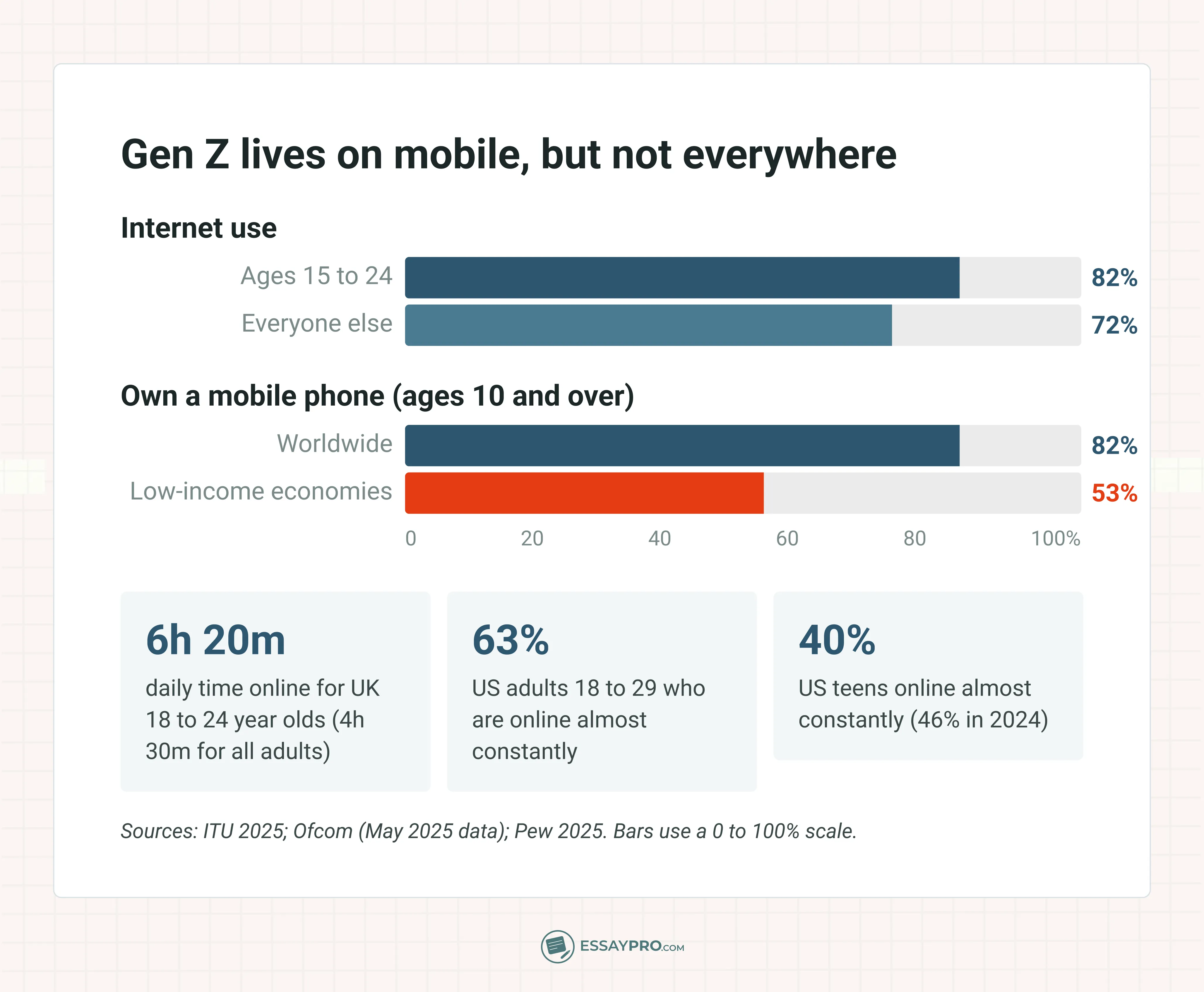
For them, the smartphone is the go-to for internet access. Kids today have become the most connected generation on earth. Spending more time on the web than any other generation. Most of it is done on their phone. "Digital" doesn't apply equally to everyone. Depending on how much money you have or where you live.
Key facts
- Most connected age group: 82% of 15- to 24-year-olds use the internet, compared with 72% of everyone else. Youth use has already passed 95% in Europe, the CIS region, and the Americas (ITU, 2025).
- Mobile is the gateway: 96.2% of internet users go online with a mobile phone at least some of the time (DataReportal, Digital 2026 Mid-Year, all ages).
- The access gap: 82% of people aged 10 and over own a mobile phone worldwide, but only 53% do in low-income economies (ITU, 2025).
- Heavy social use: Respondents aged 16 to 24 are the most frequent social media users, averaging 4.6 days a week. Women aged 16 to 24 spend 25 hours 45 minutes a week on social and video feeds, against a global average of 18 hours 36 minutes.
- UK time online: 18- to 24-year-olds spend 6 hours 20 minutes a day online, compared with 4 hours 30 minutes for all adults. They also have the most daily smartphone time, at 5 hours 5 minutes (Ofcom, May 2025 data).
- US young adults: 63% of adults 18 to 29 say they are online almost constantly (Pew, 2025).
- US teens: 97% use the internet daily, and 40% say they are online almost constantly. That is a slight dip from 46% in 2024, but still well above 24% a decade ago.
Takeaway: Design for the phone first, but don’t assume every young person is online. In low-income countries, phone ownership and internet access are far lower.
Busting common stereotypes: Are Gen Z more entrepreneurial than other generations?

Partly true. In the US, Gen Z starts businesses at the highest rates of any age group, and many young people run side jobs. But the pattern is not universal, and starting a business is not the same as keeping one running. Young adults launch more ventures, while older adults still own most established businesses.
Key facts
- Starting: In the US, 18 to 24-year-olds and 25 to 34-year-olds both had the highest early-stage entrepreneurial activity in 2024, at 25% each (GEM, which counts people starting or running a business under 3.5 years old). In the 2025 to 2026 report, the rate stayed above 20% among 18 to 34-year-olds.
- Not the same everywhere: In the UK in 2025, 25- to 34-year-olds had the highest rate (24.4%), while 18- to 24-year-olds (19.6%) matched 35- to 44-year-olds (19.7%).
- Staying power: Younger people are more likely to start businesses, while older people tend to own established ones, possibly because they have less to lose, GEM says. In the US, established business ownership fell from 10.6% in 2019 to 5.5%.
- Necessity, not only ambition: Over two-thirds of US entrepreneurs cite job scarcity as a motive.
- Side jobs: Nearly 30% of Gen Zs and about 25% of millennials have a part-time or full-time side job.
- Money holds them back: In the same survey, 55% of Gen Zs say they have delayed major life decisions, including launching a business, because of their finances.
- Interest outruns guidance: One third of Gen Zers say they would like to start their own business, but only 13% of Gen Z high schoolers say others have talked with them a lot about starting one.
Busting common stereotypes: Do they have a negative outlook on the future of the environment?
Partly. Young people are worried about the environment, and many doubt that leaders will act. But the picture is more mixed than “doom.” Concern often sits next to action, and in 2026, money worries outrank climate in Gen Z’s top concerns.
Key facts
- Worry is widespread. In a ten-country survey of 10,000 people aged 16 to 25, 59% were very or extremely worried about climate change, and 84% were at least moderately worried. More than 45% said these feelings affected their daily lives, and about three in four agreed the future is frightening.
- Similar in the US: In a survey of 15,793 US youth aged 16 to 25, 85% were at least moderately worried, and 57.9% were very or extremely worried.
- Workers say the same: 65% of Gen Zs said they felt worried about the environment in the past month.
- But priorities have shifted. In Deloitte’s 2026 survey, the cost of living is Gen Z’s top concern (38%), followed by crime, unemployment, their generation's mental health, and political instability. Climate change is not in Gen Z’s top five. It is fourth for millennials (18%).
- Worry becomes action. 48% of Gen Zs said they and their colleagues had pressed employers to protect the environment, and 43% had taken steps to conserve water.
- A youth gap exists in several countries: In India, Indonesia, Mexico, and Turkey, younger adults are more likely than those aged 50 and older to be concerned that climate change will harm them personally.
- Younger voters push harder, even across party lines: Among US Republicans, 48% of those under 30 say the federal government is doing too little on climate change, against 21% of those 50 and older.
Gen Z is anxious about the environment, but not simply gloomy. The most intense pessimism concerns whether governments and companies will act, and many young people respond by pressing for change.
Summing up
There are around 2 billion people who make up Generation Z. They have different tendencies depending on where they live. You'll find them online more than any other age group; in fact, 82% of 15 to 24-year-olds are connected. Mainly using their phone. However, if you lack the financial means, access remains out of reach. They create many businesses but don't own any major businesses. They do care about the environment, but the cost of living has recently climbed to the top of their list of concerns. Ultimately, the underlying theme is pressure driving Gen Z to take action.


Sopho Miller
is an experienced content writer who specializes in digital marketing, business, and academic topics. With a Master’s degree in Digital Marketing, she combines her expertise with a practical approach to create clear, engaging, and educational content. She crafts detailed guides and resources that support students in their academic journey. Outside of work, Sopho stays current with the latest industry trends and regularly attends workshops to further sharpen her skills.