

Something unusual is happening in college classrooms, and professors have started talking about it out loud. Each semester, a share of students cannot get through a single sentence of the assigned text. Jessica Hooten Wilson, a humanities professor at Pepperdine University, has watched students arrive unable to read even one line, and her concern centers on comprehension and reading stamina.
The data matches what instructors describe. Twelfth-grade reading scores hit a record low in 2024, the weakest result since the exam began in 1992. Daily reading for pleasure has fallen 40% over two decades. These shifts in Gen Z reading habits show up the moment students reach campus, and they touch far more than one seminar. The sections below cover how this change in college students reading affects teaching, plus the longer stakes for work, friendship, and mental health.
Students are struggling to read long passages
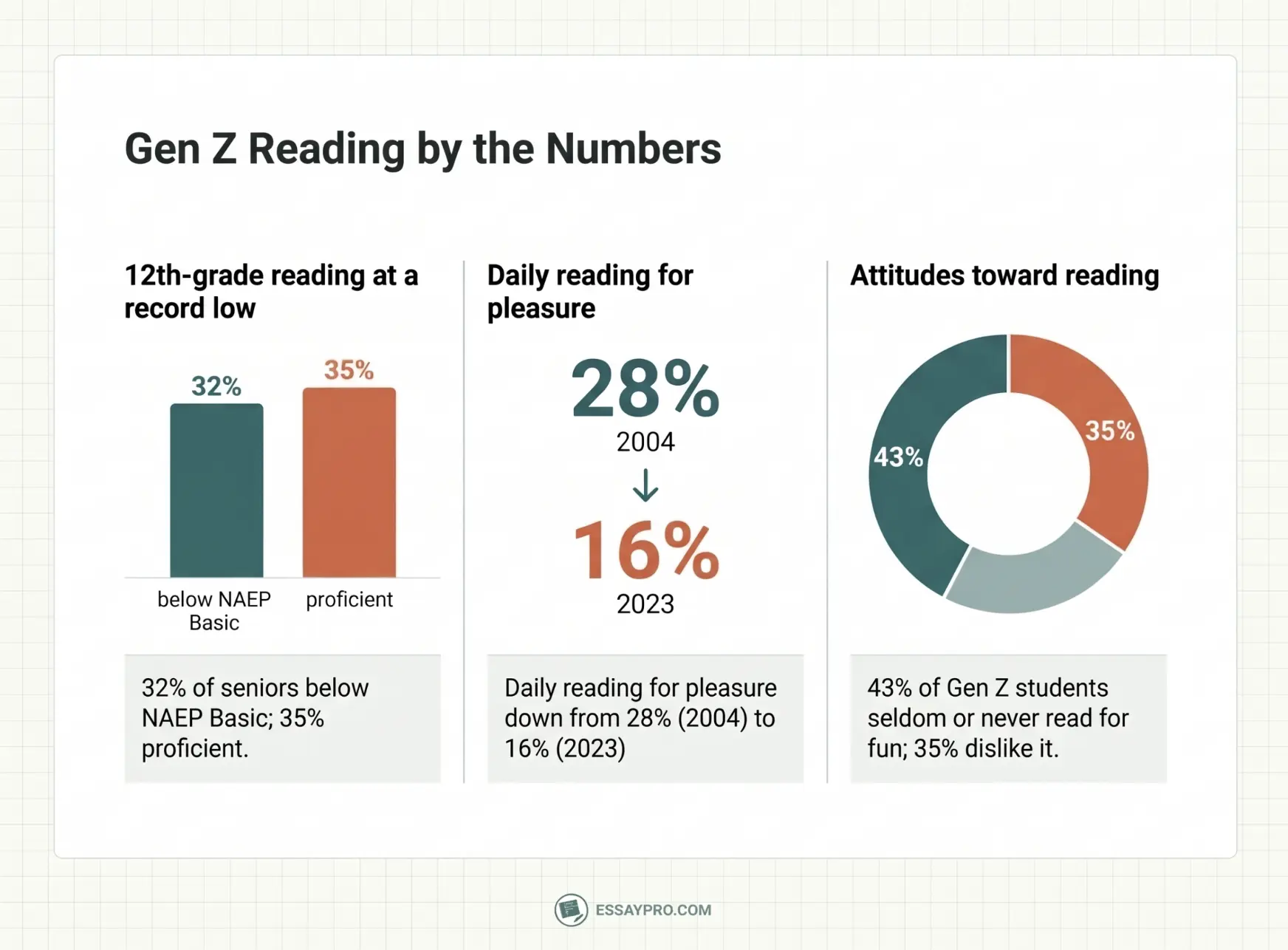
Professors are changing how they teach because the old method stopped working. Wilson’s own blunt verdict: “It’s an inability to read sentences.” The data backs the alarm. In 2024, 32% of seniors scored below NAEP Basic in reading, the largest share on record. Her response is to rebuild the skill in class, through three moves:
- Reading passages out loud with the group.
- Working through the text one line at a time.
- Returning to a single poem again and again across a whole semester.
The aim is to hold the standard steady and give students a workable path to meet it. Much of what she’s up against traces back to habits that form long before freshman year. A Walton Family Foundation and Gallup survey found 43% of students seldom or never read for fun, and 35% say they dislike it outright. Those attitudes show up in class as a few consistent root causes:
- Low confidence and short stamina for long or difficult chapters.
- A scanning habit that hunts for keywords and loses the thread of an argument.
- Heavy use of AI digests that skip the nuance and the main point.
- Reading routines that form years before college.
Timothy O’Malley, a theology professor at the University of Notre Dame, sees the same pattern, and his own syllabus shows how far expectations have moved:
The trend of college students reading less began back in high school, so Gen Z reading patterns are mostly in place before anyone sets foot on campus. The teaching fixes do work. They also eat into class time that once went toward discussion and analysis, the tradeoff professors now manage.
How AI is changing college reading habits

Students now open a chatbot before the actual reading, and that single habit changes the whole process. A summary tool has genuine uses, and it also comes with a cost once it takes over:
An eight-week study of undergraduates put a name to the problem: students were “reading through AI rather than with it.” Students using AI summaries treated the output as the main text and dipped into the source only here and there. The result is costly in a way that is easy to miss. A student can finish the assignment on time and still miss what the author actually argued, the gap professors keep running into.
Reading is on the decline, and it could have wide-ranging impacts
The drop in reading is simple to count, and its fallout runs well past any single classroom. A lot of what gets called laziness is really a confidence problem. Students struggling with reading usually want to do the work, but then their stamina runs out halfway through a dense chapter, and the book closes.
That is why some professors treat reading as a skill they can rebuild. Brad East, a theology professor at Abilene Christian University, eases the grade anxiety around assignments and reworks them for a classroom where AI is one click away. Lower the fear, he finds, and more students open the book.
The same confidence gap shows up far from the humanities. At Northwestern’s Kellogg School, Brooke Vuckovic estimates that between 40% and 50% of her business students each term call themselves novice or reluctant readers. Give them a push to start, she notes, and the turnaround can be almost immediate, a sign the barrier was confidence.
If reading is worth saving, notice who still holds onto it. A JPMorgan survey of more than 100 billionaires ranked reading the top habit that elite achievers share. That is a correlation and nothing more; reading alone makes no one a billionaire. Even so, those with the most options still make time to read.
For Wilson, the stakes are human. Reading, she argues, lets a person borrow someone else’s eyes for a while, and that grows empathy, community, and a connection that outlasts any future career.
What declining reading skills mean for academic performance
Weak reading does not stay in one place. It spreads to almost every part of a degree. When young adults reading less reach college, the gaps surface fast across the core academic tasks:
- Comprehension: a student who misses the argument in a chapter cannot summarize it, apply it, or question it later.
- Class discussion: Seminars depend on everyone having met the text, so thin preparation leaves the room silent and a few voices doing the work.
- Writing: strong essays grow out of close reading, because a writer borrows structure, evidence, and phrasing from good models.
- Critical analysis: spotting a flawed claim takes patience with long arguments, which is the exact skill that erodes first.
- Dense material: upper-level courses run on primary sources and research papers that no summary can fully replace.
Each gap feeds the next, so a small reading deficit in year one can compound into a serious disadvantage by graduation.
What can students do to improve reading comprehension?
Reading comprehension responds well to practice, and small habits add up quickly. A student who wants to rebuild the skill can start with a simple routine:
- Start short and daily. Ten focused pages each day builds the habit without wearing you out.
- Kill the distractions. Put the phone in another room so one paragraph gets full attention.
- Read with a pen. Mark the main claim in each section and jot a one-line summary in the margin.
- Talk it back. Explain the chapter out loud to a friend, since teaching a point proves you understood it.
- Use AI to check your understanding after you read. Ask it to quiz you or clarify a hard term, and do the first read yourself.
- Build stamina on purpose. Add a few pages each week so long texts start to feel normal.
Final thoughts
College professors are meeting students who struggle with full sentences, and the national numbers confirm the slide. AI summaries deepen it when they replace the reading. The costs reach grades, future careers, and a sense of connection. The habit is rebuildable, so steady daily practice remains the clearest route back.
FAQs

Why are Gen Z students reading less?
How does AI affect students’ reading habits?
Can college students improve their reading stamina?

Sopho Miller
is an experienced content writer who specializes in digital marketing, business, and academic topics. With a Master’s degree in Digital Marketing, she combines her expertise with a practical approach to create clear, engaging, and educational content. She crafts detailed guides and resources that support students in their academic journey. Outside of work, Sopho stays current with the latest industry trends and regularly attends workshops to further sharpen her skills.