Half the country’s teenagers hit snooze at 6:30 a.m. with the exact same kind of groggy resentment. They really have to start getting ready for school, but that one more video, one more message, one more scroll through an endless feed has come to collect its debt from last night. It’s easy to sweep that under the rug and call it teenage stubbornness or even laziness, but biology has a lot to say about it, and it goes far deeper than what we like to call the science of sleep.
So the question worth asking, ultimately, is why do teenagers naturally stay up later, what does the science tell us about what happens in a young brain, and whether it can be solved simply by changing the daily habits.
Our Internal Clocks
The circadian rhythm, the roughly 24-hour internal timer that our bodies run on, is a kind of master clock that decides for us when we feel alert and when our brains start to fade. The time on the watch doesn’t set the rhythm in motion, though, it’s light. Let’s go a bit deeper into science of sleep and it physiological machinery:
- Light hits the retina at the back of each eye, and special cells send a signal about how bright the world is right now.
- That signal travels to the suprachiasmatic nucleus (SCN), a tiny cluster of cells in the brain that acts as the timekeeper.
- When darkness falls, the SCN tells the pineal gland to release melatonin, the hormone that makes you drowsy.
- Melatonin levels rise through the evening, dip before dawn, and keep your sleep-wake cycle on schedule.
Circadian Rhythms and Life
I’m sure you can already guess that the internal clock is not just an on/off switch for sleep and wakefulness. It runs in the background all day and affects almost everything about how you function. Your sharpest hours for a test or a workout aren't random, your clock booked them in advance. In more detail, across a normal 24-hour stretch, the circadian rhythm directs:
- Sleep and wakefulness: when you drift off and when you snap awake
- Alertness: those mid-afternoon slumps are partly the clock at work
- Hormone production: cortisol, melatonin, and others rise and fall on schedule
- Body temperature: it dips at night and climbs again before you wake
- Energy levels: the natural highs and lows you feel across the day
- Attention and performance: focus and reaction time follow a daily pattern
Teens and Melatonin
When we reach puberty, the circadian clock naturally moves a little later. Melatonin, the drowsiness hormone, starts releasing later in the evening than it did when we were children. That’s why “just go to bed earlier” is not the fix many parents think that it is. You can lie in the dark, eyes closed, for hours, but unless you have melatonin in your system already, sleep just won’t come.
Now the math side of the science of sleep and how it plays into all this. The American Academy of Sleep Medicine recommends that teenagers aged 13 to 18 get 8 to 10 hours of sleep a night. Yet the CDC reports that roughly three in four high school students fall short on a school night. Biology nudges them toward sleep around 11 p.m. The school bell demands they be awake by 7 a.m. The two schedules don't agree.
With no early alarm to fight, teenagers start sleeping in for hours on the weekends to repay the debt they build up over five school days. Then, Sunday night comes, and they have to slide right back toward the later rhythm that Monday morning promptly punishes.
Sleep, Learning, and the Teenage Brain
Plenty happens in a sleeping brain. While a teenager sleeps, it runs some of its most important work of the day, and a surprising amount of that work is about learning.
Anything a student picks up during the school day is first converted into short-term memory, a temporary trace that’s easily lost. Overnight, the brain replays those traces and moves the ones worth keeping into long-term memory, the durable store you can pull from weeks later, a process called memory consolidation. Most of it depends on getting enough deep sleep, so when it suffers, so does the transfer.
- Attention span and concentration take the first hit. A tired brain drifts off task more often and takes longer to come back.
- New information takes longer to absorb, and less of it survives the night.
- Problem-solving and decision-making get sloppier, since both lean on working memory, which is depleted when you're exhausted.
- Creativity suffers in a way people underestimate. Some of the best idea-linking happens in well-rested brains during REM sleep.
- Classroom engagement and test performance, the two things teachers and parents actually measure, end up tracking all of the above.
I wish someone had told me at 17 that longer study sessions do not reliably produce more learning. An all-nighter is not a proof of dedication as so many of us think. A teenager who pushes through until 2 a.m. on four hours of sleep usually ends up worse off the next day, in fairly predictable ways, such as:
- Remembering less of what they studied.
- Making more careless errors.
- Losing focus in class, right when new material is being taught.
- Processing everything more slowly.
- Needing extra time to finish work that would normally take twenty minutes.
Put those together and you get a loop that keeps tightening on itself:
More studying at night → less sleep → poorer concentration → lower productivity → even more study time needed
How Social Media Is Robbing Gen Z of Sleep
The teenage body clock, as already discussed, is already wired for late nights. But, obviously, a late night spent eyes closed, trying to fall asleep, is miles different than the one spent on bottomless, always-on source of entertainment to fill those hours. The Pew Research Center reports 46% of US teens describing themselves as “almost constantly” online. What doesn’t make anything any better is the fact that the apps they spent time on are engineered, very deliberately, to keep them there.
I counted five largest ways social media cuts into sleep.
Time Displacement
Every minute on the feed is a minute of lost sleep. Doesn’t get much simpler than this, does it? What makes it dangerous is how invisible the process feels. I’m sure a typical night I’ll describe now will sound disappointingly familiar:
- "Just five more minutes." You even mean it.
- But an endless feed hands you no reason to stop, so five minutes quietly becomes five more, then thirty.
- Recommendations that fit your taste exactly, one autoplaying into the next, because the algorithm already has you figured out.
- A message pops up. You reply. Congratulations, you're in a conversation now.
- It's 12:40 a.m., and where the last ninety minutes went is a genuine mystery
Ten minutes at a time, bedtime erodes.
The 2021 OxWell Student Survey of nearly 20,000 students backs this up by reporting the average teen running close to two hours of "social jetlag," defined as the mismatch between a person's biological sleep timing and their actual sleep schedule. Social media use before bed was one of the strongest predictors of that gap.
Constant Mental Stimulation
Lost hours are lost hours. The condition your brain is in when you finally set the phone down is a second one, and it's easy to overlook. Sleep onset, the actual business of falling asleep, depends on the nervous system easing itself into a lower-arousal state, which means less alert, closer to rest. An active feed works against precisely that, through a string of small events that keep flipping the system back on:
- Notifications do their job a little too well. One buzz builds the reflex, and before long you're checking without having decided to.
- Or the group chat is mid-argument, the sort of thing your brain point-blank refuses to let go of.
- Then the news, which is built to alarm you, since alarm is what earns the clicks.
- You watch the funny clip again. Then you send it to three people.
- And a reply you're still waiting on holds a thread of your attention open in the background.
So by the time the phone goes face-down on the nightstand (well, on the mattress, more often than not), the brain is still highly active. Science of sleep tells us that cortisol, the stress hormone that ought to be low this late, is running high, and your attention is scattered across six things at once. A brain in that state won't fall asleep on command, however much you want it to. This is why I keep pushing the same unglamorous fix: build yourself a buffer, thirty to sixty minutes between the last scroll and lights-out. I know half an hour of doing nothing sounds like a waste. It's the part that actually lets you drop off.
FOMO and Social Pressure
A good chunk of the pull we feel toward our phones is social. Adolescence is the period where we unarguably feel the most need for peer belonging, to the point where it becomes almost non-negotiable. The fear of missing out shows up in a handful of very specific behaviours:
- You sent something funny or vulnerable or a bit risky, and now sleep is off the table until you find out how it landed.
- The group chat keeps going without you, and dropping out at 1 a.m. can feel like quietly vanishing from your friend group.
- Comparison creeps in too, since everyone's posts make their night look better than the one you're having.
- An unanswered text can come across as rude, so quick replies are close to mandatory, and the urge to send one holds up even half-asleep.
- Then the sneakiest habit: phone down, "just once" you reach for it in the dark, and that one glance wrecks the whole wind-down.
No sleep-hygiene lecture stands a chance against the very teenage, very human dread of being the last to know. And willpower is the wrong tool for a 1 a.m. urge to see a meme that won't even be funny by morning. So take the decision away from yourself: kill notifications after a set hour, mute the loudest chats overnight, and settle it with friends that a slow night-time reply is completely fine.
Short-Form Content and Endless Scrolling
It's worth understanding the design, because the behaviour makes a lot more sense once you do. All short-form content apps converge on the same format:
- Clips so short that a "session" has no real unit and no obvious place to stop.
- Autoplay takes away the small decision to keep going; the next thing just starts on its own.
- The feed learns you, and the longer you watch, the better its aim gets.
- Supply never runs out. There's always a next video, and then another, forever.
I don’t exactly want to slide into technophobia here, so I’ll say outright that the apps aren’t villains, and I’m not telling anyone to delete them. The design simply optimises for watch-time, and watch-time at 11 p.m. comes directly out of sleep. That's the behaviour to notice, on any platform, whichever logo happens to be on it.
Screens, Light, and Melatonin
There's a physiological angle on top of the behavioural one. Light in the evening, especially bright light, feeds into the circadian system through the retina and can delay the release of melatonin, which shifts the body's sleep timing later. For a teenager whose clock already leans late, that's an unhelpful nudge in the wrong direction. A few influencing factors:
- Brightness of the screen
- Timing of the exposure, meaning how close to bedtime it happens
- Duration, meaning how many minutes or hours of light your eyes take in
- The starting position of your circadian rhythm that evening
The internet loves to say “blue light destroys sleep” because it’s simple and memorable, almost like a clickbait. Plus the underlying science is a good deal messier than those punchy words. Sure, phone light does have a measurable effect on melatonin production, but it’s modest compared to what the panic implies.
The research on teenagers keeps pointing at the activity itself, on top of the illumination. A 2024 study in the Journal of Adolescent Health tracked early adolescents over a year and found that texting, listening to music, and using social media in bed each predicted shorter and more disrupted sleep down the line. Those are behaviours, and their effect on sleep showed up regardless of the light's wavelength.
What Happens When Teens Don't Get Enough Sleep?
The debt teenager owes to sleep is very specific. First, the immediate one, is the grogginess that hits the morning after. The slow damage that builds across months and hides very skillfully is a whole another story. I'll go area by area, and I'll be fussy about the word "causes," since sleep research gets mangled the moment it reaches a headline.
Learning and School
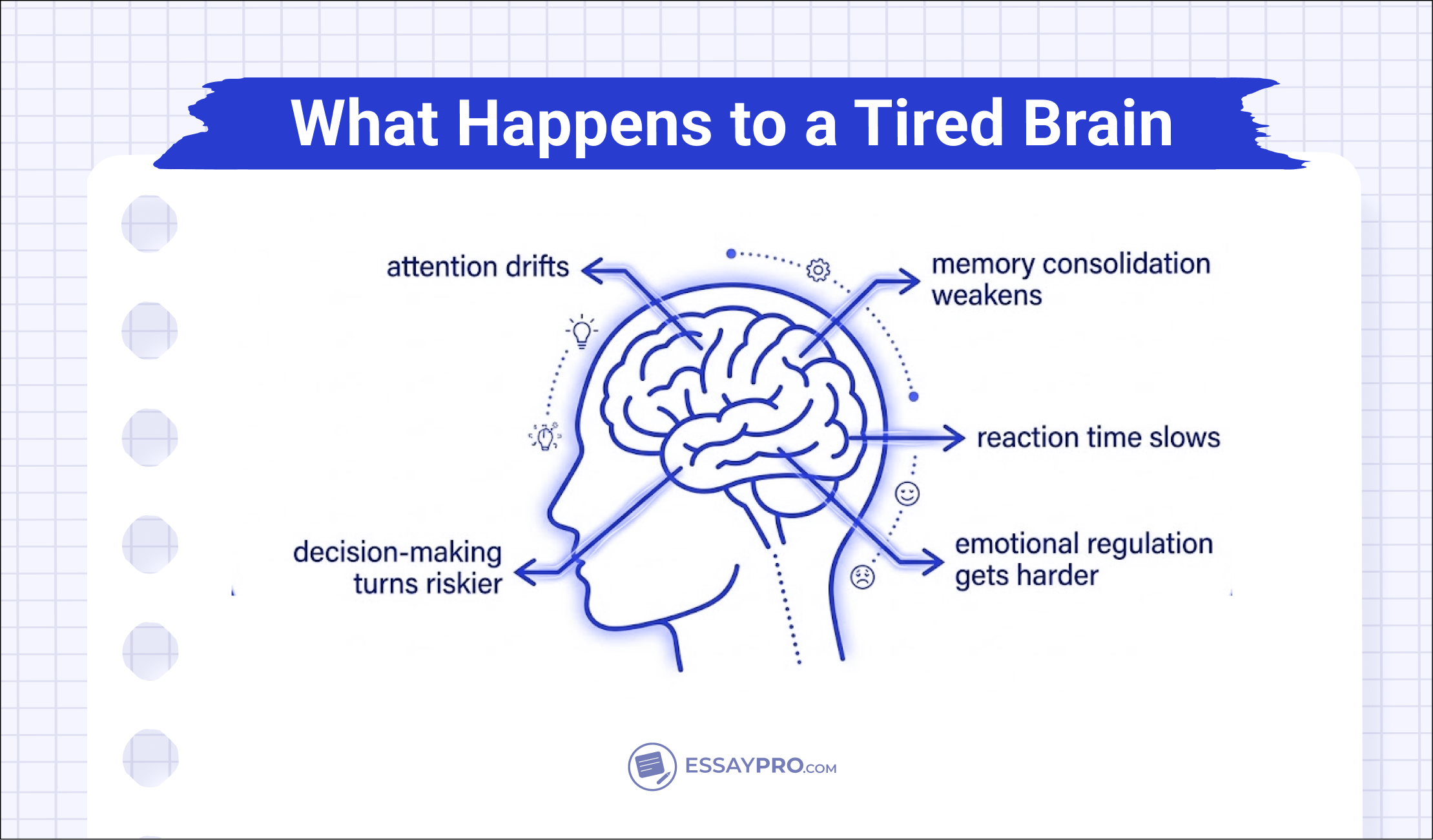
School first, since, more or less, the cost can be seen relatively soon. A tired brain doesn't fail dramatically. It loses focus one function at a time:
- Focus is the first casualty. A single lesson costs a wrecked student far more effort than a rested one ever needs to spend.
- Weaker encoding during the day, weaker consolidation overnight.
- Everything slows down. Same worksheet, more minutes, no reason the kid can name.
- Because attention keeps cutting out, whole chunks of the lesson never land.
- Worst hit is hard new material, since effortful learning is exactly what an exhausted brain does least well.
- Fewer hands up, fewer questions, and a slow drift toward the back row.
- Then the careless errors pile up, a misread question here, a dropped sign there, marks lost on things they actually knew.
The outcome once you stack these all up is predictable (and simple): grades. That’s it. For teenagers, this is the part of the science of sleep I'd underline twice. The intelligence is intact. The retrieval is what fails, and a tired brain can't reach what it holds.
Mood and Emotional Health
Mood tracks sleep closely enough to watch in real time. One deadline, one bad night, and by the next afternoon it's all over a kid's face.
- Irritability, mostly. Small stuff a rested teen would shrug off becomes something to snap at.
- The mood swings widen within a single day, higher and lower, often with nothing behind them.
- Staying level takes real effort now, and that effort is precisely what's run out.
- Across the board, stress sits higher.
- Homework that felt fine last week suddenly feels harder, and the frustration builds.
- And motivation flattens, until starting anything at all is a big ask.
Now the careful bit, because sleep writing loves to overreach here. Chronic sleep loss is associated with more anxiety and depression in teenagers, and the American Academy of Sleep Medicine counts it a risk factor worth respecting. But associated is doing heavy work there. Causation runs both ways at once: bad sleep drags mood down, and low mood wrecks sleep, and separating them is hard. I wouldn't tell any teenager that one grim week earns a diagnosis. The modest claim is the honest one that sleep is one factor among several in emotional health, and one of the few they can actually change.
Daily Behaviour
Grades and mood aside, a run of short nights reworks the ordinary habits of a day. The tells are obvious once you've seen them:
- After lunch, in a warm room, the head-nodding starts.
- What used to be a simple wake-up is now a fight the snooze button keeps winning.
- Come Saturday, they'll sleep three or four hours past the school alarm, the body repaying a loan it took out all week.
- Caffeine makes the jump from a treat to requirement, until the first period is unthinkable without it.
- Bedtime? No longer a fixed thing.
- Exercise is usually the first casualty, dropped the moment a teen gets that depleted.
- Meals at odd hours, study whenever, downtime bleeding into everything, that's what a week of unpredictable sleep does to a routine.
The caffeine habit earns its own paragraph, since it's where teens make things worse without meaning to. Adenosine, the molecule that piles up through the day and makes you drowsy, gets blocked. So bedtime creeps later, the morning's rougher, the rough morning wants more caffeine. Round it goes.
Safety and Reaction Time
This should be at the top of any parent’s worry list because unlike groggy mood and lost grades, this is the one that can cause something that can’t be undone. Sleep loss degrades the bodily functions that keep us out of danger:
- Reaction speed slows, so there's a longer lag between spotting a hazard and responding to it.
- Attention lapses cause brief seconds when the brain entirely checks out without you noticing.
- Decision-making gets riskier and more impulsive, which is already a live issue during the teenage years.
The AAA Foundation for Traffic Safety found that drivers aged 16 to 24 are nearly twice as likely to be involved in a drowsy-driving crash as drivers in their forties and fifties. Teen drivers who get under eight hours a night are about a third more likely to crash than those who sleep eight or more.
Then there are the athletics, which call for coordination and split-second judgement, and for a lot of it, too. Both suffer from short sleep, so any teen chasing a personal best on just four hours undermines the very thing they train for.
The Sleep Debt Cycle
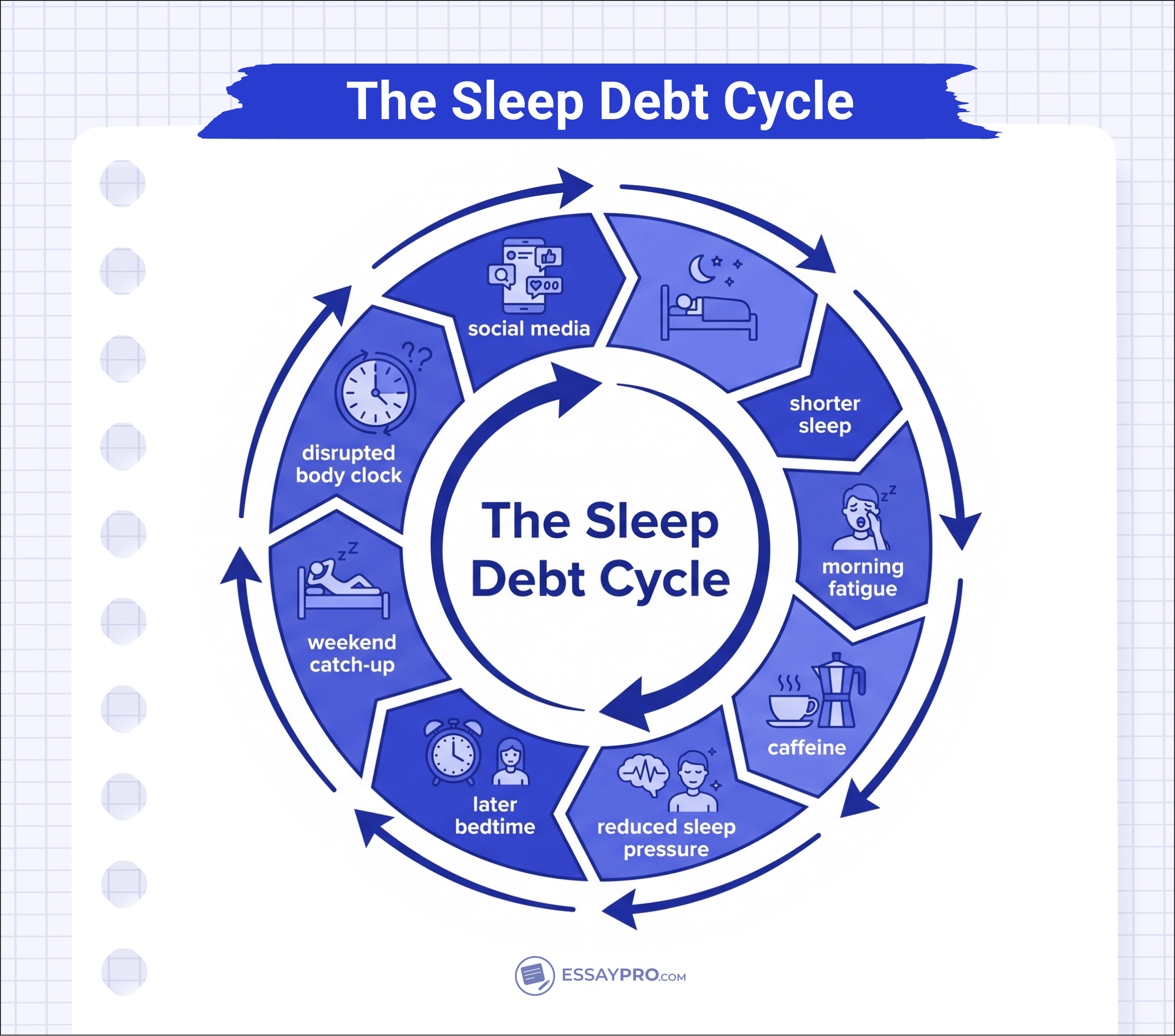
The teenage sleep loss is so stubborn because everything we discussed above interlocks and each piece feeds the following one. The loop I see play out most often:
- Late-night social media drags the real bedtime well past where it ought to sit.
- The alarm, though, doesn't budge, so shorter sleep follows on its own.
- Morning fatigue: heavy, and hard to shake off.
- To fight it, caffeine shows up, usually in the afternoon or later.
- Here's the hidden cost of that caffeine, weaker sleep pressure at night, so the body never feels tired at a sensible hour.
- Bedtime slides later still, and the debt keeps growing.
- Then the weekend catch-up hits, those enormous lie-ins that feel wonderful and fix next to nothing.
- What you're left with is a scrambled body clock, since the late weekend mornings haul the circadian rhythm later again.
Then Monday arrives, and the 6:30 alarm goes off into a body that still thinks it's the middle of the night. The body clock spent the whole weekend drifting later, and Monday yanks it back with no time to adjust. Plenty of adults read that as laziness when it should simply be attributed to biology.
Once you recognise the cycle, you can find the weak link. My honest opinion is that the two most breakable steps are the caffeine and the weekend lie-in.
A Balancing Act
If there's one idea I want to leave you with, it’s that teenage sleep deprivation never has a single detectable cause.
The reality of a chronically underslept teenager usually looks more like this:
biology + school schedules + technology + social habits + daily responsibilities = the sleep a teenager actually gets
Any change in the input is genuinely good news for the total. Good news, technically, because it means there are several intervention places. It's also why the tidy "ten tips for better sleep" listicle is… useless. So I'll end on understanding instead of a checklist. Once you grasp how the adolescent body clock works, the late nights start to make sense. They're a predictable result of real forces, most of which can be adjusted once you know where to push. That's the whole point of learning science of sleep.


Ana Ratishvili
Ana is a professional literary writer with a Master’s Degree in English literature. Through critical analysis and an understanding of storytelling techniques, she can craft insightful guides on how to write literary analysis essays and their structures so students can improve their writing skills.