Screens take up most of our lives, both as young students and as adults. The average American over the age of 15 spends 2.6 hours per day in front of the TV. Half of teens use their screens for at least 4 hours a day. Is screen time bad? Well, it can be.
There have been many studies that link screen time effects on students and adults. Some of which include being twice as likely to show symptoms of depression and anxiety if you use social media for 3+ hours a day. There isn't a clear conclusion about screen time and its effects on us, but there are ways it can be harmful. Here are some health impacts of screen time and ways it can affect your well-being as a student and adult.
How much screen time is too much?
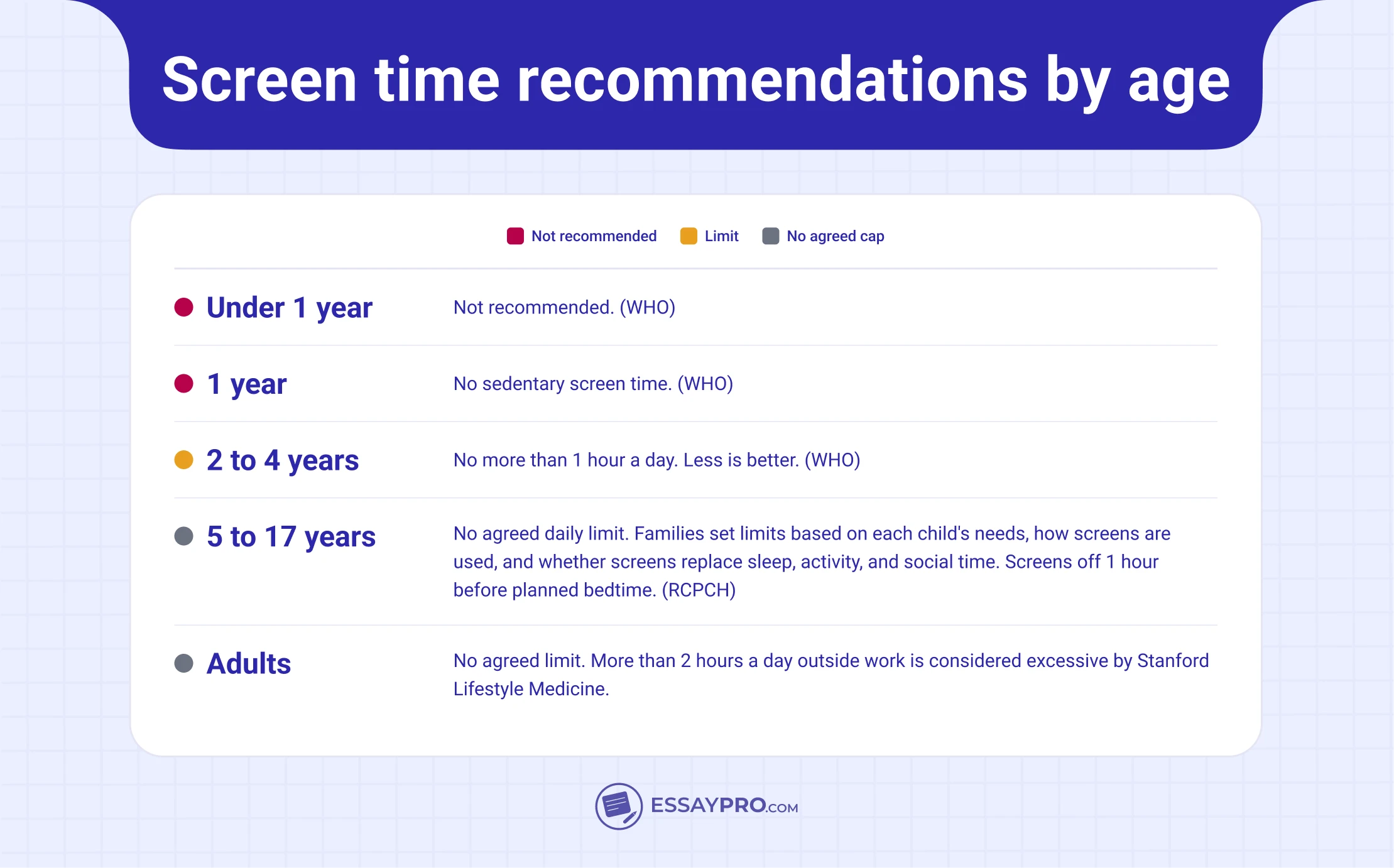
There is no definitive answer for screen time recommendations by age. For adults, Stanford Lifestyle Medicine states that spending more than 2 hours per day outside of work is too much. Children are harder to put a number on. There was not enough research when the Royal College of Pediatrics and Child Health issued a guideline on children's screen time in 2019. There are screen time limits for babies. No screen time for those under 2, and only 1 hour per day for 2-4-year-olds, according to the WHO.
As far as students go, what matters is how much leisure screen time you are doing in place of other things like sleep, exercise and schoolwork.
What the research says: key messages
Three messages stand out.
- A direct “toxic” effect is contested. The Royal College of Pediatrics and Child Health found the evidence base for it to be weak. CDC’s analysis of teens reports associations based on self-reported data, which can’t prove the cause.
- Much older research looks only at television. The RCPCH’s review was largely about television screen time.
- What screens replace may matter most. A 2024 expert panel found screen use impairs sleep in children and adolescents, and the RCPCH points to lost sleep, exercise, and social time.
Why it matters: alarming headlines often turn an association into a cause or apply old television findings to phones. Check who was studied, which screens were used, and whether the study tested the cause.
What happens in the adult brain during screen time?
Most studies compare heavy and light screen users, so they show links, not proof of cause. Here is what the main research found.
Memory, learning, and the cerebral cortex
According to Stanford Lifestyle Medicine, a 2019 review links excessive screen time in adults aged 18 to 25 with thinning of the cerebral cortex. The cortex is the brain’s outer layer, which handles memory, decision-making, and problem-solving.
Long-term brain health
In a UK study of 407,792 middle-aged and older adults, people who watched TV five or more hours a day had a 44% higher risk of dementia, 12% higher risk of stroke, and 28% higher risk of Parkinson’s disease than those who watched an hour or less. This is an association. It doesn’t show that TV caused the diseases.
Gray matter
Screen time and gray matter have been linked in small studies. In an MRI study of 22 people with smartphone addiction and 26 controls, the addiction group had lower gray matter volume in parts of the brain, and a meta-analysis found a potential association with reduced brain volume. Gray matter supports movement, memory, and emotions, and it shrinks naturally with age. Stanford Lifestyle Medicine suggests exercise, restorative sleep, social connection, and stress management to support brain health.
How screen time affects sleep and other areas of health
The body has greater contact with screens than our brains do. The most evidence is for sleep, then eyes and mental health.
Sleep
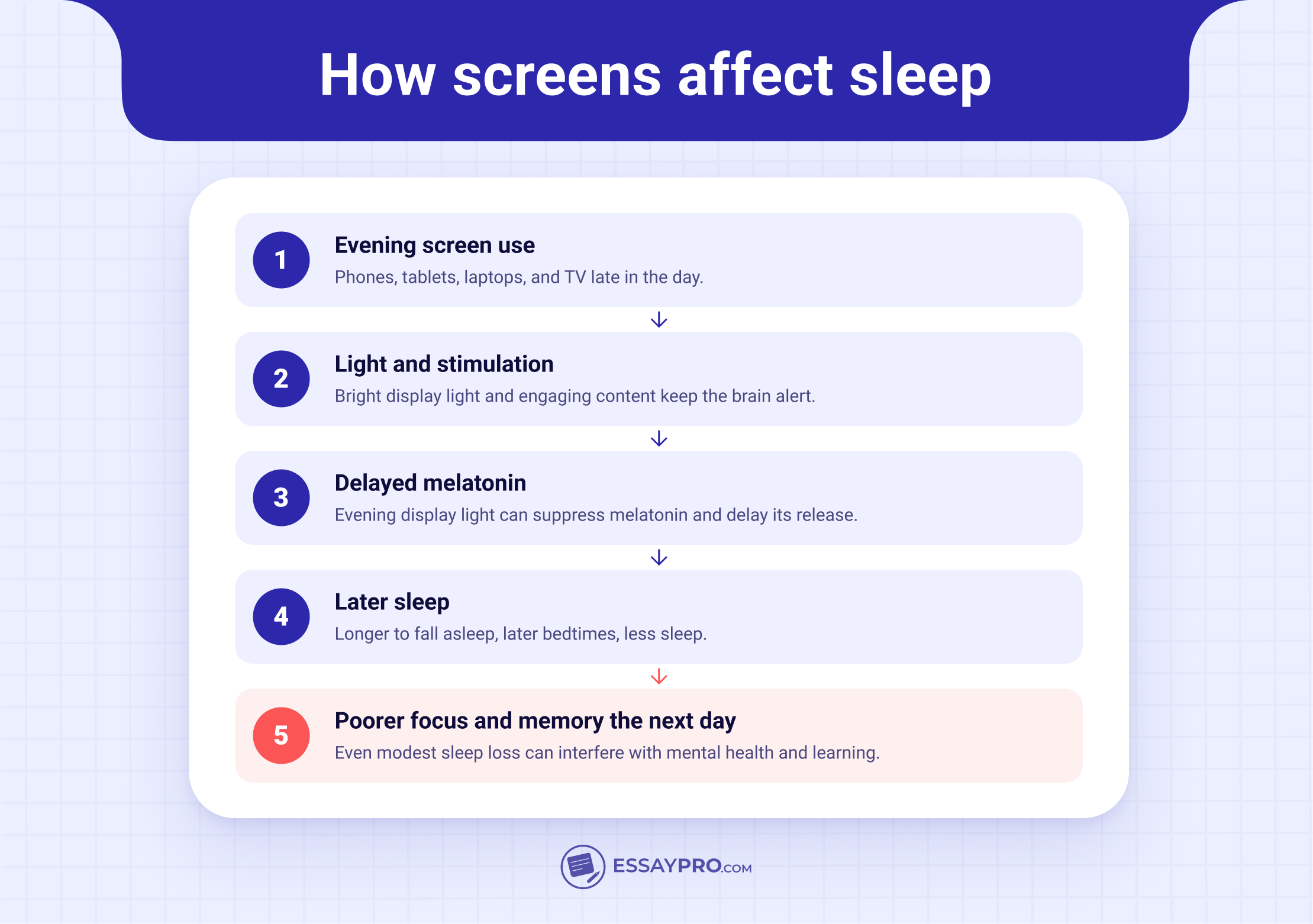
Screens before bed can disrupt your sleep. Light from displays has been shown to lower melatonin production, decrease the time we produce melatonin, and increase the time to fall asleep (Royal College of Pediatrics and Child Health). It is advised to stop using screens an hour before your desired bedtime. This is true for both children and adults.
Eyes
Too much time on screens can lead to eye strain. Other symptoms may include neck pain and shoulder pain. The American Academy of Ophthalmology recommends looking at something 20 feet away for 20 seconds after 20 minutes of screen time.
Social/Mental Health
When looking at the CDC studies, they found that screen time of 4+ hours per day was associated with more depressive symptoms and anxiety, as well as decreased social and emotional support. These are all self-reported. The RCPCH suggests that screens can take away from other positive activities, i.e., social time, sleep and physical activity.
Why the first hour of your day matters
According to Stanford Lifestyle Medicine, you should avoid any screens for at least one hour after you wake up. Maris Loeffler from their Cognitive Enhancement team stated that when you wake up and reach for your phone, it shocks your body into a heightened state of awareness. If you continue to do this every morning, you are programming your body to be stressed out in the morning and keeping your brain in a hyper-alert mode. It's similar to eating sugar for your brain; it may feel good at the moment, but you're not gaining anything from it.
Stanford’s alternatives for that first hour:
- Exercise
- Call a friend or family member
- Eat a healthy breakfast
- Meditate
- Write a gratitude list
- Read a book
- Listen to music
- Get morning light outdoors
For students, try a phone-free start before class:
- Review your notes on paper
- Walk to campus without your phone
- Plan your day
Screen time for children: recommendations for families
The RCPCH’s main recommendation is that families negotiate screen time limits based on each child’s needs, how screens are used, and whether screen use replaces sleep, activity, and social time. Its four questions help families check:
- Is screen time in your household controlled?
- Does screen use interfere with what your family wants to do?
- Does screen use interfere with sleep?
- Are you able to control snacking during screen time?
Families who are satisfied with their answers can feel reassured that they are likely doing as well as they can.
To cut back:
- Agree on boundaries together and apply them consistently.
- Protect sleep: no screens for an hour before planned bedtime.
- Be snack aware, since it’s easy to lose track when eating in front of screens.
- Include adults. The first question covers their screen use too.
How to reduce screen time?
These tips to reduce screen time focus on habits, not strict limits. Pick two or three to start.
For students
- Use app blockers or focus modes during study sessions.
- Keep the phone in another room while studying.
- Study in timed blocks, such as Pomodoro, with screen-free breaks.
- Take handwritten notes where possible.
- Set a screen-off time before bed, especially before exams. The RCPCH recommends an hour before planned sleep.
- Follow the 20-20-20 rule during long study sessions: every 20 minutes, look at something 20 feet away for 20 seconds.
For adults and families
- Keep screens out of bedrooms.
- Set screen-free times, such as meals and the first hour of the day.
- Replace passive scrolling with active hobbies.
- Turn off nonessential notifications.
- Model healthy habits for children. The RCPCH’s first family question covers adults’ screen use too.
Conclusion
Studies show that poor sleep and some negative health effects can be associated with screen time. However, there are not enough data to make that link with hours of screen time per day. It's more about the quality of screen time, what you're using it for and when. Making sure your screens are not displacing sleep, exercise and time with others. Try this one tip today: put your phone down an hour before you go to sleep.
FAQs

How much screen time is healthy for adults?
Does screen time damage the brain?
Why should you avoid screens before bed?

Sopho Miller
is an experienced content writer who specializes in digital marketing, business, and academic topics. With a Master’s degree in Digital Marketing, she combines her expertise with a practical approach to create clear, engaging, and educational content. She crafts detailed guides and resources that support students in their academic journey. Outside of work, Sopho stays current with the latest industry trends and regularly attends workshops to further sharpen her skills.