
Key Takeaways
- Up to 39% of Americans Have a Side Hustle in 2026.
- Active side hustlers now average $1,242 per month.
- Only about 11% of side hustlers clear $1,000 monthly, and just 2% exceed $5,000
- 57% of Gen Z workers have one, versus 48% of millennials, 31% of Gen X, and 21% of boomers.
- 53% of side hustlers would struggle to cover essential expenses without the income, and three in four say rising costs have deepened their reliance on it.
- 32% of side hustlers expect to always have one, and 28% of Americans doubt they can retire without one, yet 65% would prefer a single sufficient paycheck if they could get it.
- 67% of side hustlers report burnout, and side income is taxable, setting aside 25–30% for taxes is a common rule of thumb.
Side hustles can bring the average American anywhere from a couple hundred dollars to well over $1,000 a month in 2026, and amid persistent inflation and rising living costs, many people use those funds for day-to-day expenses rather than "fun money." From delivering takeout and walking dogs to running online stores, creating content, freelancing and consulting, Americans continue working outside their full-time jobs. But the headline numbers depend on who's asking.
Across recent surveys, roughly one in three to two in five American adults report having a side hustle, meaning they earn money outside their primary job, main business, or other main source of income. Side Hustle Nation's 2026 statistics put the figure at 39% of working Americans, or roughly 80 million people. LendingTree's 2026-published survey landed at 38%, down from 44% in 2022, while other 2026 compilations estimate participation at around 36%.
Why the spread? Definitions matter. Surveys that count occasional gig work, online reselling, and survey-taking capture far more people than those asking about a regular second income stream. Sample composition (all adults vs. working adults) and timing also shift the results. The honest takeaway: roughly one in three to two in five American adults earns some money on the side, and the trend since the 2022–2023 peak has been flat to declining, even as the people who remain committed are earning more than ever.
This breakdown covers 2026 participation rates, who is most likely to have a side hustle, average earnings, why people take on side gigs, how they use the money, whether these income streams are becoming permanent, and practical ways to put extra earnings to work.

Fewer People Are Side Hustling, But Those Who Do Are Earning More
One important shift much of the early side hustle coverage missed: participation has cooled from its pandemic-era peak. LendingTree's tracking shows the share of Americans with a side hustle falling from 44% in 2022 to 38% in its latest survey, a decline researchers link to a stretch of solid job-market conditions and wage growth that, for a few years, outpaced inflation and reduced the urgency to take on extra work.
With inflation creeping back up and the job market softening for younger workers, several analysts expect participation to rebound, particularly among 18-to-44-year-olds already comfortable juggling multiple income streams.
Meanwhile, earnings among active side hustlers have hit record levels. LendingTree's March 2026 survey of roughly 2,050 U.S. consumers found side hustlers earning an average of $1,242 per month, the highest figure the company has ever recorded. Many of them depend on that income to keep up with rising costs. The pattern is clear: casual dabblers have dropped out, while committed side hustlers are devoting more time and treating the income as financially necessary rather than optional.
Half of Millennials and a Majority of Gen Z Have a Side Hustle
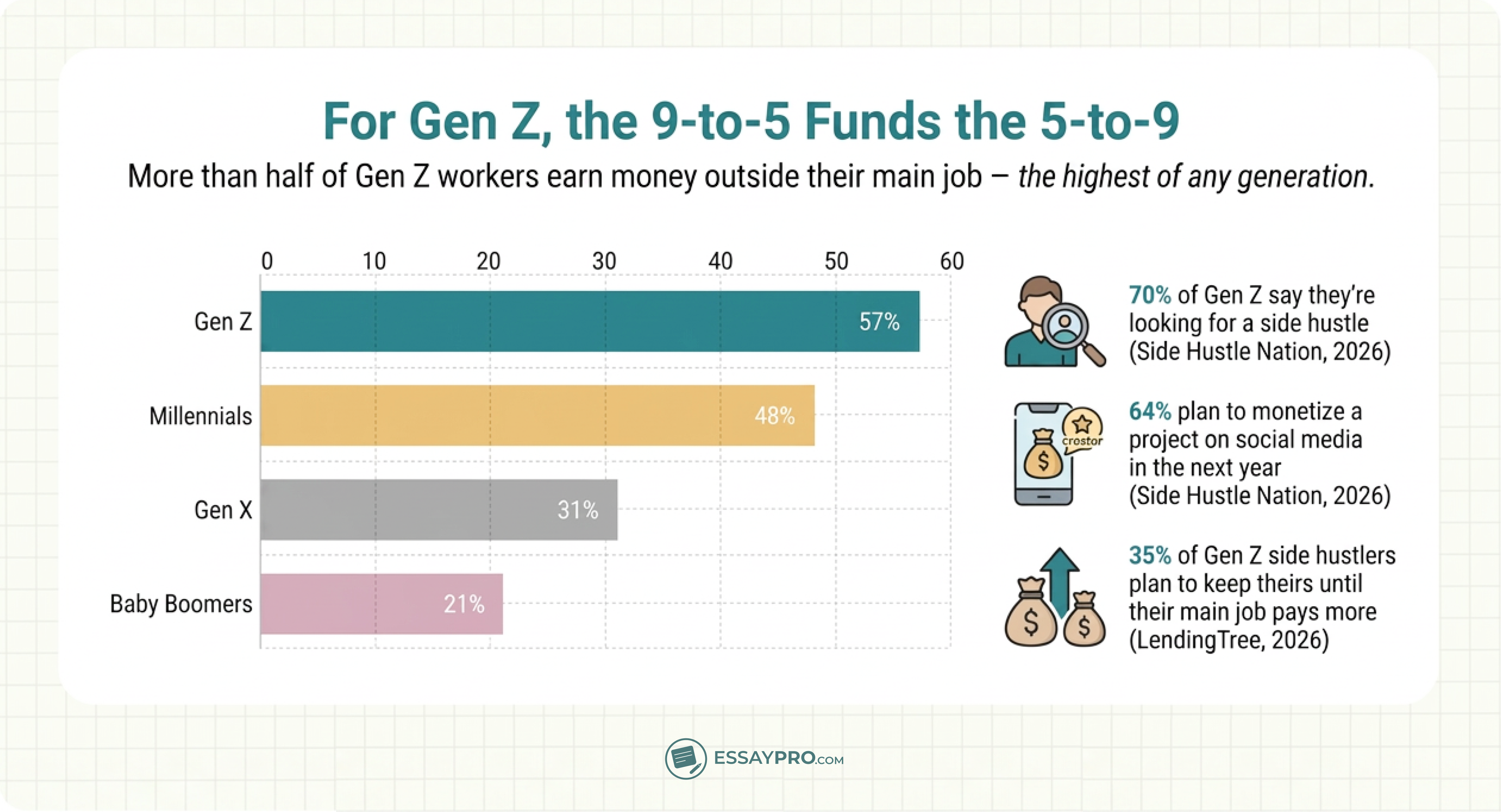
Generational breakdowns vary by study, but the pattern is stable: millennials and Gen Z have the highest adoption rates, Gen X sits in the middle, and baby boomers are least likely to report a side gig. A Fortune–Harris Poll found that 57% of Gen Z workers currently have a side hustle, compared with 48% of millennials, 31% of Gen X, and just 21% of baby boomers, leading Harris to dub Gen Z "America's first true side hustle generation." Side Hustle Nation's data similarly shows millennial participation around 50%, well above the overall average.
Along gender lines, men and women side hustle at broadly similar rates, but the earnings gap is significant: one 2026 analysis found men with side hustles averaging around $1,034 per month versus $735 for women, a disparity researchers attribute partly to unequal household and caregiving responsibilities that leave women less time for side work, and partly to women setting lower rates for comparable services.
Income brackets show a more complex picture. Higher-income households (over $100,000) are often just as likely to have side hustles, and in some surveys even more likely, but those tend to be consulting, freelancing, or small businesses that build wealth, while lower-income households lean toward gig apps and hourly work aimed at covering current expenses. One analysis found 45% of gig workers come from households earning $100,000 or more, while 40% come from households earning under $50,000.
What Side Hustlers Actually Earn: Averages Mislead, Medians Tell the Truth
It's still possible to bring in meaningful money every month from a side gig in 2026, but earnings are highly skewed: a small group earns a lot, and most earn relatively little.
The headline averages sound impressive — LendingTree reports $1,242 per month in 2026; Side Hustle Nation's longer-running data shows an average of $1,122. But medians tell a very different story. LendingTree's median is just $400 per month, and Side Hustle Nation puts it even lower, at roughly $200. A handful of high earners pulls the mean far above what the typical person actually makes, which is why anyone setting expectations for a new side hustle should anchor on the median, not the average.
The high end is real but rare. Side Hustle Nation's data shows only about 11% of all side hustlers earn more than $1,000 per month, and just 2% exceed $5,000 — typically from freelancing, consulting, agency-style work, or scalable online products. Among side hustlers who move past the startup phase, the share earning over $1,000 monthly rises to 36%, suggesting persistence matters as much as the initial idea.
Earnings also correlate with time invested. In Side Hustle Nation's subscriber survey, 81% of those making $500 or more per month spend at least five hours a week on their hustle. Time commitments across the broader population are moderate: LendingTree found about 32% of side hustlers spend five to ten hours per week on their extra work, while 24% devote eleven to fifteen hours.
For Many, Side Income Covers Necessities — But the Picture Is Mixed
Side hustles in 2026 aren't just funding nicer gadgets or upgraded vacations. The Penny Hoarder's 2026 survey of 1,000 U.S. side hustlers found that 53% would struggle to cover essential expenses without the extra income, and three in four said rising costs have increased their reliance on earning money outside their regular job. An Omnisend survey similarly found 73% of side hustlers work out of financial necessity rather than passion, and LendingTree found 49% of Americans started a side gig to make ends meet, with 42% citing inflation specifically.
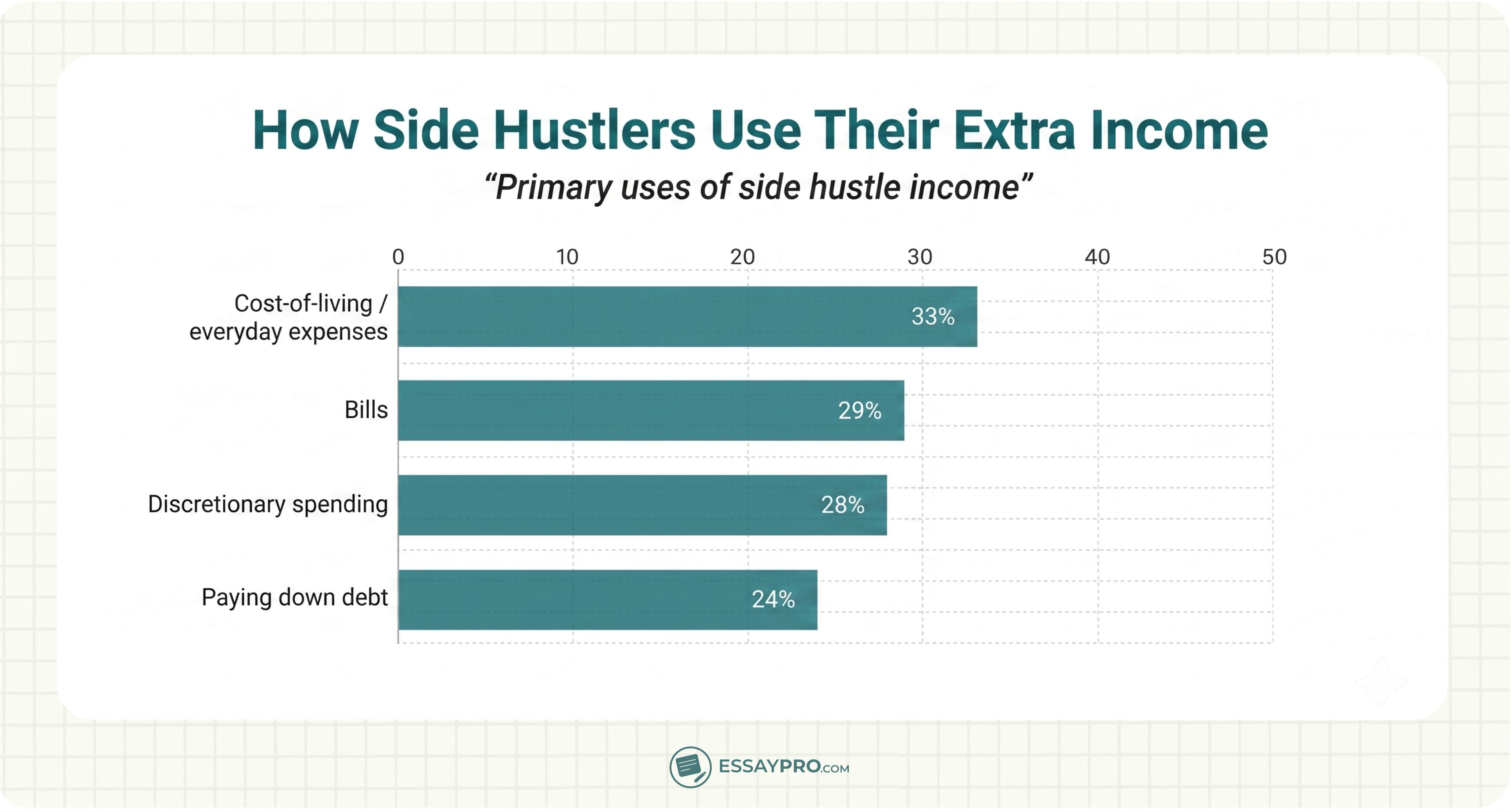
That said, the "necessity" narrative shouldn't be overstated. In LendingTree's data, roughly a third of side hustlers cite cost-of-living pressures, 29% need the money for bills, and 28% direct it toward discretionary income, with others prioritizing savings and debt payoff. When LendingTree asked what people would cut if their side hustle disappeared tomorrow, most named discretionary items such as dining out (46%) and entertainment (39%), but a meaningful 18% said they'd have to cut an essential bill.
The class divide runs through all of it: higher-income households more often route side income toward discretionary spending, savings, and investing, while lower-income households more often allocate it to core expenses and debt payments. Women are more likely than men to report needing the income for essentials.
Roughly 1 in 3 Side Hustlers Expects to Always Need One
A side hustle can be a way to test-drive turning a passion into a career or to monetize skills that go unused in a 9-to-5. But recent data suggests many people now view side income as a semi-permanent fixture, not a temporary fix.
.webp)
LendingTree's 2026 survey found 32% of side hustlers expect to always have one, while another 25% — including 35% of Gen Z — plan to keep theirs until their primary job pays more. Other 2026 compilations put the "will always need one" share at around 38%, and 28% of Americans say they don't believe they'll be able to retire without a side hustle. Notably, the desire for permanence is not enthusiasm: nearly two-thirds of side hustlers (65%) told LendingTree they'd prefer a single, sufficient main income if given the choice. Still, interest remains high — 55% of Americans say they're likely to start a side hustle within the next year.
Gen Z: Building Side Hustles Into the Career Path Itself
Gen Z workers are entering a labor market where side hustles are almost expected, and many are designing their careers around multiple income streams from the start. The Fortune–Harris research frames this as "career minimalism": rather than climbing toward the corner office, Gen Z treats the day job as a financial foundation that funds passion projects and entrepreneurial ventures. As Glassdoor's researchers put it, for Gen Z, the day job funds the passion project. A striking 68% of Gen Z respondents said they wouldn't pursue management roles without a significant pay or title bump.
For younger adults who grew up with social media, creator platforms and gig apps, earning money outside a traditional job feels natural. Side hustles function as both financial safety net and career testing ground: 70% of Gen Z report looking for a side hustle, and 64% plan to monetize a project on social media within the next year. Gen Z is also more comfortable than older cohorts using online tools, automation and AI to streamline and scale their projects. That includes batching content, optimizing online stores, and managing multiple clients with digital infrastructure.
The sustainability question looms large, though. Some 67% of side hustlers report that the extra work leads to burnout, and more than half say the strain is only worth it above roughly $500 per week, a threshold most early-stage side hustlers never reach. Remote work and flexible schedules have made it easier to fit secondary income around a primary job, but they've also blurred boundaries, and burnout rates run highest among the younger workers juggling the most roles.
A Quick Word on Taxes
One practical reality that catches many new side hustlers off guard: side gig income is taxable, and most side hustlers are classified as independent contractors. That means no employer withholding, potential quarterly estimated tax payments, and self-employment tax on net earnings. Tracking expenses from day one can meaningfully reduce the tax bill.
That includes mileage, supplies, software, and home office costs, and setting aside 25–30% of side income for taxes is a common rule of thumb. Anyone earning more than trivial amounts should consider consulting a tax professional in their first year.
3 Ways to Put Extra Side Hustle Income to Work in 2026
Most side hustlers don't spend every dollar of side income on day-to-day survival, which frees at least some of that money for other goals. If you're able to choose where to direct extra cash, here are three practical options.
1. Build (or Upgrade) Your Emergency Savings
An emergency fund covering three to six months of household expensesremains the foundation of financial stability. For those with volatile income, six to nine months may be more appropriate. A high-yield savings account keeps the money accessible while earning meaningfully more interest than a standard savings account.
For a typical side hustler earning $200–$500 per month, consistently routing that income into an emergency fund for one to two years creates a real buffer against job loss, medical bills, or major car repairs, reducing reliance on high-interest debt. This matters even more for gig workers and freelancers, whose income is inherently less predictable. It's a widespread gap: one 2026 survey found only 37% of working Americans keep a dedicated emergency fund at all, even as 62% of side hustlers describe their gig as a form of job-loss insurance.
2. Pay Off Debt Faster and Cheaper
Side hustle income can materially accelerate standard debt payoff strategies. The debt snowball method (smallest balances first) builds psychological momentum; the debt avalanche method (highest interest rate first) minimizes total interest paid. Both approaches work. The best method is simply the one you'll stick with.
Because many credit cards carry interest rates above 20%, the effective "return" on extra payments funded by side income outperforms most low-risk investments, making this one of the most powerful uses of extra cash in 2026. Once high-interest debt is under control, redirect the same monthly stream into savings and investing — preserving the habit while changing its impact.
3. Reward Yourself and Invest in the Future
Extra work is more sustainable when some of the money goes to you and your loved ones while still funding long-term goals. Setting clear percentages helps: for example, 50% of side income to savings or investments, 30% to debt payoff, and 20% to discretionary spending.
On the enjoyment side, a vacation, local getaway, or simple night out is a reminder that life isn't only about work. That reminder matters, given how commonly side hustlers report burnout. On the long-term side, allocating side income to retirement accounts or diversified index funds turns today's extra hours into compounding financial resilience. The key is intentionality: knowing exactly what your side hustle income is doing, so extra effort translates into durable improvements rather than disappearing into everyday spending.
Summary
Side hustles in 2026 occupy a paradoxical position in American financial life. Participation has cooled from its 2022–2023 peak: LendingTree tracks a slide from 44% to 38%, while broader definitions still capture up to 39% of workers. Yet those who remain are more committed, working more hours, and earning record amounts, with the latest surveys reporting an average of $1,242 per month
The typical side hustler, however, still earns a few hundred dollars at most: medians sit around $200–$400 monthly, and only about one in ten clears $1,000. Financial necessity drives most participation: over half of side hustlers say they'd struggle to cover essentials without the income. Even so, a large share also uses the money for discretionary spending, savings, and debt payoff.
Younger generations, led by Gen Z at 57% participation, are building entire career identities around multiple income streams, treating the day job as the funding mechanism for the passion project. Roughly a third of all side hustlers expect to always need one, though most would prefer a single sufficient paycheck if they could get it. Used intentionally to build emergency savings, retire high-interest debt, and invest for the future, side hustle income can be a genuine tool for long-term financial resilience rather than just another source of burnout.

Sopho Miller
is an experienced content writer who specializes in digital marketing, business, and academic topics. With a Master’s degree in Digital Marketing, she combines her expertise with a practical approach to create clear, engaging, and educational content. She crafts detailed guides and resources that support students in their academic journey. Outside of work, Sopho stays current with the latest industry trends and regularly attends workshops to further sharpen her skills.