
It’s difficult to exaggerate how momentous that change has become at this point. A global survey conducted in 2026 by the Digital Education Council, the largest ever on the subject, received 45,398 responses from 27,284 students and 18,114 faculty members across 35 countries. The survey showed that 88 percent of students were learning with AI, while 77 percent of faculty were teaching with it, an increase of 16 points for both groups over the previous year (DEC, 2026). Suddenly, that steady growth exploded. Half of a generation of students and more than three-quarters of their teachers worldwide are treating AI as an expected part of their classroom experience.
In this article, we examine how students and teachers in different countries are reacting to this change, and what’s actually changed since we last took a swing at predicting how 2026 would unfold. If you’re a student who is already feeling overwhelmed by everything that’s going on, you can use EssayPro to stay on top of it all.
AI and education on the global stage
AI is entering classrooms; no doubt about that. However, its integration is happening on very different timelines around the world. For example, some nations are designing entire curricula around AI, while others are still debating when, where, or even if it should play a role in education. This year, in 2026, the difference between a "pilot program" and a "national mandate" became especially clear, largely due to developments in China.
The policy race: China vs. the US
This is the story worth leading with, because it's the clearest head-to-head in AI education policy right now.
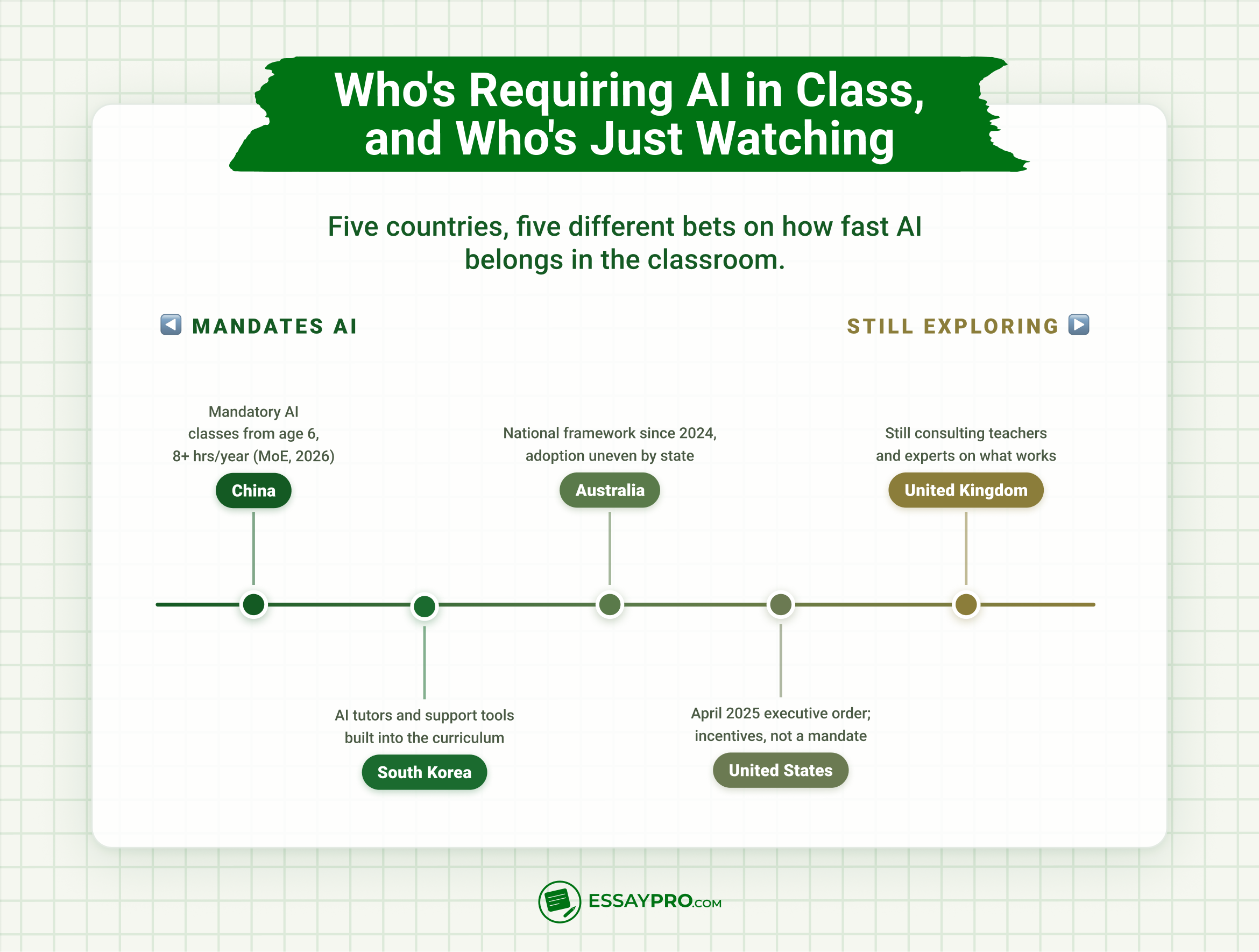
China has gone further than any other country. Beijing ordered every primary and secondary school to deliver at least eight hours of AI instruction per year starting September 1, 2025, making AI literacy compulsory from age six (Heritage Times, 2026; Global Times, 2025). In April 2026, the Ministry of Education escalated this into a nationwide "AI Plus Education" action plan running through 2030, moving the country from scattered pilot schools to a full implementation mandate spanning primary school through university (WTL Governance, 2026). The curriculum is staged by age: basic concepts and robotics for ages 6 to 12, machine learning and misinformation detection for ages 13 to 15, and applied AI projects for ages 16 to 18. Notably, the guidelines also bar primary-age students from using open-ended generative AI on their own and prohibit teachers from letting AI substitute for their core teaching duties (Global Times, 2025).
The United States is taking the opposite approach: incentives rather than a curriculum mandate. On April 23, 2025, President Trump signed the executive order "Advancing AI Education for American Youth," which created a White House Task Force on AI Education and directs federal grant money toward teacher AI training and a nationwide "Presidential AI Challenge" for students (Federal Register, 2025). Rather than requiring anything, the order leans on public-private partnerships and existing funding streams. At the state level, the picture is even more fragmented: legislative trackers counted 52 active bills on classroom AI across 25 states by late 2025 (Fifthrow, 2025).
Put simply, China is telling every school what to teach and when. The US is telling schools what money and partnerships are available if they want to move on their own. Which model produces better outcomes for students is genuinely an open question, and one worth revisiting in a year.
Global attitudes toward AI in education

AI reaches primary school
Here's an angle almost nobody else in this space has covered well: how young AI use is starting.
A February 2026 study in JAMA Network Open, drawing on 6,488 US youths aged 4 to 17, found that nearly a third (32%) had accessed a generative AI app on their own device, including 20% of children aged 10 to 12 and even 9% of children aged 8 to 9 (Maheux et al., JAMA Network Open, 2026). ChatGPT was by far the most-used app among these young users. The study's authors flagged something worth sitting with: a meaningful share of the apps kids are using are marketed as companionship or social tools, not education tools, which raises different questions than "is AI helping with homework."
This is the part of the AI-in-education conversation that policy debates rarely touch, and it puts China's decision to ban unsupervised generative AI use for primary-age kids in a different light.
Conclusion & forward look
Last year, we forecast that fewer than 10% of institutions would have formal GenAI guidelines and that governments would need to move fast on tailored policy. Here's what actually happened:
- We predicted a slow, uneven policy movement. Instead, China went from pilot programs to a full national mandate in about 18 months, one of the fastest top-down education policy shifts anywhere in the world (MoE, 2026).
- We flagged the US as an area to watch on federal action. It got a federal executive order in April 2025, though implementation has run through incentives and task forces rather than a mandate, and most of the real movement has happened state by state (52 bills, 25 states).
- We didn't predict the primary-school angle at all. The JAMA Network Open data on under-13 GenAI use (2026) turned out to be one of the more surprising findings of the year.
- Our call for UNESCO-style ethics frameworks mostly didn't happen at the pace we expected. Most countries are still writing policy in real time rather than adopting a shared model.
How teachers are responding to AI in classrooms
Some teachers are experimenting with caution, some with curiosity. AI is reshaping how knowledge is delivered, how students engage, and even how progress gets measured. In 2026, the clearest and most-cited dataset on this is the Gallup-Walton Family Foundation "Teaching for Tomorrow" report, and it's worth leading the section with it.
Where AI is helping educators most
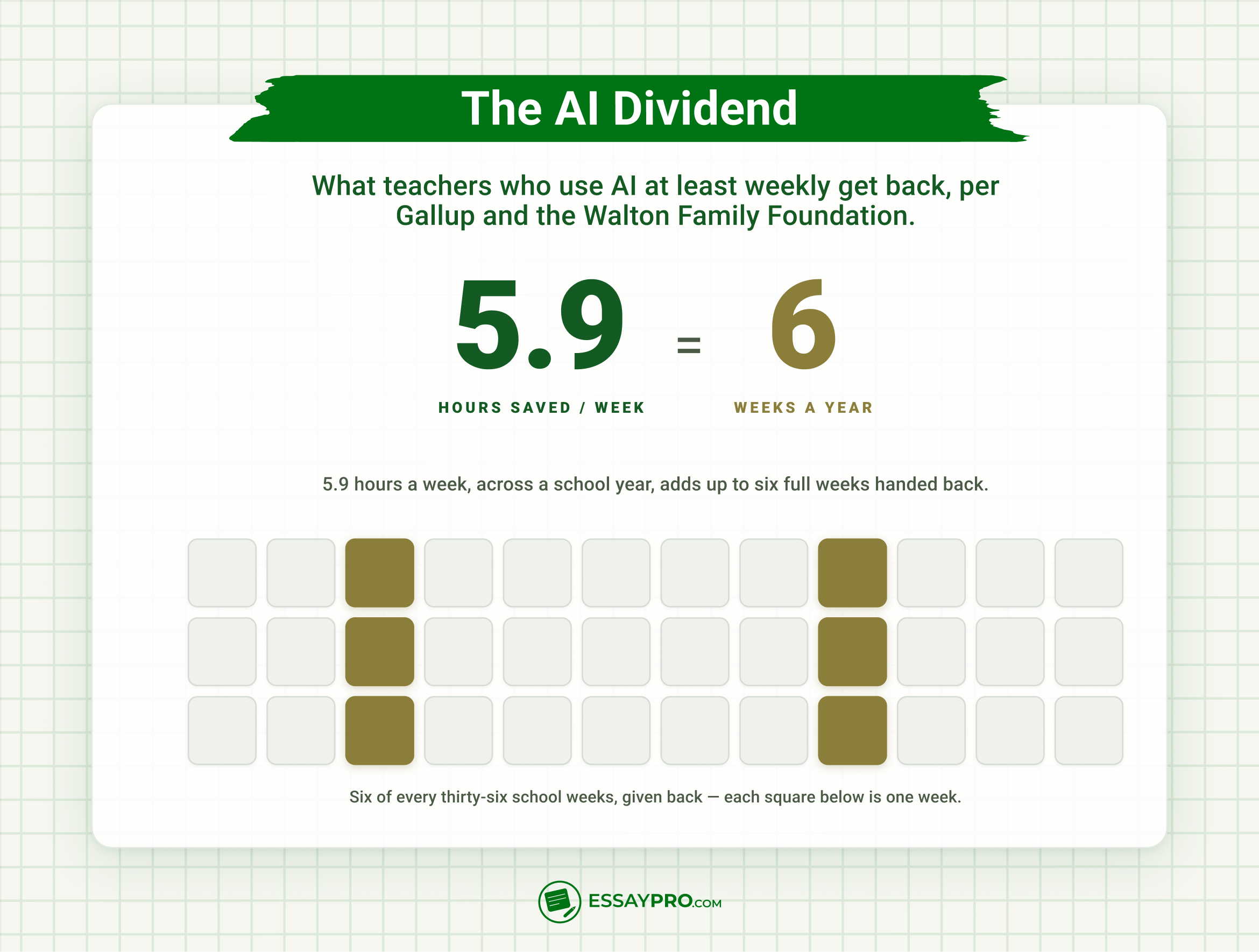
Six in ten US teachers have used AI tools this school year, and three in ten use them at least weekly (Gallup-Walton Family Foundation, "Teaching for Tomorrow: Unlocking Six Weeks a Year With AI," 2025). The headline number from that report is what Gallup calls the "AI dividend": teachers who use AI weekly save an average of 5.9 hours per week, the equivalent of six weeks across a school year (Gallup-Walton Family Foundation, 2025).
That time mostly comes back from lesson planning, worksheet creation, and administrative tasks, not from grading or one-on-one instruction, which teachers still handle largely on their own. The adoption trend backs up how fast this moved: EdWeek Research Center data shows teacher AI usage nearly doubled from 34% in 2023 to 61% in 2025 (EdWeek Research Center via Gallup, 2025).
Our own EssayPro data still holds up here too: 63% of school teachers say AI-powered resources have made a real difference in student outcomes, and 38% of school teachers and 36% of English language teachers report using AI tools in their teaching over the past year.
“If it is used properly, it can only have a positive impact on student learning, creating individualized lessons for all types of learners, and not a ‘one for all’ methodology. I see AI as the ultimate teaching tool for the learner, where the teacher creates materials, questions, or activities for the learner to then use AI to ‘assist’ them in their learning path.” – English language teacher, Italy
Where teachers are still worried
The optimism isn't unqualified, and the Gallup-Walton data captures the concern side clearly too. 57% of teachers say weekly student AI use would decrease independent thinking, and 52% say it would hurt critical thinking specifically (Gallup-Walton Family Foundation, 2025). Our own numbers back this up from a different angle: 62% of teachers in the EssayPro study believe AI poses a high risk to the integrity of student work, with another 32% calling the risk moderate. In the UK, nearly half of teachers think their students already use tools like ChatGPT to complete assignments outright.
What's still difficult about teaching with AI
Time and training are still in short supply, and adapting to AI demands both. Preparedness remains a real gap: only 23% of UK teachers in our study felt prepared to work with AI tools in the classroom, and 88% said they'd benefit from having relevant research and insights collected in one place.
Without structured guidance, teachers are often left to experiment on their own, which is risky for lesson quality just as much as for student outcomes. The potential is real. So is the gap between that potential and what most teachers have actually been given to work with.
Conclusion & forward look (look-back version)
Last year, we forecast that over 50% of teachers globally would be using AI tools weekly by 2026, and that structured training could cut adoption hesitation by up to 40%. Here's what actually happened:
- We predicted 50%+ weekly use globally by 2026. The real US number, per Gallup-Walton, is 30% weekly, well below the forecast, though six in ten teachers have used AI at some point this year.
- We didn't have a number for time savings last year. It turned out to be measurable and specific: 5.9 hours a week for weekly users, the "AI dividend" figure that's now the most-cited stat in this whole conversation.
- We predicted structured training could cut hesitation. The data now backs this up more precisely than we expected: schools with a formal AI policy saw meaningfully greater time savings per teacher than schools without one.
- Our forecast on integrity policy concerns held up almost exactly. 62% of teachers still flag integrity risk as high, nearly matched by Gallup's finding that a majority worry about the effect on independent and critical thinking.
How AI is changing the way students learn
Students are already using AI constantly to get through their daily assignments, and the pace of change here has been the fastest of any group in this article.
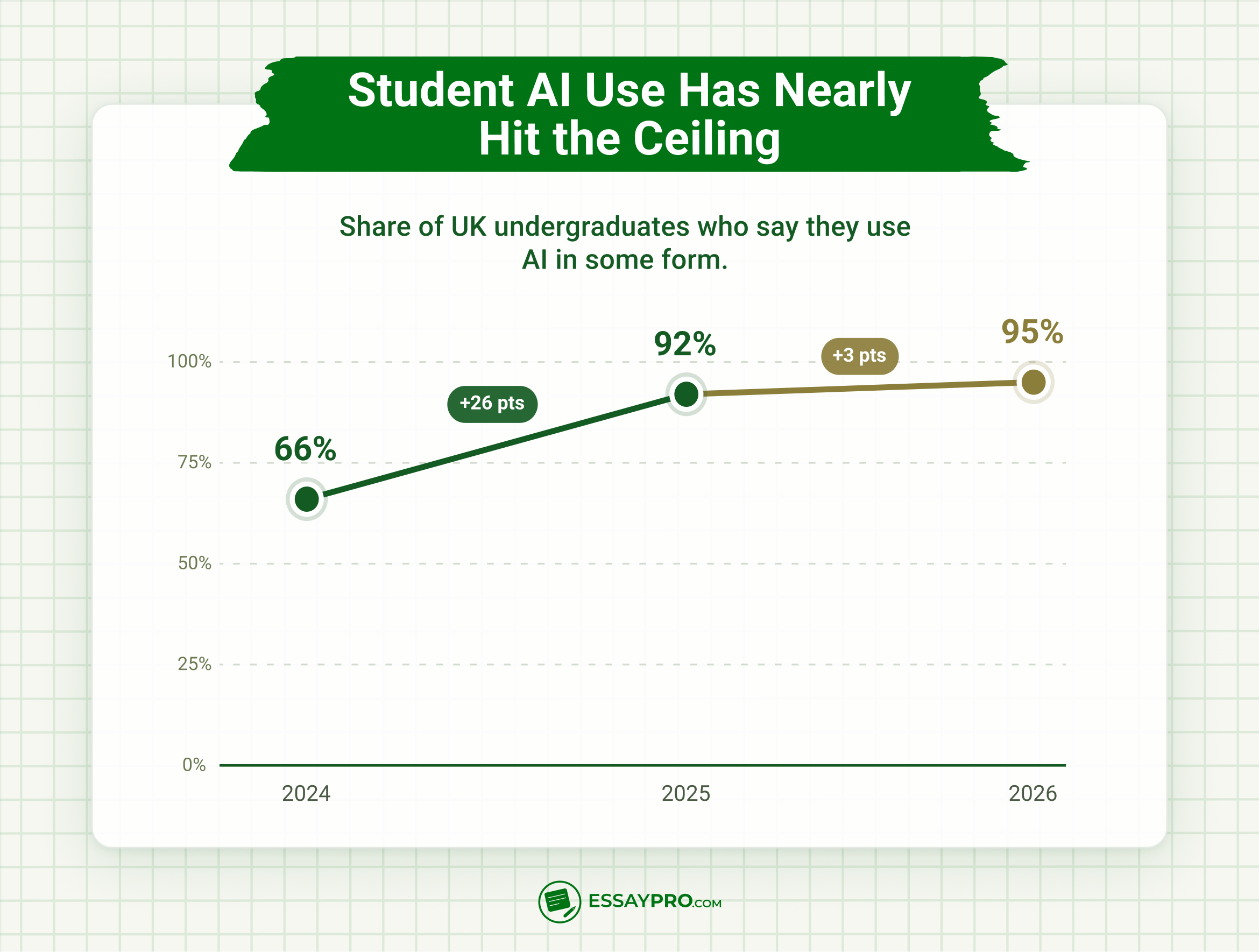
HEPI's UK survey of full-time undergraduates shows student AI use rising from 66% in 2024 to 92% in 2025 and 95% in 2026, with 94% now using generative AI to help with assessed work specifically (HEPI Report 199, "Student Generative AI Survey 2026"). That's not a niche behavior anymore. That's nearly every student, using AI on the work that actually gets graded.
The confidence gap that showed up in earlier years still holds, though it's worth being precise about where each number comes from. In the Digital Education Council's global student survey, 58% of students say they don't have sufficient AI knowledge and skills for the future, and a similar share don't feel prepared for an AI-enabled workplace (DEC student survey, cited via Campbell Academic Technology Services, 2025-26). Separately, in the 2026 HEPI survey, 68% of UK students believe AI skills are essential to thrive in today's world, but fewer than half, 48%, feel their teaching staff are actually helping them build those skills (HEPI Report 199, 2026). Two different surveys, two similar gaps: usage is nearly universal, but neither students nor the institutions around them feel ready for what that usage demands.
The polarised student experience
2026 data reveals something more interesting than "everyone uses it now": a genuinely split landscape. 37% of students say their institution encourages AI use, while 36% disagree, essentially an even split. 20% say AI makes them feel lonelier, and 21% say it makes them feel less lonely (HEPI Report 199, 2026). This isn't a story of consensus forming around AI. It's a story of a student body that's adopted the same tools for very different reasons and come away with very different experiences.
Where AI makes the learning experience easier
Our EssayPro study shows more than half of students rely on AI for grammar checks, mainly through Grammarly, used by 84% of users for proofreading. 42% use it to help write papers, and 39% turn to AI for summarizing long texts. 32% generate ideas and outlines with AI help.
The tools students are using have shifted, too. ChatGPT still dominates, but Microsoft Copilot is now the clear number-two institution-provided tool, alongside a growing presence for Google Gemini and Claude. According to HEPI, 38% of institutions now provide AI tools to students directly, up from 23% in 2025 and just 9% in 2024 (HEPI Report 199, 2026). Grammarly is still part of the mix but has shrunk in relative share as general-purpose assistants have taken over more of what it used to handle alone.
Where AI starts to get in the way
Speed and convenience come at the cost of depth. More than half of students in our study have caught AI hallucinating facts, forcing them to double-check everything it generates. 33% say these tools don't understand some subjects deeply enough, generating vague or flat-out wrong answers. 28% struggle to write prompts that lead to useful results, and just 23% report no difficulties at all.
Nearly 75% of students are teaching themselves through trial and error. 31% seek help from online forums, 27% turn to short tutorials, and a quarter ask classmates or friends. Nobody's really explaining these tools to them, which is exactly where the risk creeps in: if a student can generate a passable paragraph about something they don't understand, the gap in understanding stays hidden.
Conclusion & forward look (look-back version)
Last year, we forecast that student AI use could surpass 90% by 2026, alongside a persistent confidence gap. Here's what actually happened:
- We predicted 90%+ student adoption. HEPI's UK data landed at 95% in 2026, ahead of even our own forecast.
- We flagged the 58% "lack of knowledge" gap as something curricula needed to close. It's essentially unchanged: HEPI now finds 68% of students see AI skills as essential while only 48% feel supported in building them, the same shape of gap under a different survey.
- We predicted trial-and-error reliance, then at 75%, would come down with better guidance. It hasn't moved. Most students are still teaching themselves.
- We predicted institutional AI tool provision would keep climbing. It has, from 9% in 2024 to 23% in 2025 to 38% in 2026, though that's still a minority of institutions even as usage nears universal.
Check also: Podcast by Sri Krishna on broadening AI participation.
Where AI might take us next in education
The future of AI in education still holds real promise alongside real pressure. Personalized learning is closer to reality than a buzzword now: lessons that adjust to a student's pace, tools that help level the playing field for students with learning differences or language barriers, and more time for teachers to actually connect with students instead of grading papers.
The risks haven't gone away, either. The more AI gets used in classrooms, the more questions surface about the reliability of what it generates. Academic integrity concerns haven't eased as adoption has grown; if anything, the HEPI data on the split "encourages AI use" numbers above shows institutions still haven't agreed on where the line sits. That's part of why more teachers are turning to AI content detection tools.
Does AI actually improve learning?
The reason I wanted to linger on this point is that conversations about AI in education rarely pause long enough to ask if any of this actually benefits student learning. The early evidence here is suggestive, not conclusive. There's some research into AI-tutoring interventions, including from researchers at Harvard, that demonstrates tangible improvements in narrow, closed-domain settings like math practice problems (because, obviously, an AI tutor can instantly deliver personalized feedback to a student practicing math problems at scale in a way that a single teacher of 30 students cannot).
But there's far less evidence for these tools helping students with open-ended work like essay writing or higher-order analysis, which, as noted above, are precisely the types of tasks where "confidence gap" and "hallucination" issues seem to arise most frequently. The truth right now is likely: it depends on the task. Viewing "AI in education" as monolithic is probably selling students short. Access is another huge issue to be tackled. As of now, 37% of the world has no access to the internet.
AI tools could exacerbate the digital divide rather than helping bridge it in areas where many people are underconnected to online platforms. There's also a less technical but equally important issue to consider: if we allow education to become too automated, we risk losing face-to-face mentorship along with it. The future doesn't just arrive. We decide what it looks like.
Wrapping up
AI isn’t coming to education. It’s here, and in classrooms across almost every continent. Denying it doesn’t do anyone any favors. Feedback comes faster, teachers gain actual hours back and lessons flex to individual needs in ways they couldn’t just five years ago.
But the challenges remain just as challenging. Students still have anxiety over proper AI usage, and the data we gathered in 2026 shows a sharply divided experience, not a growing majority. Teachers are given these incredibly powerful tools with little to no instruction on how to best deploy them. Misinformation, hallucination, and the disparity between connected and unconnected areas are as worrying as they were last year, if not more so now that we understand the consequences at stake.
Things are moving. Likely faster than most systems can keep up with. The question we should be asking isn’t whether AI should be in education. It’s how much agency we maintain as it expands, and what we choose to do with the time and mental clarity it provides us.
If you’re a student feeling overwhelmed by AI tools and are looking for genuine human assistance, come to EssayPro. Our team of professional writers can help you improve the structure and flow of your writing with no guesswork.
FAQ
What are the benefits of AI in education?
How is AI changing the world of education in 2026?
How is AI a problem in education?
What is China's new AI education mandate?

Ana Ratishvili
Ana is a professional literary writer with a Master’s Degree in English literature. Through critical analysis and an understanding of storytelling techniques, she can craft insightful guides on how to write literary analysis essays and their structures so students can improve their writing skills.