

The Pomodoro method is named after a tomato-shaped kitchen timer that Francesco Cirillo used while studying in college in the late 1980's. As you can see, it still works today. In 2025, a Scoping review in BMC Medical Education reported that multiple studies found a 15-25% increase in self-rated attentiveness. While decreasing fatigue levels by about 20%. This goes hand in hand with what Apoorva Bhandari says at Brown University. When looking at studies from 1948, we see people begin to lose performance after about 20-30 minutes of doing a single task. Which is almost exactly how long you go between pomodoro intervals.
This article breaks down how the technique works, what the research actually supports, and how to use it effectively in 2026.
What is the Pomodoro Technique?
The Pomodoro Technique involves breaking your work into chunks. These generally consist of 25 minutes of studying followed by 5-minute breaks. After completing 4 pomodoros, you can take a longer 15-30 minute break. It was created by a college student named Francesco Cirillo, who used a tomato-shaped kitchen timer for his initial test.
It is surprisingly effective. In a 2025 study in Behavioral Sciences, researchers at Maastricht University conducted an experiment with 94 college students. They studied for two hours, either taking breaks when they felt necessary, using the Pomodoro technique (study for 25 minutes, then take a 5-minute break), or using Flowtime, which took breaks only when their focus decreased.
How the Pomodoro Technique works
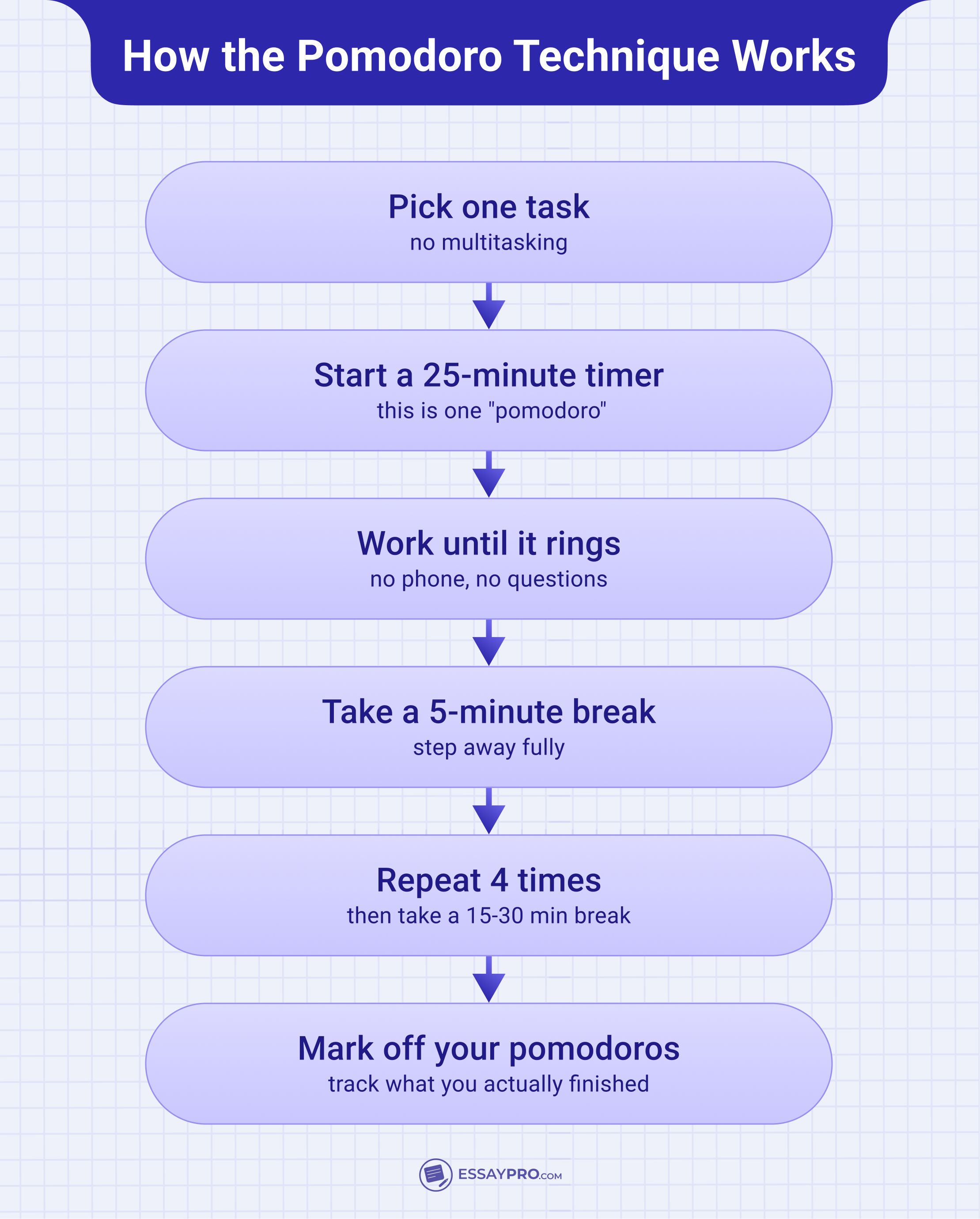
This technique consists of a few steps that you will continuously loop through. Here’s how to use the pomodoro technique:
- Pick one task: Make sure you select what you want to work on before you start the timer. Do not try to multitask.
- Start a 25-minute timer: You have 25 minutes to complete that one task. This is called a pomodoro.
- When the timer goes off, stop working on that task: Do not answer any questions or check your phone.
- Take a 5-minute break: Once the timer goes off, you can pause that task.
- Complete this process 4 times: Then take a longer break between 15 and 30 minutes.
- Mark off your pomodoros: Cirillo suggests keeping track of how many pomodoros you have completed. This allows you to see how much you actually worked.
The Pomodoro technique has an external timed element, which allows for greater regulation. In a study conducted at Maastricht University and published in Behavioral Sciences, researchers found that students who used the Pomodoro technique took more externally regulated breaks than those who used self-regulated or flow time. The students were still self-regulating their learning, but had to remember to hit the timer again. By having the pomodoro timer there to regulate your breaks, you have fewer decisions to make.
How to get started with the Pomodoro Technique
You need only a few things to get started with pomodoro technique steps. All you really need is a timer and something to focus on.
- Choose something to focus on: Before you begin, make sure you know what you are trying to accomplish. It can be as simple as studying. If you can narrow down your studying, that would be even better (ie, Flashcards for Chapters 4-5).
- Start a 25-minute timer: You can use any kind of timer. Many universities offer study sessions like this. At Fairfield University, they offer Guided Focus, which consists of four 25-minute intervals with a mandatory 5-10-minute break while at the library.
- Stay distraction-free: Put your phone on silent and give your full attention until the timer rings.
- Break: It's important to truly disengage from your academic work.
- Repeat, then rest longer: After completing four Pomodoros, take a more extended break lasting 15 to 30 minutes.
The findings from a 2025 review in BMC Medical Education revealed insights into employing active recall with the pomodoro method. To practice active recall, you essentially quiz yourself on the material instead of just going over it again. This method, they concluded, resulted in students remembering the content more effectively.
Who tends to benefit most from the Pomodoro Technique
Not everyone responds to the method the same way, but research points to a few groups who tend to benefit most.
Students prone to procrastination or task-switching often see the biggest gains, since the timer removes the decision of "when to start" or "when to stop," a common sticking point for putting off work. A 2025 study presented at the American Public Health Association's annual meeting specifically examined neurodivergent students in virtual study halls, finding the technique reduced stress and burnout while improving mindfulness scores in this population.
It also suits students working through cognitively demanding material in short, digestible chunks, like anatomy, language vocabulary, or dense reading, since the enforced breaks prevent the kind of prolonged mental fatigue that builds during long, uninterrupted sessions.
That said, the Maastricht University study found some students experienced faster-rising fatigue under strict Pomodoro timing than with self-regulated breaks, suggesting people who fall into deep focus easily may prefer a more flexible method like Flowtime instead.
Pairing Pomodoro with other study systems
The Pomodoro Technique doesn't have to work alone, it pairs well with other study and productivity systems, often strengthening both.
- Pomodoro + active recall: Use one interval to test yourself with flashcards or practice questions instead of re-reading notes. The BMC Medical Education scoping review found this combination improved retention more than either method alone.
- Pomodoro + task batching: Group similar small tasks (emails, flashcard review, problem sets) into a single 25-minute block instead of spreading them across the day.
- Pomodoro + time blocking: Use a calendar to schedule which pomodoros go toward which subject or project, then let the timer handle execution within each block.
- Pomodoro + the two-minute rule: Knock out any task under two minutes immediately, rather than "spending" a full interval on something trivial.
Final advice
Here's a fact worth sitting with: Gloria Mark's research at UC Irvine found it takes an average of 23 minutes and 15 seconds to fully return to a task after just one interruption, and her more recent work shows attention on a single screen has dropped to just 47 seconds before switching, down from 2.5 minutes in 2004. That's the real argument for Pomodoro. It's not really about the 25 minute study method, it's about protecting yourself from the interruptions that cost you 23 minutes each.
The advice most people skip: don't just silence your phone, put it in a different room entirely. Proximity alone measurably pulls attention, even with notifications off. And when a stray thought or unrelated task pops into your head mid-interval, don't fight to forget it, keep a small notepad next to you and jot it down in three seconds, then return to the timer. That single habit prevents the mental thread from turning into the kind of internal interruption Mark's research shows is just as costly as an external one.


Sopho Miller
is an experienced content writer who specializes in digital marketing, business, and academic topics. With a Master’s degree in Digital Marketing, she combines her expertise with a practical approach to create clear, engaging, and educational content. She crafts detailed guides and resources that support students in their academic journey. Outside of work, Sopho stays current with the latest industry trends and regularly attends workshops to further sharpen her skills.