
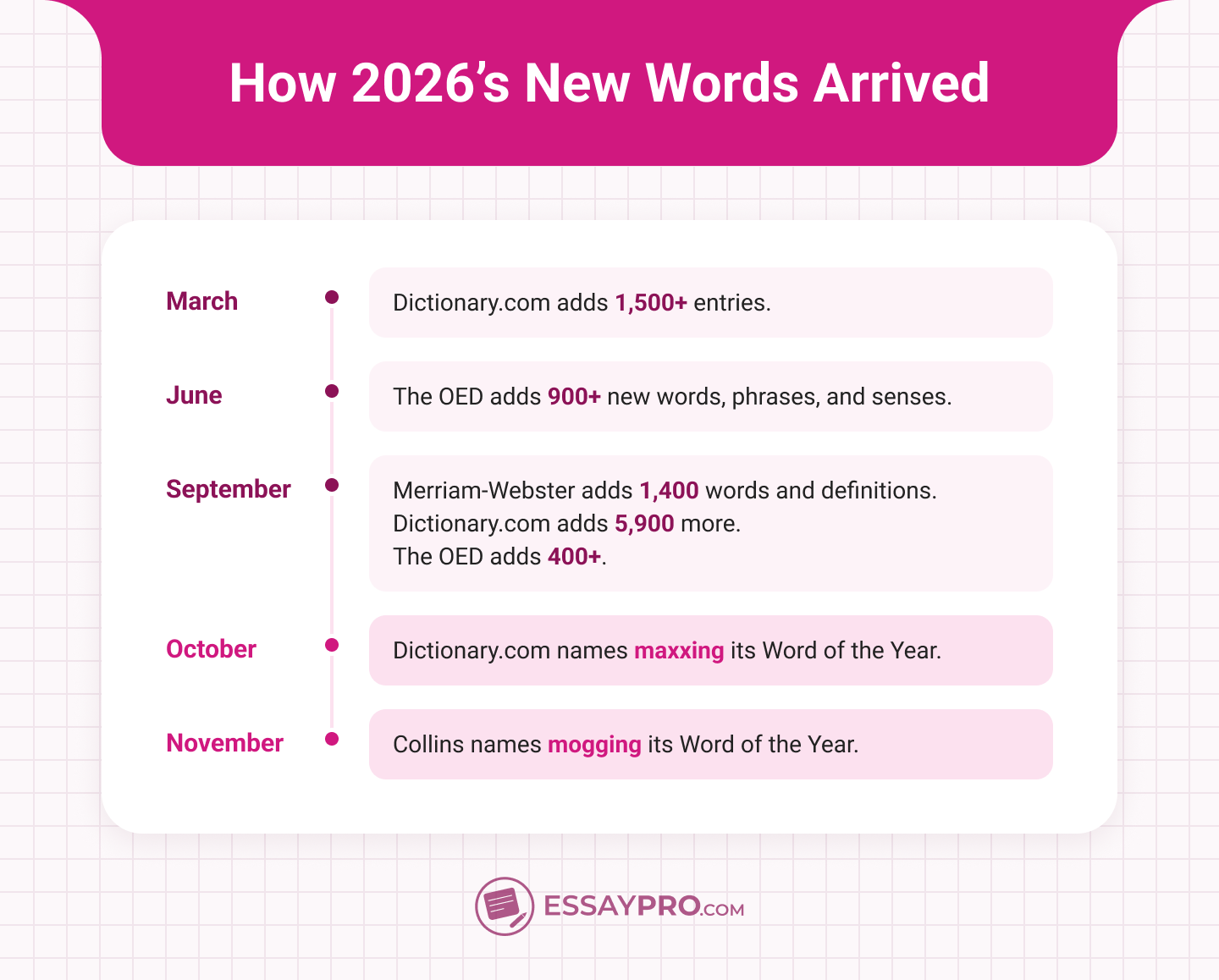
Dictionaries added thousands of words in 2026, and many came straight from social media. Dictionary.com added more than 1,500 entries in March and 5,900 more in September. Merriam-Webster added 1,400 words and definitions that same month, and the Oxford English Dictionary adds hundreds more each quarter. Collins has named “mogging” its 2026 Word of the Year, and Dictionary.com picked maxxing. This guide sorts the most interesting new words for 2026–27 by theme, from slang to AI jargon, with a plain definition for each. Not every entry is brand new. Dictionaries add a word once many people use it the same way over time, so a few of these have been around for years.
Slang and social media
The newest slang often starts in a small online community and spreads through TikTok, Reddit, and X before a dictionary notices.
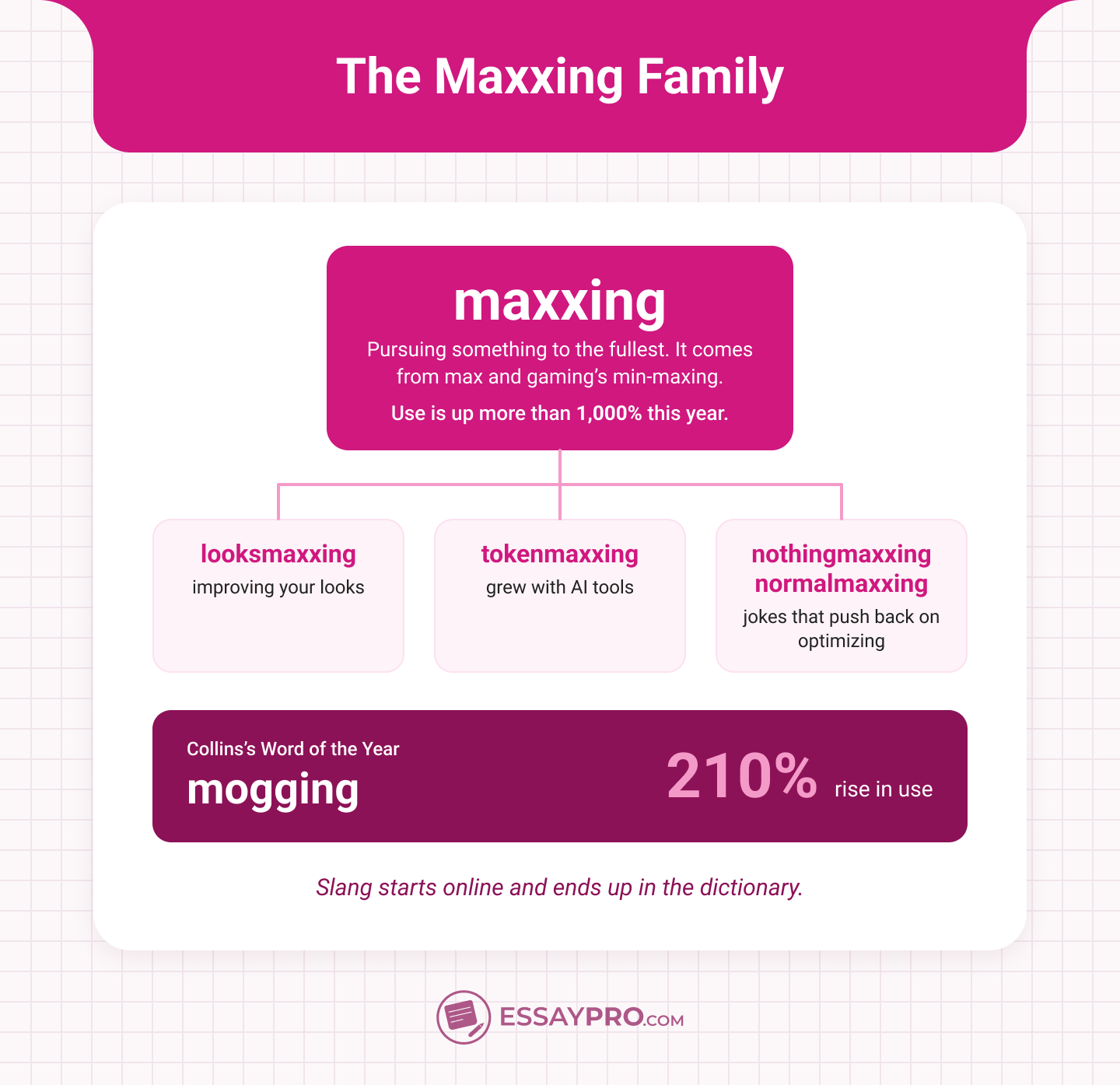
- maxxing verb, combining form. Pursuing an activity to the fullest, or optimizing one part of your life. Dictionary.com traces it to “max” and to the gaming habit of min-maxing, and says its use rose more than 1,000% this year.
- looksmaxxing noun. Taking steps, sometimes extreme ones, to look as attractive as possible. Merriam-Webster added it in September.
- mogging verb, noun. Outshining someone or something, usually in a playful, ironic way. Collins reports a 210% jump in use this year.
- aura farming noun. Cultivating an image of effortless coolness. It was on Dictionary.com’s 2025 shortlist, and some people use it as a jab at those trying too hard.
- crashout noun. A dramatic emotional meltdown, now among Merriam-Webster’s newest entries.
- copium noun. A made-up “drug” people supposedly take to cope with a loss or a hard truth through self-delusion.
- glow-up noun. A big positive change, usually in looks but often in confidence too. Merriam-Webster and Dictionary.com both added it.
- lost in the sauce idiom. Confused, clueless, or in a fog.
- kiki noun. A get-together of close friends to swap gossip.
Also notable: Last year’s Word of the Year, 6-7, has no fixed meaning. It is often read as “so-so,” and it spread from a rap song to classrooms.
Life online
Online communities have their own habits, and dictionaries are starting to name them.
- engagement bait noun. Posts made mainly to provoke comments, likes, and shares.
- face reveal noun. A creator posting their own face publicly for the first time.
- reply guy noun. A man who replies to women’s posts too often and inappropriately.
- IYKYK abbreviation. “If you know, you know,” used for inside references.
- parasocial adjective. Describing a one-sided emotional bond with someone who doesn’t know you, such as an influencer. Merriam-Webster added it in 2026, after it became Cambridge Dictionary’s 2025 Word of the Year.
- friendslop noun. A low-budget, independent video game meant to be played with friends. A user on X is widely credited with coining it in 2025, and Collins shortlisted it a year later.
- Slow Social Era noun. A period when people use social media less often and more carefully, listed on Cambridge’s new-words blog.
AI and technology
Dictionary.com says AI is producing a rapidly growing technical vocabulary. These are some of the new entries.
- vibe coding noun. Using AI to turn plain-language instructions into working code. It was Collins’s 2025 Word of the Year and joined Merriam-Webster in 2026.
- compute noun. The processing power and memory a system needs to run. Merriam-Webster added this noun sense.
- AGI abbreviation. Artificial general intelligence.
- uncanny valley noun. The uneasy feeling you get when something artificial looks almost, but not quite, human.
- context window noun. How much text an AI model can take in at once when it writes a response.
- model collapse noun. Poor output from a generative AI trained on data that other AI made.
- overprompt verb. To give an AI so many instructions or limits that the results get worse.
- P(doom) noun. A person’s estimate of the chance that AI will cause civilization to collapse.
- enshittification noun. The gradual decline of an online platform’s quality. The OED added it in June, and it can now describe any general decline.
Work, money, and relationships
- ghost job noun. A job posted with no plan to hire anyone. Collins shortlisted it.
- slammed adjective. Very busy or buried in work, added by the OED in September.
- love bomb noun, verb. An overwhelming show of affection, often used to manipulate.
- trauma bond noun. The bond an abuse victim feels toward the abuser, especially when cruelty alternates with kindness.
- cuffing season noun. The colder months, when many people look for a steady partner.
- Sunday scaries noun. Dread on Sunday about the week ahead.
- STBX abbreviation. Soon-to-be ex.
Health, climate, and cities
- bioprinter noun. A 3D printer that makes material from living cells.
- longevity escape velocity noun. A hypothetical point at which medical advances extend life expectancy faster than time passes.
- agrivoltaics noun. Using the same farmland for crops and solar power.
- blue carbon noun. Carbon captured by coastal ecosystems and stored in their plants, sediment, and algae.
- greenhushing noun. A company keeping quiet about its sustainability work, often to avoid criticism.
- sponge city noun. An urban design that uses green infrastructure to soak up stormwater and reduce flooding.
- firewave noun. A series of urban wildfires in a short period.
- carspreading noun. Carmakers building longer, wider, heavier vehicles.
Food and borrowed words
Borrowing is a big source of new English. Dictionary.com’s winter update included 55 direct borrowings, and 40% came from Japanese. In its summer update, Spanish supplied the most borrowed entries.
- nasi lemak noun. A Malay dish of rice cooked in coconut milk with pandan leaves, often served with sambal, egg, cucumber, and peanuts.
- pandan noun. Fragrant leaves used in Southeast Asian cooking.
- pandesal noun. A soft, slightly sweet Filipino bread roll.
- quesabirria noun. A cheese-filled tortilla with birria-style beef, served with broth for dipping.
- fricy adjective. Food or drinks that are both fruity and spicy, shortlisted by Collins.
Also new: Merriam-Webster added shishito, bao, and chili crisp.
How a word gets into the dictionary
A new entry is not always a new word. Dictionary.com adds words that many people use the same way and that look likely to last. Editors read widely, search large collections of text, and check search trends. “People pleaser” is one example: it is decades old, but interest rose in the mid-2010s and again in the early 2020s. Merriam-Webster looks for widespread use over time.
Words to watch in 2027
Several terms may be next. “Maxxing” is spawning its own family: Dictionary.com’s lexicographers noted that “tokenmaxxing” grew with AI tools, and that playful forms such as “nothingmaxxing” and “normalmaxxing” push back against constant optimizing. Keep an eye on “Slow Social Era,” “P(doom),” and “firewave” as well. Some will fade, and dictionaries wait to see which ones stay.
Final word
The 2026–27 list shows English pulled in three directions: toward online communities, toward new technology, and toward the rest of the world’s food and language. Slang is only part of it, but it is the part most of us hear first.