Search “study music” and you will find playlists labeled 432 Hz that promise calmer nerves and sharper focus. Most modern music is tuned so the note A vibrates at 440 Hz. A 432 Hz tuning lowers every note by about 2%, and fans say it sounds warmer, more relaxing, and more natural. So should you convert your own study playlist? Treat it as a cheap experiment, not a cure. A=432 is a valid tuning, and one small pilot study found a slightly lower heart rate with 432 Hz music. But the big claims, such as healing, “the frequency of the universe,” or DNA repair, have no solid evidence, and research on 432 Hz is small and early. This guide separates the sound, the history, and the myths. Then it shows how to convert a track, test it fairly, and choose study music that does help.
What does converting music to A=432 Hz mean?
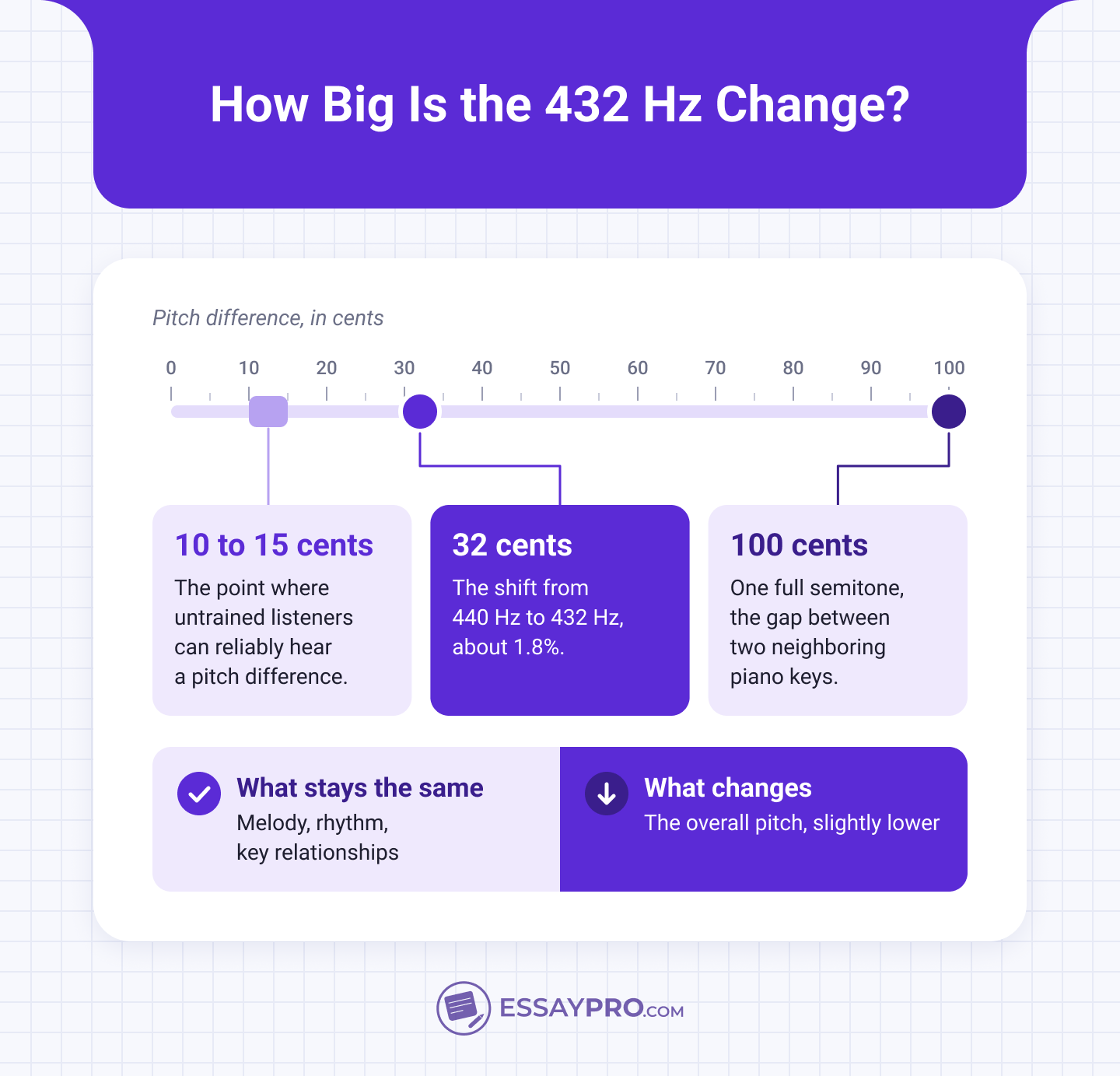
Musicians tune to a reference note, and today that note is A4 at 440 Hz, the standard concert pitch. Converting to A=432 Hz shifts the whole song down by a small, fixed amount: about 1.8%, or roughly 32 cents. A cent is one hundredth of a semitone, so the change is less than a third of the gap between two neighboring piano keys. The melody, rhythm, and key relationships stay the same. Only the overall pitch moves slightly lower, much like slowing down a record by a hair.
Why do fans say 432 Hz sounds better?
People who prefer 432 Hz describe it in warm terms. The listeners quoted in reposts of the original article say it sounds more harmonious, feels “inward” in the chest, and seems to fill a room, while 440 Hz feels more “outward” and mental. Those are real impressions, and you are free to enjoy them.
They are not measurements, though. Untrained listeners typically need 10 to 15 cents before reliably hearing a pitch difference, so a 32-cent gap is noticeable side by side but subtle. It is also hard to hear fairly when you know which version is “the special one.” Expectation shapes what we hear. A blind test, which you will find below, is the honest way to check.
Where did the 432 Hz idea come from?
Before the twentieth century, concert pitch varied from city to city. France set a legal standard of A=435 in 1859, and Giuseppe Verdi argued in the 1880s for a lower pitch, mostly to protect singers. The label Verdi tuning for 432 was popularized much later by an advocacy campaign. Then, in May 1939, delegates from France, Germany, the Netherlands, Italy, and England met at the BBC in London and agreed on A440. The International Organization for Standardization adopted it in 1955 and formalized it as ISO 16 in 1975.
The original article added a darker story: that Nazi officials pushed 440 Hz to make people anxious. Scholars of the movement describe this as a conspiracy theory that traces back to a late-twentieth-century article by political activist Lyndon LaRouche. The article’s own wording called it unproven. The record shows an international meeting in London, a standard that took decades to formalize, and no evidence that the number was chosen to harm anyone.
What about cymatics and “vibrational states”?
The original leaned on cymatics: sand on a vibrating plate forms neat patterns, and the body is about 70% water, so music might change our own “vibrational state.” The patterns are real. They are called Chladni figures, and a university physics demo explains that they appear when a plate vibrates at its own resonance frequencies, driving sand toward the still lines. The shape depends on the plate and the frequency.
That shows how plates resonate. It does not show that 432 Hz is special for people. I found no study testing the idea that music at 432 Hz retunes the body, so treat it as an analogy, not a finding. The number games in the original, such as ratios between breath, pulse, and 108 Hz, are numerology, and they can’t be tested either way.
What does research on 432 Hz music show?
A handful of small studies have compared 432 and 440 Hz. Here is what they found:
The pattern is clear. These studies are small, mostly pilots, and the results are mixed. Music in general often helps, which is why both frequencies beat silence in the dental trial. None of these studies measured exam scores or learning, so none can tell you that 432 Hz music helps you study.
How to convert music to 432 Hz?
You can do this for free with Audacity, using tracks you own or that are free to use:
- Open the track in Audacity and select all (Ctrl+A or Cmd+A).
- Go to Effect > Pitch and Tempo > Change Pitch.
- Set the frequency “from” to 440 and “to” to 432. Audacity then shows about -1.818% and -0.32 semitones. Ignore the start frequency Audacity suggests.
- Tick “Use high quality stretching,” then apply.
- Export under a new name, and keep the original.
Use Change Pitch, not Change Speed, if you want to keep the tempo the same. Change Speed alters both pitch and tempo.
How to test 432 Hz music for studying?
Make a 432 Hz copy of two or three tracks and ask a friend to relabel the files “A” and “B” so you can’t tell which is which. Use the same volume and the same kind of task, for about 20 to 25 minutes per session. After each session, rate your focus from 1 to 5 and note how much you finished. Alternate versions for two weeks, then reveal the labels and compare. This won’t prove anything medical, but it will tell you whether the change matters for you.
What matters more for study music?
Several better-supported factors matter more than the tuning:
- Lyrics: In one study of 30 students, reading comprehension was best in quiet or with non-lyrical music, and worst with lyrics, whether students liked the song or not.
- Speed and volume: In another study, fast and loud instrumental music disrupted reading comprehension the most.
- Overall effect: A large meta-analysis found that background music had no overall effect on performance.
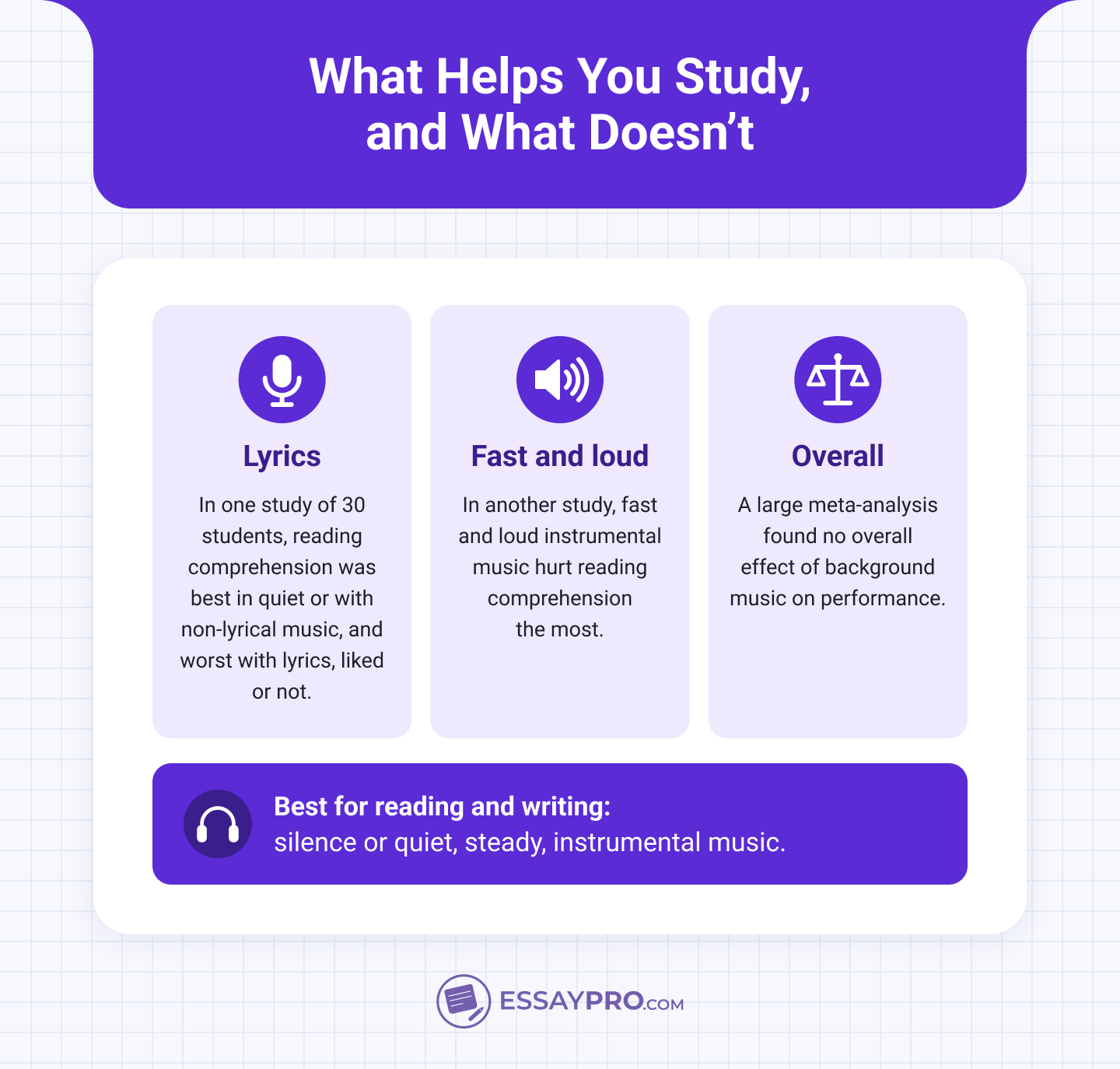
For reading, writing, or memorizing, choose silence or quiet, steady, instrumental music. Save lyrics and loud favorites for breaks.
So, should students convert their music to 432 Hz?
Yes, if you are curious, and as an experiment. It costs nothing, the change is small, and you may like the sound. Just keep your expectations honest. The evidence is small and early, and the claims about healing or cosmic frequencies are unsupported. If sleep or anxiety is a real problem, see a professional, and do not rely on a tuning. For studying, the biggest wins come from lowering the volume, skipping the lyrics, and picking music you find steady and unobtrusive.

Daniel Parker
Daniel Parker is a senior academic writer with a background in English Literature and Education. His guides cover all kinds of essays, research papers, theses and dissertations, case studies, and grammar and style, plus college and scholarship applications. He also follows education trends and student surveys, and he turns new data into advice students can actually use. Whether a reader is in their first semester or finishing a graduate degree, Daniel tries to give them clear steps, real examples, and sources they can trust.