Companies with more varied leadership teams tend to report more innovation. That is the headline of a well-known BCG survey of 1,681 companies, where firms with above-average management diversity reported 45% of their revenue from recent products, against 26% at less diverse firms. Newer research is more careful. A 2024 meta-analysis of more than 600 reports found a link that is consistently positive but small, explaining under 1% of the differences in team performance. So the topic is a mix of strong claims and honest limits, and students are already living inside it. Every group project is a small team with different strengths. In the 2026 NACE survey, 85% of employers said they look for teamwork on a résumé. This article walks through what the research found, where it is disputed, and how students can use it.
What research says about diversity and innovation
The BCG study surveyed employees at more than 1,700 companies in eight countries: Austria, Brazil, China, France, Germany, India, Switzerland, and the US. It measured innovation as the share of revenue from products and services launched in the past three years. Companies with above-average diversity on their management teams reported 19 percentage points more of that revenue (45% vs. 26%). They also reported EBIT margins 9 percentage points higher. The authors described this as a strong, statistically significant correlation, and it showed up in both developed and emerging markets. The link was stronger at companies that invest more in digital technology.
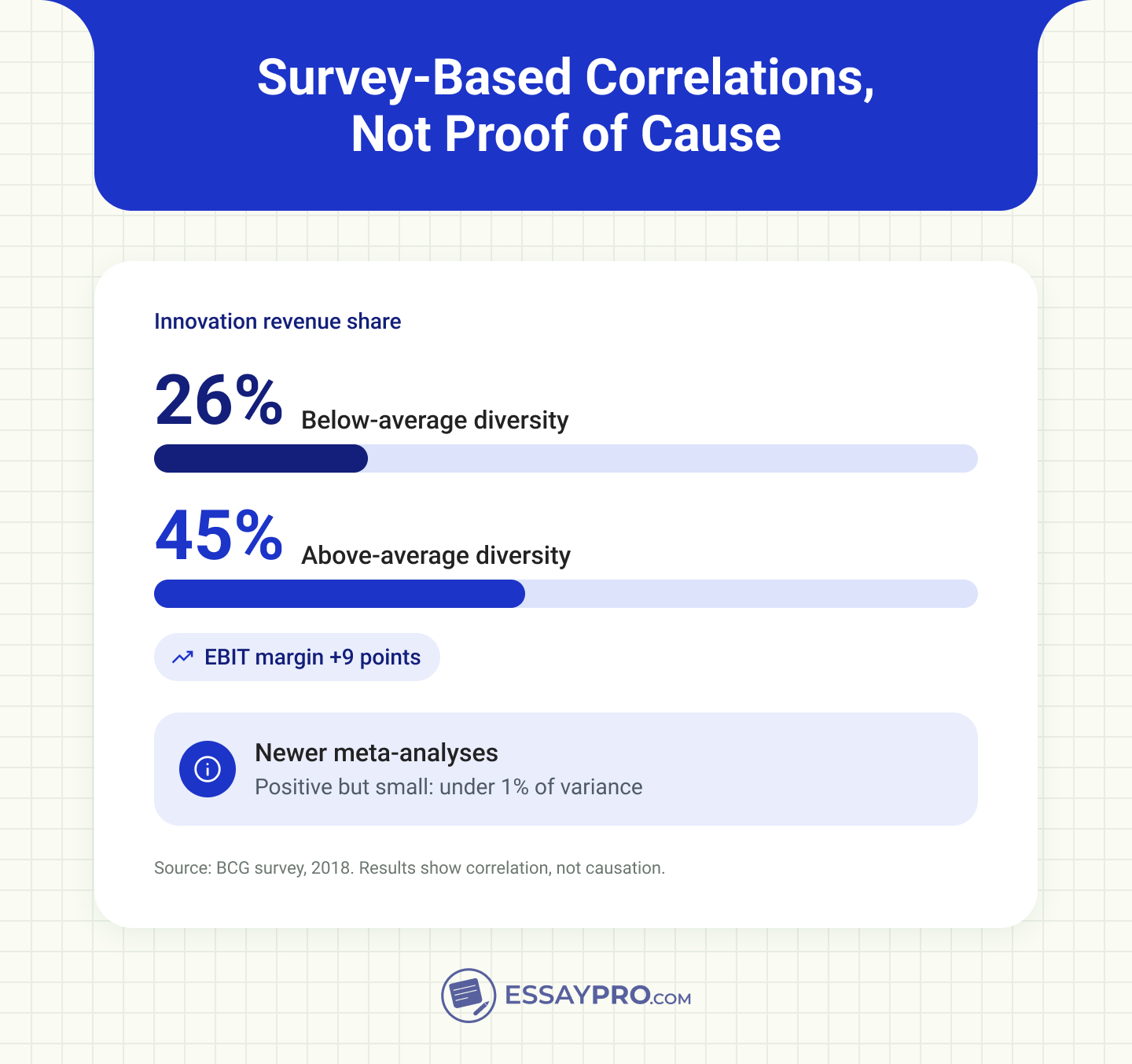
Fresh studies add detail, and the picture is more modest:
- Meta-analysis, 2024: The Wallrich team’s review of more than 600 reports and 2,600 data points found that diversity is linked to better team performance mainly for innovative or complex tasks. On average, the link was weak.
- Meta-analysis, 2025: A review of 57 studies found top-team diversity was modestly associated with corporate entrepreneurship, with effects that depended on the country.
- Firm-level data, 2026: In a study of Colombian firms, top-team cultural diversity was linked to innovation through a firm’s ability to absorb new knowledge. Overall explained variance was small (R² = 0.055).
- Chinese listed firms: A study of 2011 to 2021 data linked foreign executives to better innovation performance, mostly radical rather than incremental innovation.
Which types of diversity matter most
BCG looked at six dimensions: gender, age, national origin, career path, industry background, and education. All six correlated with innovation. The strongest links were for national origin, industry background, gender balance, and career path, while age and educational focus showed less. The authors also modelled a company of about 50,000 employees and 1,500 managers. Replacing 2% of managers (30 people) with ones from other industries was associated with one extra percentage point of innovation revenue. The same gain was linked to 2.5% more female managers (38) or 1.5% more managers from another country (23). Effects were mostly additive, except for industry and career path, which overlap.
Definitions differ between studies. BCG measured the focus of study, while other work counts degree types, so results do not always match.
Why diversity works only with inclusion
Hiring different people is not enough. BCG checked for five enabling factors: equal pay and fair practices, leaders who value different views, visible CEO support, frequent open communication, and a culture open to new ideas. Fewer than 40% of respondents said any of them described their company. Where they were present, innovation revenue was nearly 13 percentage points higher. BCG also noted that 91% of companies had a gender diversity program, yet only 27% of women said they had benefited.
Newer data points the same way:
- A 2026 study of 393 Italian firms found that top-team functional diversity was not significantly linked to innovation intentions when open discussion was low. It became positive and significant when open discussion was high.
- A 2026 study in the Journal of Applied Social Psychology reported that identity diversity was more strongly linked to psychological safety in inclusive climates, and only weakly linked under low inclusion.
- The 2024 meta-analysis found diversity’s benefits were stronger in cultures where authority is shared more evenly. The researchers could not test psychological safety directly because too few studies reported it.
- Among students, a 2025 study of 124 engineering design groups linked nationality diversity to lower shared understanding and less trust. It found no direct effect on group performance, and the authors urged teachers to build awareness of the value of diverse groups.
What this means for students
A group project is a small version of the same question. Two recent student studies are worth knowing:
- A University of Michigan research brief followed 1,221 engineering students in teams of four to six. Demographic diversity in a team was not significantly correlated with grades, but it was linked to higher grades for underrepresented minority students. Teams with more skill coverage, meaning at least one strong member for each needed skill, had higher grades. The study covers one course at one university and relies on self-reported skills.
- A 2024 study of 129 undergraduate groups found that more culturally diverse groups had lower cohesion. It found no direct or indirect link between cultural diversity and performance. The most diverse groups did spend longer in discussion.
Employers are asking for the skills that mixed teams exercise. In NACE’s spring 2026 survey of 185 employers, 85% look for teamwork on résumés, 82% for problem-solving, 78% for verbal communication, 73% for technical skills, and 72% for written communication. Only 31% mentioned AI skills. Another NACE survey found that 70% of employers use skills-based hiring, up from 65%, so concrete examples count. Communication is a gap: 98.7% of employers call it important, but only 55.4% rate graduates as proficient. A survey of more than 8,000 study abroad alumni found that 94% said it helped them build job skills, with 85% naming adaptability and 83% intercultural communication. These are self-reports, not hiring outcomes.
How students can build skills for diverse teams
- Join mixed project teams. When you can choose, build a team with different majors and strengths. The Michigan data links skill coverage to grades. Agree on roles in the first meeting.
- Take interdisciplinary courses. Diversity in degrees and functions is among the types more consistently linked to performance. Practice explaining your field without jargon.
- Study abroad or join an exchange. Alumni report gains in adaptability and intercultural communication. Virtual exchange programs and international clubs are lower-cost options.
- Practice active listening. Repeat the other person’s point before you answer, then ask one follow-up. BCG’s enabling factors include views being heard and valued.
- Seek feedback from different perspectives. Ask a classmate from another field or country to review a draft. Open discussion was the condition under which diversity helped in the 2026 Italian study.
Limits and debates around diversity research
The main caution is that these are correlations. BCG’s figures come from survey responses on perceived diversity and reported innovation revenue. Several explanations could fit the same pattern. Diversity may support innovation. Successful, innovative firms may have more room to hire varied leaders. Or something else, such as company size, industry, or digital spending, may drive both.
Researchers have also questioned similar consulting-firm studies. In 2024, Jeremiah Green and John Hand, in Econ Journal Watch, tried to replicate four McKinsey studies of executive racial and ethnic diversity. Using S&P 500 data for 2015 to 2019, they found no statistically significant relationship with financial performance. They argued that the earlier results may reflect better performance causing diversity, not the reverse. They also said their results do not cover employee diversity, board diversity, or non-financial goals. McKinsey’s 2023 report had found that companies in the top quartile for ethnic representation at senior level were 39% more likely to outperform those in the bottom quartile. BCG’s study used a different design, but it belongs to the same family of correlational, consulting-led work.
Academic results are also mixed. The 2024 meta-analysis concluded that moral, legal, and talent-pool reasons for diversity stand on firmer ground than promises of performance gains. Readers can weigh the evidence for themselves.
The bottom line
BCG’s survey linked more diverse leadership teams to more innovation revenue (45% vs. 26%) and higher margins, with job background, national origin, gender, and career path showing the strongest ties. Newer studies find the link is real but small, stronger for creative tasks, and dependent on open, inclusive team cultures. These are correlations, and some researchers dispute similar consulting-firm findings. For students, the lessons are practical. Employers ask for teamwork, problem-solving, and communication, and group projects and study abroad let you practice them. Build mixed teams, listen actively, and ask for different views.

Ana Ratishvili
Ana is a professional literary writer with a Master’s Degree in English literature. Through critical analysis and an understanding of storytelling techniques, she can craft insightful guides on how to write literary analysis essays and their structures so students can improve their writing skills.