
Few generations have taken as much heat as millennials. Somewhere along the line, they picked up a reputation for being self-absorbed and overly entitled, a label they still haven’t shaken off yet. The label? It was harsh. The Me Me Me Generation, they were called. You probably have heard some version of it, if not from a person, then from a headline.
The millennials me me me generation is an easy accusation to throw around, and the TIME magazine millennials article didn’t help their case. Although the charge didn’t appear from nowhere, certainly, because there are real studies behind it, actual figures on millennials narcissism and self-centeredness. Joel Stein millennials dissection was one of the most prominent, in-depth looks into the topic, and in this article, we’ll spend some time in each nook and cranny of his arguments and counterarguments.
Who the Millennials Are
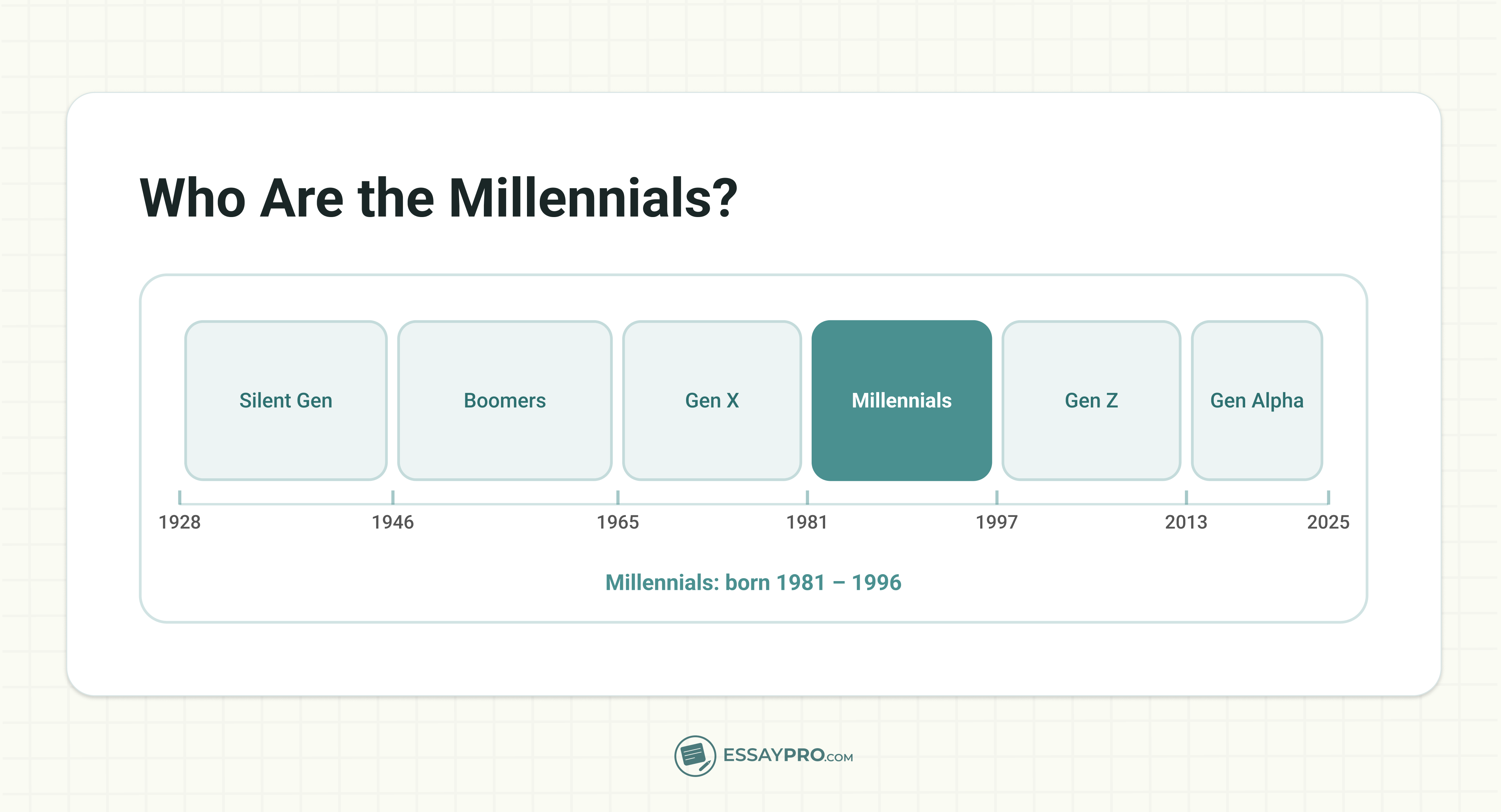
So who, and what age, are we exactly talking about? Stein's definition was loose, as he pegged the millennials generation as people born between 1980 and 2000, though even he hedged on the exact range. Round that off, and you get teens and twenty-somethings, roughly 80 million of them in the U.S. alone. That made them the biggest age grouping in American history at the time. Despite the precise age, thanks to social media and globalization, millennials in different countries began to resemble one another. A young person in Shanghai and one in Chicago grew up on the same apps and the same trends.
Most researchers today use a shorter window, even though Stein's millennials birth years span a full twenty years. Pew Research Center counts millennials as people born between 1981 and 1996. Why the gap? A twenty-year span throws together people with almost nothing in common, so Pew trimmed it for cleaner data.
The Data Behind the "Me Me Me" Label
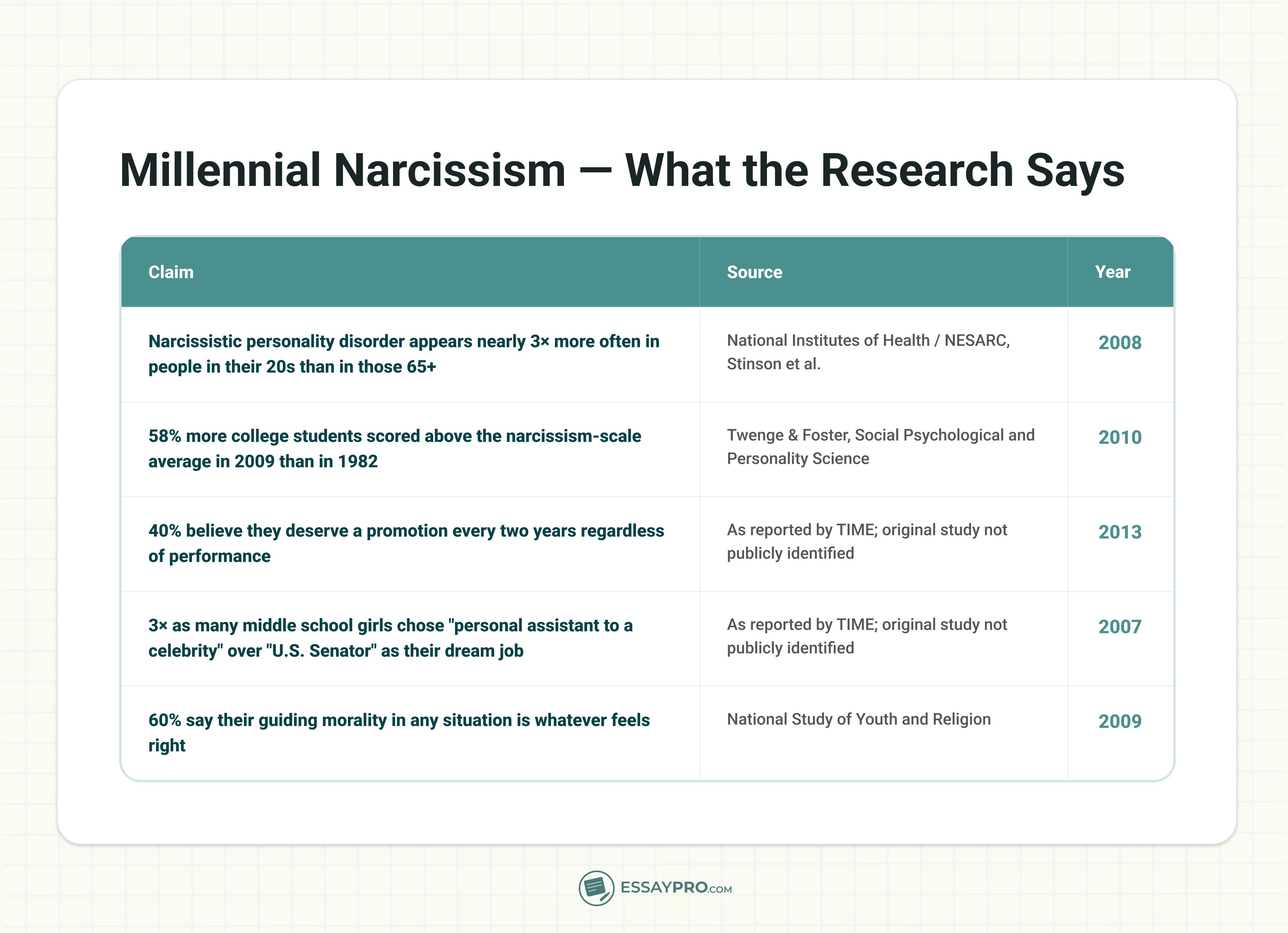
According to figures Stein cited from the National Institutes of Health, narcissistic personality disorder showed up nearly three times as often in people in their twenties as in those aged 65 and older. On top of that, college students kept scoring higher on narcissism tests. Work by psychologist Jean Twenge found that 58% more of them landed above the old average in 2009 than back in 1982.
Stein pointed to a workplace stat as well, reporting that 40% of young people felt they deserved a promotion every two years, no matter how they performed. He cited a 2007 survey where three times as many middle school girls picked "personal assistant to a celebrity" over "U.S. Senator" as their dream job. And per the National Study of Youth and Religion, 60% said their moral compass in any situation came down to one thing, which was whatever felt right to them.

Entitlement in the Workplace
So what does narcissism look like once it clocks in for work? Stein's answer was entitlement. This is the section that stuck with me most, probably because I've watched a version of it play out in every office I've worked in.
The logic runs simple. A generation that grows up certain of its own value brings that certainty to the job. A few habits Stein flagged, and that managers kept griping about:
- They email the CEO directly and skip every rung of the ladder in between.
- They beg off tasks they find boring, as if boredom were a valid excuse.
- They expect fast promotions on a schedule that has little to do with performance.
There was money in the frustration. A small consulting industry sold seminars to middle managers on how to handle these people, and "millennials entitled" hardened into shorthand for a whole millennials workplace headache.
The sharpest phrase in the piece is the diagnosis Stein borrowed: a "crisis of unmet expectations." Highest hopes and lowest satisfaction, and the two fed each other. The cultural pushback landed too. In 2012, a high school teacher named David McCullough Jr. gave a graduation speech called "You Are Not Special," and, as reported by TIME, it reached nearly two million views, roughly 57 likes for every dislike. Teenagers cheered it. That detail still gets me.
Fame, Selfies, and Self-Documentation
Now we reach the millennials fame obsessed charge, the accusation everyone remembers. For older generations, fame arrived as a side effect of doing something worth noticing. Stein argued that the order had flipped, and the fame itself was now the target, the thing a teenager would actually name when you asked about their future.
His evidence was all in the numbers on self-documentation:
- A 1950s home displayed a couple of framed photos. By 2013, a middle-class household held around 85 pictures of the family and its pets.
- Teens sent and received an average of 88 texts a day, per Pew.
- People had begun to log their steps, their locations, even their DNA (23andMe was the period example).
Then the brand math. Stein described follower and friend counts as a kind of personal sales figure, and noted that a decent feed could turn an ordinary person into a microcelebrity. Reality TV handed over a template everyone already knew.
On millennials social media, the platforms rewarded this behavior. And in his telling, they went a step further and produced it. That's a big accusation, only half right in my view, though we'll get to my objections later.
Delayed Adulthood
The last charge is about the clock. Stein's millennials would not grow up on schedule, and the labels came fast. Some writers reached for the Peter Pan generation. Psychologist Jeffrey Arnett offered a gentler term, "emerging adulthood." Stein preferred his own coinage, twixters, which never caught on.
The markers of delayed adulthood were easy to count:
- More millennials living with parents than any earlier cohort at the same age.
- Later marriages. The median first-marriage age for American women stood at 20.6 in 1967, and by 2011 it had climbed to 26.9.
- Later career starts. The first "real job" now came well after graduation.
Here's what I respect about the original: Stein refused the easy read. He held two explanations at once. Some of the delay was choice. A world of options, an economy of seven jobs before thirty, online dating, and longer lifespans all made waiting reasonable. Some of it was economics, plain and simple, because record student debt and rising rent kept pushing kids back to their childhood bedrooms.
A Global Generation
A fair objection shows up right about here. Was any of this actually global, or was it just an American story about comfortable kids? The article answers no twice over.
China is the case study that stuck with me. A mix of the internet, breakneck urbanization, and the one-child policy had produced a young cohort with the same self-assurance and self-focus you saw in the West. Not identical circumstances, and yet the profile matched almost point for point.
Class is the second twist. Lower-income millennials, according to the data cited, posted the same rates of narcissism and materialism as their wealthier peers. In several measures, higher. I'd always assumed entitlement was a product of a soft, cushioned upbringing. The numbers here say it wasn't.
Why Millennials Will Save Us All
This is the pivot, and it's the part almost nobody quotes. If your whole memory of the me me me generation article is the narcissism data, you stopped reading at the intermission. Around the midpoint the tone changes completely. The prosecution rests, and a defense opens.
The core reversal deserves a clean statement. Millennials weren't rebelling against big institutions, and the reason is that they had grown up without powerful ones to rebel against in the first place. No looming Establishment, so no revolt.
Then comes the claim that has aged the best. The information revolution put tools in the hands of individuals that let them compete against organizations many times their size. A few of the head-to-heads the piece named:
- Bloggers vs. newspapers.
- YouTube creators vs. studios.
- App developers vs. entire industries.
Give a generation that kind of leverage and it stops waiting for permission. It just builds. And suddenly the entitlement charge reads differently, because what one observer calls arrogance, another calls plain self-reliance.
The character portrait warms up as well. What emerges across the back half is a pragmatic cohort, a set of tinkerers and life-hackers who cared mostly about what works in practice. They were unusually accepting of difference. They actually liked their parents, called them for advice, kept them close. They adapted at speed.
By the final paragraphs the Joel Stein millennials verdict turns almost fond. Millennials optimism becomes the trait that defines them, a stubborn conviction that things will somehow come good, and the argument decides to place its bet accordingly. The last line sides with the kids. I finished it a little ambushed, honestly, by how generous it had turned.
What the Research Says Now
Before you take those millennials narcissism numbers to the bank, a caveat is in order. The science on this question has kept evolving since the original reporting, and some of it points the other way.
For example, Roberts, Edmonds, and Grijalva (2010) ran a developmental analysis and concluded that age explains most of the variation in narcissism scores, with birth generation playing only a small role. Their reading was that people tend to score high in their twenties and settle down later, and any cohort would do the same at that stage.
The larger millennials narcissism study, Wetzel and colleagues (2017), pooled more than 59,000 students across three cohorts (the 1990s, 2000s, and 2010s). After correcting for flaws in the standard narcissism inventory, they measured a small overall decline (d = -0.27), with drops in entitlement, vanity, and leadership too.
None of this hands down a final verdict, the more correct wording would be to say it muddies the older one. Where that leaves the original argument is a call I'll let you make.
Millennials in 2026: "Me Me Me" vs Gen Z
So where do the millennials 2026 figures actually land? The kids the article described are firmly middle-aged now. Here is the current picture:
- Millennials age today puts them between 30 and 45, using Pew's window of births in 1981 through 1996.
- Between 72 and 74 million of them live in the US, which makes them the largest living adult generation now that they have passed the Boomers.
- They hold about 36% of the workforce, so more than one in three American workers.
- Their share of national wealth stays well under what Boomers held at the same age, near 10% against the Boomers' 50-plus.
And here's the twist I keep coming back to. The precise indictment, the selfies, the entitlement, the phone dependence, has moved on to a new target. It lands on Gen Z now. Every cohort seems to get a turn as the designated narcissists, and then it grows up and hands the title down.
Final Thoughts
The me me me generation article accuses millennials, then quietly forgives them. Half prosecution, half defense. The narcissism data looked damning, yet later research muddies it, and the optimistic verdict has aged well now that millennials run a third of the workforce. My advice? Keep the good data, drop the panic, and notice the same complaints now chasing Gen Z.

Ana Ratishvili
Ana is a professional literary writer with a Master’s Degree in English literature. Through critical analysis and an understanding of storytelling techniques, she can craft insightful guides on how to write literary analysis essays and their structures so students can improve their writing skills.