
A narrative essay is a type of writing that tells a story (typically your own experience) and uses that story to convey meaningful insight. With vivid details, a strong arc, and a lesson at its core, you can sway your reader with a well-written story.
Here is the process of writing a narrative essay in brief:
- Pick an experience that happened to you
- Determine what lesson/event the story unveils
- Outline from your hook to your reflection
- Write with detail, dialogue, and a clear sequence of events
- Revise to perfect your pacing, flow, and conclusion
With the groundwork laid, we’ll now go through how to write a narrative essay step by step, providing detailed instructions, helpful tips, and examples.
What Is a Narrative Essay?
A narrative essay recounts a personal experience, weaving it around a deeper significance. Instead of simply listing facts or trying to convince you of a point, it draws you into an experience with vivid details and feelings, then reveals the lesson the writer has learned. It has a distinct shape with a beginning, middle, and end. The beginning introduces the story, the middle is built around some type of conflict or turning point, and the end focuses on the lesson that was learned. Essentially, it is storytelling with a point.
Check out different types of narrative writing in our separate guide.
How Long Is a Narrative Essay?
The typical narrative essay is about 500-1000 words in length, or around one to three pages. Of course, your assignment may be different. Be sure to read your directions carefully. You should write enough to develop your story with rich detail and a narrow focus, so it doesn't wander.
Why Do Students Need a Narrative Essay?
Narrative essays are a frequent assignment because the skills developed are useful across a wide range of situations. When you write one, you learn how to:
- Create a clear, logical organization of ideas.
- Include interesting, descriptive details in your writing.
- Reflect on the experience and learn from it.
- Appeal to readers' emotions
- Write a college application essay or personal statement.
Narrative Essay Characteristics
Here are the basic characteristics that define this type of writing:
- Non-fiction – written about events that actually happened;
- Written from the author’s viewpoint (1st person);
- Includes elements of a story and follows a clear beginning, middle, and end;
- Provides information in chronological order.
- Uses lots of details to describe an event, person, or scene;
- Aims only to inform, not argue or teach.

Essays Due Soon?
Hand the hard part to expert sand get back a polished, ready-to-submit paper on time!

Narrative Essay Structure
A narrative essay format follows the shape of a good story that it builds. It opens by drawing the reader in, builds tension, reaches a turning point, and closes with reflection. Most narrative essays use five paragraphs, but the real structure is about the story's flow, not the paragraph count. Each part should lead smoothly to the next, carrying the reader from the opening scene to the final insight.
Here is how the narrative essay structure breaks down.
Introduction: Open with a hook, set the scene by stating the time, place, and people involved, and hint at what your story will reveal.
Body Paragraph 1 (Background): Introduce yourself and the situation. Show what was at stake before key events.
Body Paragraph 2 (Conflict): Now, present the central challenge or moment of tension that drives your story forward, building toward the turning point.
Body Paragraph 3 (Turning Point and Resolution): Show the moment something shifts. Explain how the conflict settles and what changes.
Conclusion: Reflect on the experience, return to the lesson from the start, and leave a final thought.
How to Write a Narrative Essay?
Every format of narrative essay essentially has six components: settle on an experience, grasp its deeper lesson, arrange the events chronologically, create a captivating start, expand on the events, and wrap up thoughtfully. By understanding these steps, you can shape a scattered memory into a focused essay that touches your reader. Let's walk through writing a narrative essay step by step.
Step 1: Choose Your Story
Begin by selecting one moment, event, or experience to center your essay on. Don’t try to cover an entire semester or summer vacation in ten pages. Instead, focus on one day, one argument, or one encounter that shifted something for you. A good story, too, needs a moment of climax, where the situation finally breaks. Once you have your story, the next task is to determine its deeper significance.
Weak choice: "My trip to Spain." (Too broad.) Strong choice: "The day I got lost in Barcelona and learned to trust strangers." (Focused and specific.)
For inspiration, check out our list of narrative essay topic examples.
Step 2: Find the Meaning
The moral of your story connects your personal experience to your reader. Dig deep to find the lesson you learned or what you changed because of the experience. Understanding the lesson prepares you to organize the sequence of events.
Consider this equation: Experience + What it taught me = My narrative's message
Example: Getting lost in a new city + learning I could handle the unexpected = "Sometimes losing your way is how you find your confidence."
Step 3: Plan the Sequence of Events
You don’t have to write your story in order, but you do need to plan it that way. List your events in order. Keep your main story to three key events leading to the turning point. Cut events that don’t move the story forward or support your lesson. With your plot mapped out, focus on creating an engaging opening.
Step 4: Craft Your Opening
Your opening lines will determine whether your reader keeps reading. Skip the boring intro and launch into a scene immediately. Start with a strong image, a line of dialogue, or a provocative statement.
Example: "The train doors closed, the platform slid away, and I realized I had no idea where I was."
Then set the scene briefly, time, place, and who is involved, and hint at the meaning to come.
Step 5: Write the Body of Your Essay
Now, tell your story. Write it in order, using descriptions that appeal to the senses. Include dialogue and share your feelings to bring scenes alive. Always show, don’t just tell.
Weak: “I was scared.”
Better: “My stomach dropped and my palms grew sweaty as I realized what had happened.”
Give your turning point room to breathe. This is the emotional center, so slow down and let the reader feel the shift. Use transitions to keep events flowing smoothly from one to the next.
Step 6: Conclude with Reflection
Finish your story by reflecting on the lesson you established in your introduction. You can refer back to it explicitly or dive right into how your perspective has changed as a result of the story. Try not to reference new events that you don’t already cover in the body of your essay.
Example: "I never did find that street I was looking for. But I found something better: the certainty that I could be dropped anywhere and find my way."
Work through these six steps, and your story will land exactly the way you intend.
See a more detailed guide on how to write an essay conclusion.
The Narrative Arc: Using Freytag’s Pyramid
To keep your reader interested, avoid simply listing events. Instead, shape your essay with a Narrative Arc. Many top essays use Freytag’s Pyramid to show the emotional journey.
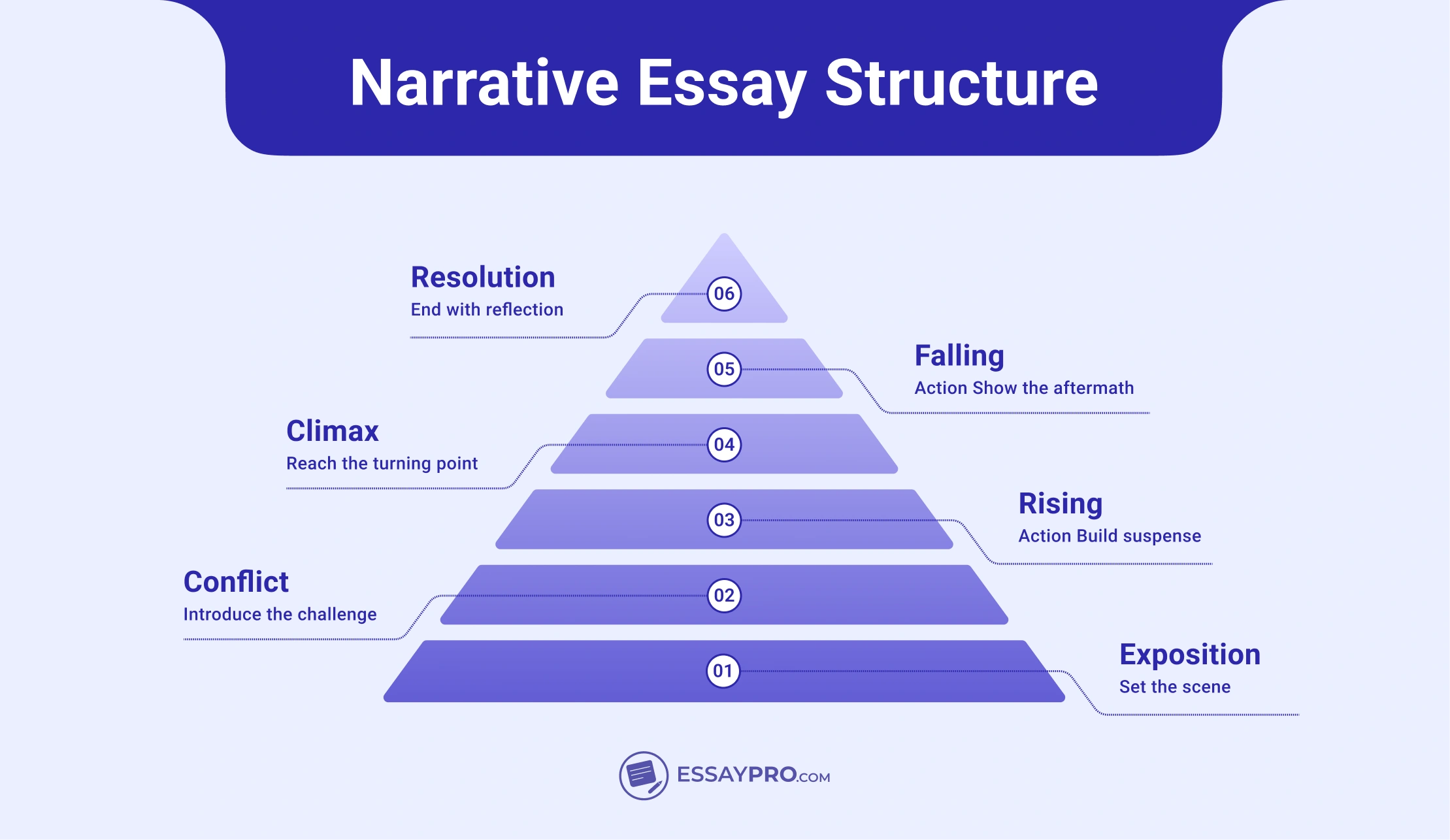
- Exposition: Setting the scene and introducing the "characters" (people involved).
- Rising Action: The series of events or internal struggles that lead to the "big moment."
- Climax: The turning point or the height of the tension.
- Falling Action: The immediate aftermath of the climax.
- Resolution: The "So What?", the lesson learned or the change in perspective.
Narrative Essay Examples
The easiest way to learn about narrative essays is to read a good one. A successful narrative draws you in on line one, takes you on a journey of rising and falling tension and transformation, and leaves you on a lesson learned that doesn’t feel forced. Here are three complete examples, divided by section so you can see how it is done.
Narrative Essay Example #1
Topic: The Audition
[Hook] My voice cracked on the very first note, and the entire choir room went silent.
[Scene setting] It was the spring of my sophomore year, and I had spent three months preparing for the solo audition that everyone said I was sure to win. I had never wanted anything more. Music was the one place I felt completely myself, and this solo was supposed to prove it.
[Background] I had been singing since I was six, in church, in the shower, in every school concert. My teachers called me a natural. So when Mr. Reyes announced auditions for the spring showcase, I assumed the solo was already mine. I practiced, but lazily, certain that talent would carry me.
[Conflict] Then came the audition. I walked in confident, opened my mouth, and my voice betrayed me. The high note I had nailed a hundred times at home splintered into a squeak. I tried to recover, but my hands shook and my breath vanished. I finished, face burning, and sat down without looking at anyone.
[Turning point] I did not get the solo. For a week I avoided the choir room entirely. But when I finally went back, Mr. Reyes did not mention the audition. He simply asked if I wanted to learn how to practice properly. For the first time, I understood that talent without effort was just potential going to waste.
[Resolution] I started practicing with real focus, recording myself, drilling the hard passages, treating each session like it mattered. By the winter concert, I earned a solo, and this time my voice held.
[Reflection] That cracked note taught me more than any easy win could have. I learned that natural ability is only a starting line, not a finish, and that the work I once skipped was the very thing that made me good.
Why it works: The essay opens mid-moment with a vivid, embarrassing image that hooks the reader instantly. It sets up a clear expectation (guaranteed success), shatters it with conflict (the failed audition), and uses the turning point to deliver genuine growth. The lesson feels earned because we watched the writer change through effort, not just stated at the end.
Narrative Essay Example #2
Topic: The Last Shift
[Hook] On my final night at the diner, a stranger taught me what eight months of paychecks never had.
[Scene setting] I was eighteen, working my last shift before leaving for college, eager to be done with greasy tables and demanding customers. I thought the job had given me nothing but sore feet and small tips.
[Background] I had taken the job reluctantly to help my family with bills. Every shift felt like time stolen from friends and rest. I counted down the months, convinced the work was beneath the future I imagined for myself.
[Conflict] That last night, an elderly man came in alone, ordered only coffee, and lingered for hours. I was tired and impatient, eager to close up. When I finally brought his check, he apologized for staying so long, explaining that his wife had passed away that week and the diner was the one place they used to go together.
[Turning point] Something in me shifted. I sat down across from him, poured myself a coffee, and listened. For an hour he told me stories about her, laughing and tearing up. When he left, he thanked me for making his night a little less lonely.
[Resolution] I finished closing the diner in silence, seeing the place differently. The job I had dismissed had quietly been teaching me patience, attention, and how much a small kindness can matter.
[Reflection] I left for college the next week, but I carried that night with me. I learned that no experience is beneath you if it teaches you to see other people more clearly, and that the work we overlook often shapes us most.
Why it works: The essay takes an ordinary setting and finds depth in a single encounter. The conflict is internal (impatience versus compassion) rather than dramatic, which makes the turning point feel honest. The reflection connects a small moment to a universal truth without overstating it, leaving the reader with a quiet, lasting impression.
Narrative Essay Example #3
Topic: The Wrong Turn
[Hook] I was supposed to be leading the group, but I had just led all eight of us in a complete circle.
[Scene setting] It was the second day of our school hiking trip, and I had volunteered to navigate. The trail wound through dense forest, and I had promised everyone I knew exactly where we were going.
[Background] I liked being the one in charge. I was the planner, the kid who always had the map and the answers. Admitting I was unsure of anything felt like failure, so I rarely did.
[Conflict] An hour in, the path forked unexpectedly. I had no memory of it from the trail guide. Rather than admit my doubt, I picked a direction with fake confidence. Forty minutes later, we passed the same fallen log we had seen before. The group realized we were lost, and so did I.
[Turning point] Everyone looked at me, waiting. I could have bluffed again. Instead, I took a breath and said the words I hated most: "I'm not sure where we are." To my surprise, no one was angry. We pulled out the map together, and one quiet classmate spotted the right path in seconds.
[Resolution] We made it back before dark, guided by the very person I had ignored because I wanted to lead alone. The trip continued, but I navigated differently after that, asking questions instead of pretending.
[Reflection] That wrong turn taught me that admitting what you do not know is not weakness but the fastest way forward. Real leadership, I learned, means trusting the people around you instead of carrying everything alone.
Why it works: The essay uses a literal journey to explore an internal flaw, pride, which gives the story two layers. The turning point hinges on a small but difficult choice (admitting doubt), making the growth believable. The reflection ties the physical lesson to a broader truth about leadership, closing the loop the hook opened.
Narrative Essay Writing Tips
With just a few clever techniques, you can turn an okay narrative essay into a powerful one. Here are tips focusing on the most important techniques to help you write your narrative essay to its highest potential and captivate your reader from beginning to end.
- Engage the five senses. Use sight, sound, taste, touch, and smell to bring scenes to life. Mention the smell of burnt coffee or the scritch of shoes on a wet sidewalk.
- Stay focused. Center your essay on one key event and its lesson. Cut anything that doesn't drive your story toward that point.
- Add conversation. Drop in two or three authentic lines of dialogue to define characters quickly, not lengthy descriptions.
- Slow down at the turning point. Linger when things shift, expanding on this moment so readers feel its weight.
- End with reflection. Conclude by stating what you learned, not by summarizing events.
Mistakes To Avoid While Writing a Narrative Essay
Even with an incredible story, small mistakes can weaken your essay. Use this list as you write and revise. Avoiding common errors will help your essay stay focused, detailed, and clear.
- Trying to tell too much. Focus on one moment rather than stretching across long periods. Detail matters more than quantity.
- Telling instead of showing. Don’t just say, “It was scary”. Instead, write vivid details and action to let the reader experience the fear.
- Forgetting the point. Ensure your anecdote has meaning or a lesson to move beyond simple journaling.
- Starting too slowly. Skip “In this essay…” and begin your story in the thick of the action.
- Overusing adjectives. Use one or two strong details instead of piling on descriptors.
- Adding new information in the conclusion. Introduce all characters and events before closing your essay.
- Ignoring the senses. Bring scenes to life by covering how things sound, smell, feel, or taste.
- Skipping revision. Reread for pacing, filler, and a strong conclusion. If you want an expert to edit your essay, you can get professional help before submitting the final draft.
Essays Due Soon?
Hand the hard part to expert sand get back a polished, ready-to-submit paper on time!
To Recap
Great narrative essays focus on a single story. They develop naturally, and feel rewarding by the end. Use scenes instead of summary, let the details do the heavy lifting and allow your climax space. If you follow these steps, your reader will fall in love with your story.
FAQ
Can I Use "I" In A Narrative Essay?
Does A Narrative Essay Need A Title?
How To Write a Good Narrative Essay?
How to Start a Narrative Essay?
What Does a Narrative Essay Look Like?

Sopho Miller
is an experienced content writer who specializes in digital marketing, business, and academic topics. With a Master’s degree in Digital Marketing, she combines her expertise with a practical approach to create clear, engaging, and educational content. She crafts detailed guides and resources that support students in their academic journey. Outside of work, Sopho stays current with the latest industry trends and regularly attends workshops to further sharpen her skills.