Key Takeaways
- Trust in the federal government has fallen to 15%, the lowest ever recorded, and half of young Americans say people like them have no real say in government.
- Hope for the country's future dropped to 26%, down from 55% in 2021. Among young Democrats, it fell from 78% to just 12%.
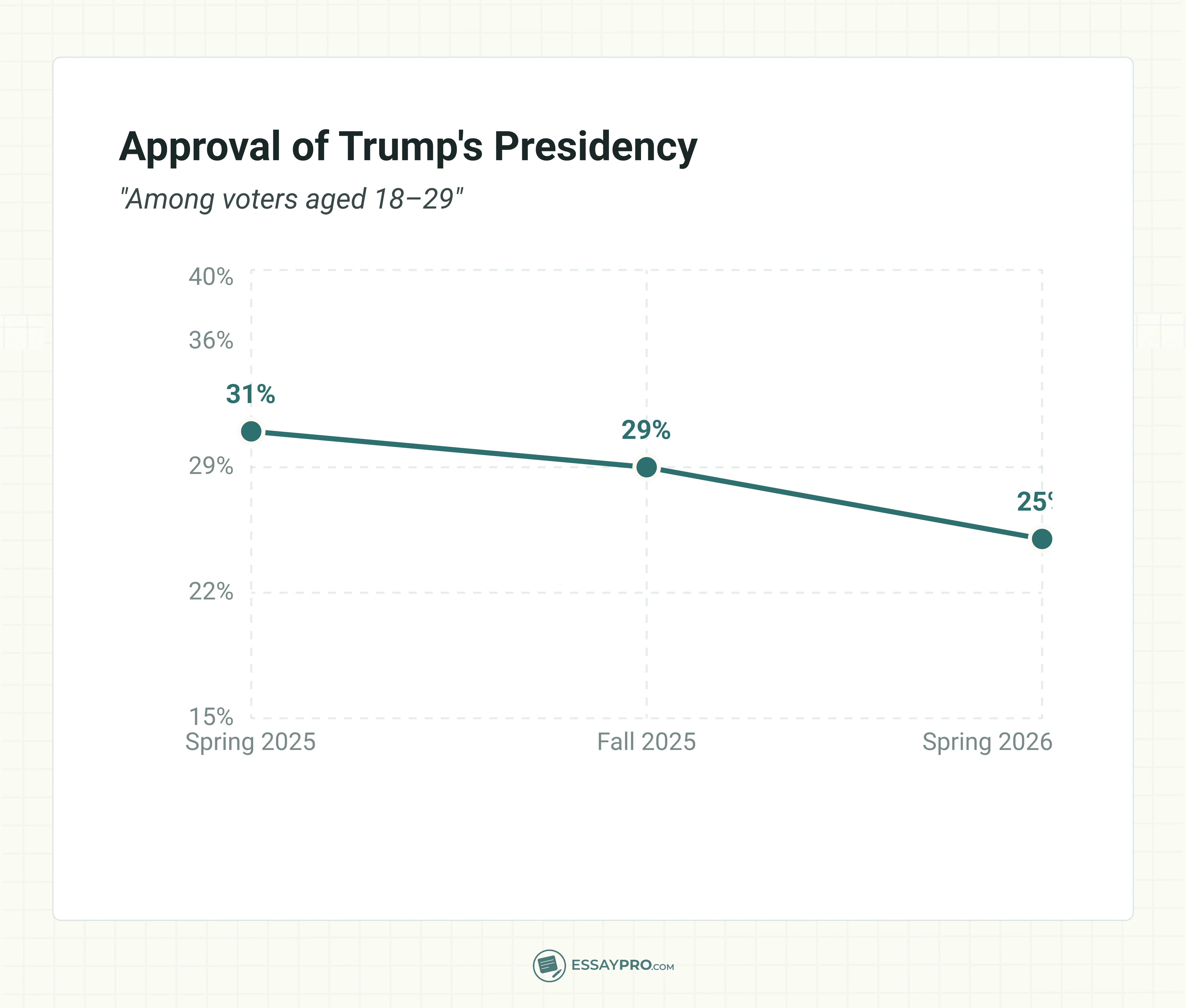
- Only 25% of young Americans approve of President Trump, 16 points below Biden's 41% at the same stage in 2022.
- Inflation hits 50% of young Americans "a lot" ad housing 41%, making the cost of living their defining crisis.
- Democrats lead the generic ballot 45% to 26% among registered young voters, yet only 33% trust the 2026 elections will be fair.
The politics of Americans under 3000 has shifted dramatically over the past four years. This generation looked one way in 2022 and looks strikingly different in 2026, and the numbers tell the story. The direction is stark.
Trust in the federal government has fallen to 15%, the lowest level on record. Half of young Americans now say people like them have no real say in what the government does. Only 13% believe the country is headed the right way, and 59% say it is off track. Hope about the country's future has dropped to 26%. The article below breaks the shift down, finding by finding, with the hard data behind each one.
1. Democrats hold a commanding lead among young voters; faith in elections and enthusiasm stay low
Young Americans still tilt heavily toward Democrats, and that preference has held firm across four years. What has changed is their belief that showing up will matter. The Gen Z voting statistics tell a two-part story: a generation that leans left, and a generation unsure whether the process is worth its trust.
- Democrats lead the generic congressional ballot 36% to 22% overall, and 45% to 26% among registered young voters. The margin reaches +49 among Black voters and +29 among Hispanic voters.
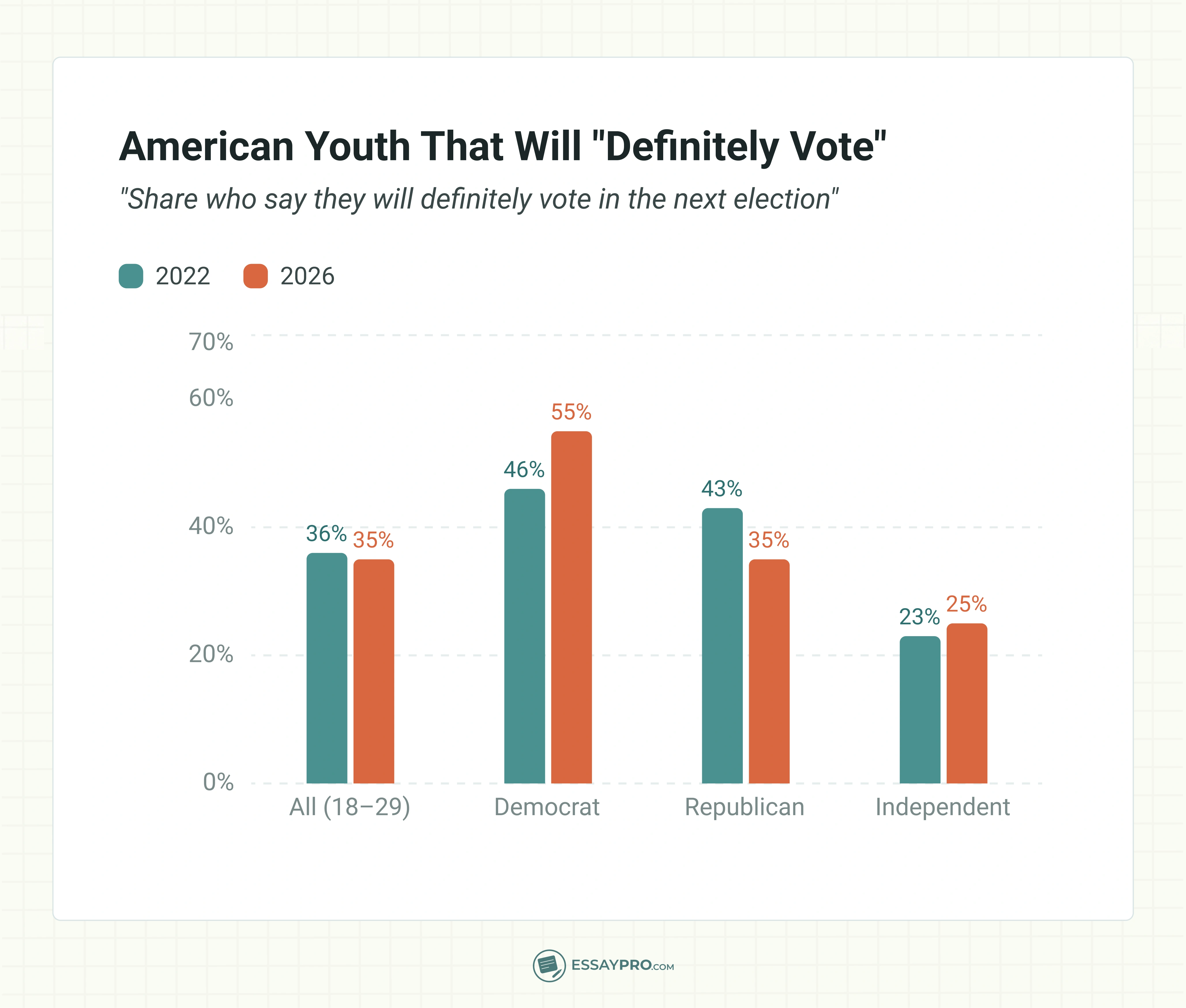
- Youth voter turnout statistics look steady. 35% say they will "definitely" vote in 2026, close to the 36% who said the same before the 2022 midterms.
- The partisan gap is wide. 55% of Democrats plan to definitely vote, against 35% of Republicans and 25% of independents.
- Trust in the process is thin. Only 33% believe the 2026 elections will be run fairly, while 43% do not, and 21% are unsure.
- Enthusiasm barely registers. Just 12% say they feel motivated and ready to participate, and 26% of Democrats plus 30% of independents describe themselves as cynical.
- Congressional approval hardly separates the two parties: 26% for Democrats, 25% for Republicans.
2. Just 25% of young Americans approve of President Trump; confidence in the country's direction stays near the floor
Four years ago, President Biden drew 41% approval among young Americans. The current occupant of the office does considerably worse, and this age group's reading on the country has soured further since then.
- 25% of young Americans approve of President Trump's job performance. The number was 29% in Fall 2025, and it matches the 25% he held at the same stage in 2018.
- Biden's approval among the same age group was 41% in 2022, so the presidential figure has dropped 16 points across the two cycles.
- Only 13% say the United States is headed in the right direction. 59% call it off track, worse than the 49% who said so in 2022.
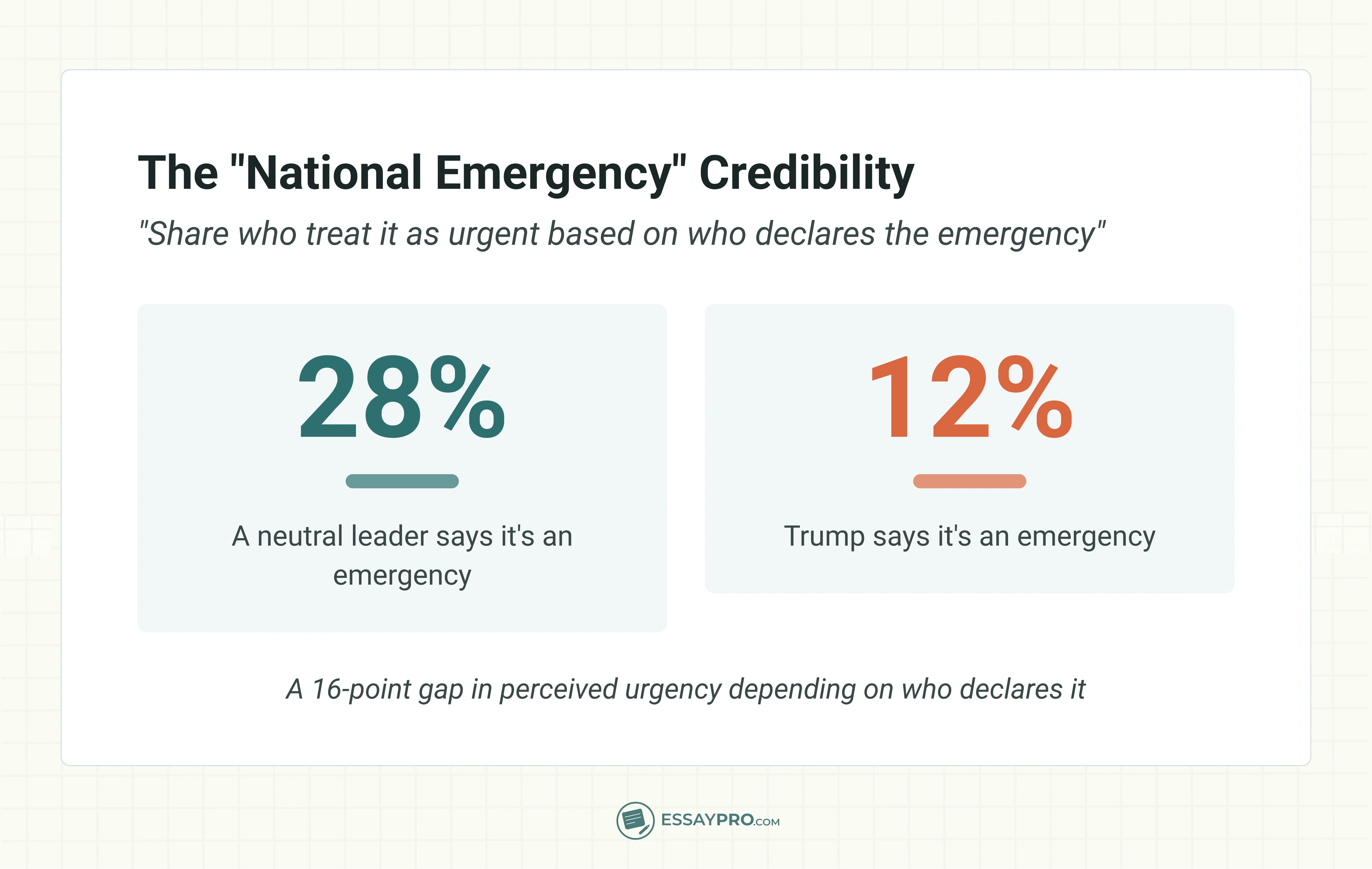
- The president's label lands with skepticism. When Trump calls something a national emergency, 12% treat it as an urgent crisis. When a neutral national leader says it, 28% do.
- 39% say a national emergency declaration from Trump is mostly a political exaggeration. 23% say the same about a neutral leader.
3. Young Americans see both parties serving elites over people like them, and they want younger candidates who share their values
Neither party comes across as being on the side of young people, and for Republicans, the numbers have moved in one direction. The current Gen Z political views show that both major parties are perceived as protectors of the elite. Beyond that frustration, this generation has a specific fix in mind.
- Young Americans say the Republican Party cares more about elites than people like them by a 41-point gap. In 2022, that gap was 30 points, so the disconnect has grown.
- The Democratic gap held steady at 11 points across both cycles. That beats the Republican number, and it is still a deficit.
- The ideal age for a congressional candidate, in the eyes of young Americans, is just 39. That runs well under the current age of Congress.
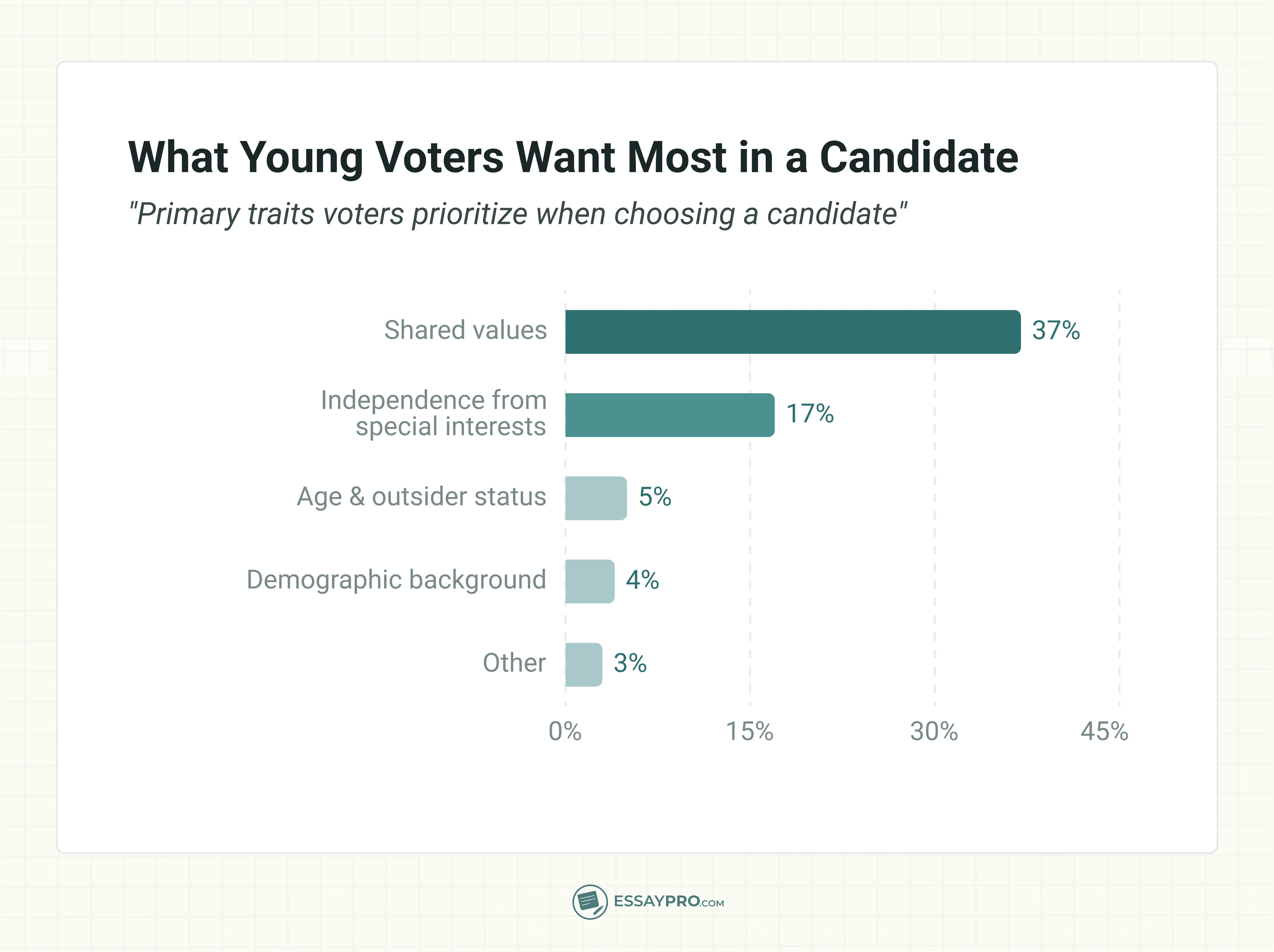
- Shared values top the list of what young voters want. 37% name a candidate who reflects their values as the single most important trait.
- Independence from special interests comes second at 17%. Every other attribute tested lands at 5% or lower, and that list covers age, outsider status, and demographic background.
4. Most young Americans feel safe day to day; women report far less safety after dark, and many fear ICE enforcement nearby
Young Americans political opinions split safety into two pictures. Most feel fine in their own neighborhoods. The national outlook looks shakier. The sexes do not read the situation the same way.
- 85% of young Americans feel safe in their community during the day, and 66% feel safe at night.
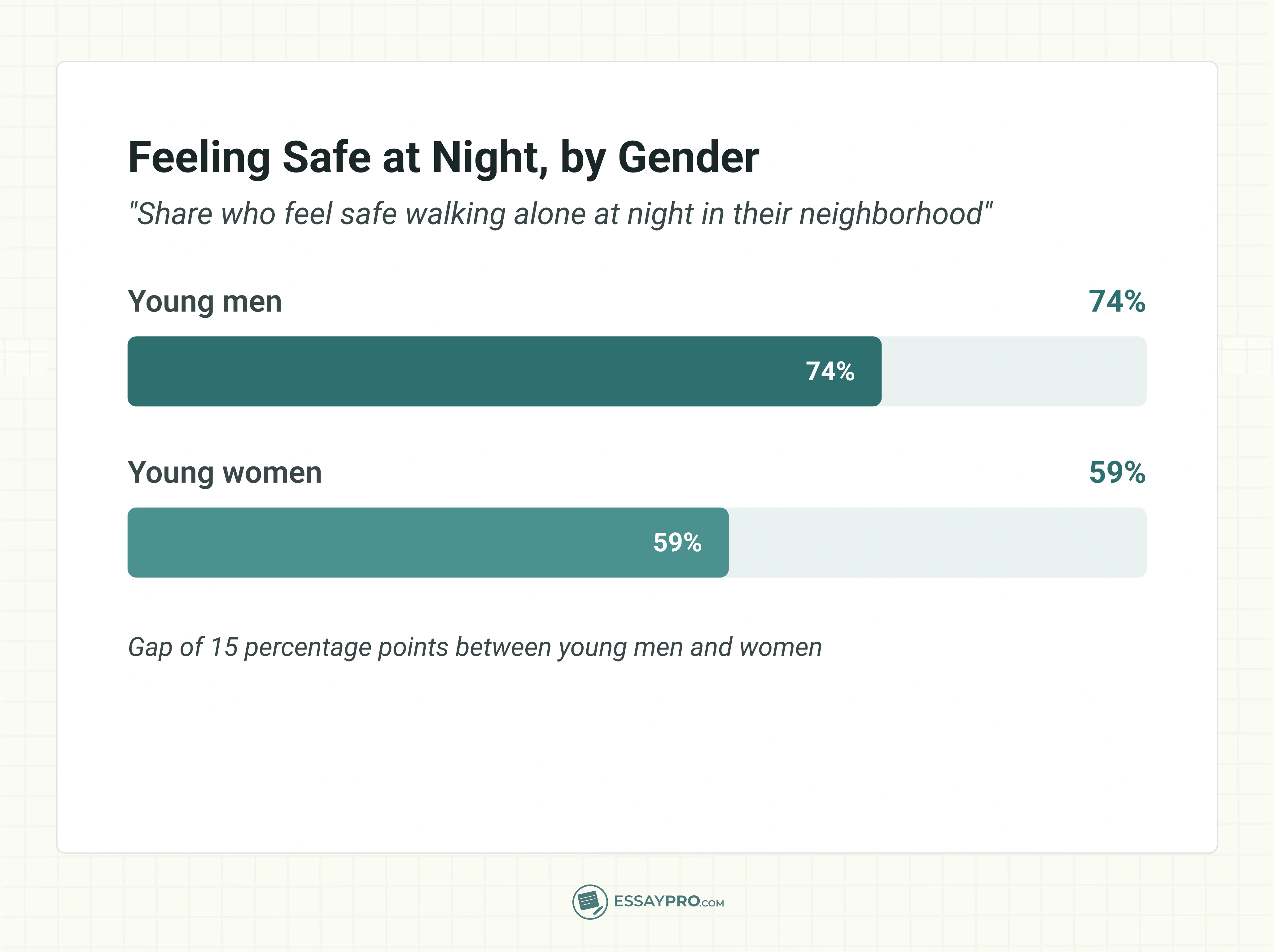
- The gender gap is widest after dark. 74% of young men feel safe at night, against 59% of young women.
- Views of the country run darker. 38% say the United States is becoming less safe, 10% say safer, and 35% say about the same.
- Immigration enforcement worries a large share. By better than three to one, young Americans say regular ICE actions in their community would make them feel less safe (47%), against the 13% who say safer.
- The concern crosses racial lines. 44% of white, 44% of Black, and 50% of Hispanic young Americans say ICE enforcement would make their communities feel less safe.
5. Economic pressure is the defining crisis for young Americans, led by inflation (50% hit "a lot") and housing (41%)
Money worries sit at the center of how young Americans read the country right now. The cost-of-living pressure outranks every other concern tested, both as a personal burden and as a national emergency.
- Inflation affects 50% of young Americans "a lot," and 46% call rising prices an urgent national crisis. Housing affects 41% "a lot," and 40% label it an urgent crisis.
- 45% say they are struggling to make ends meet (10%) or getting by with little financial security (35%).
- Money strain runs deeper for those without a college pathway. 57% of young Americans not in college and without a degree report financial vulnerability, and 52% of that group say they are struggling or just getting by.
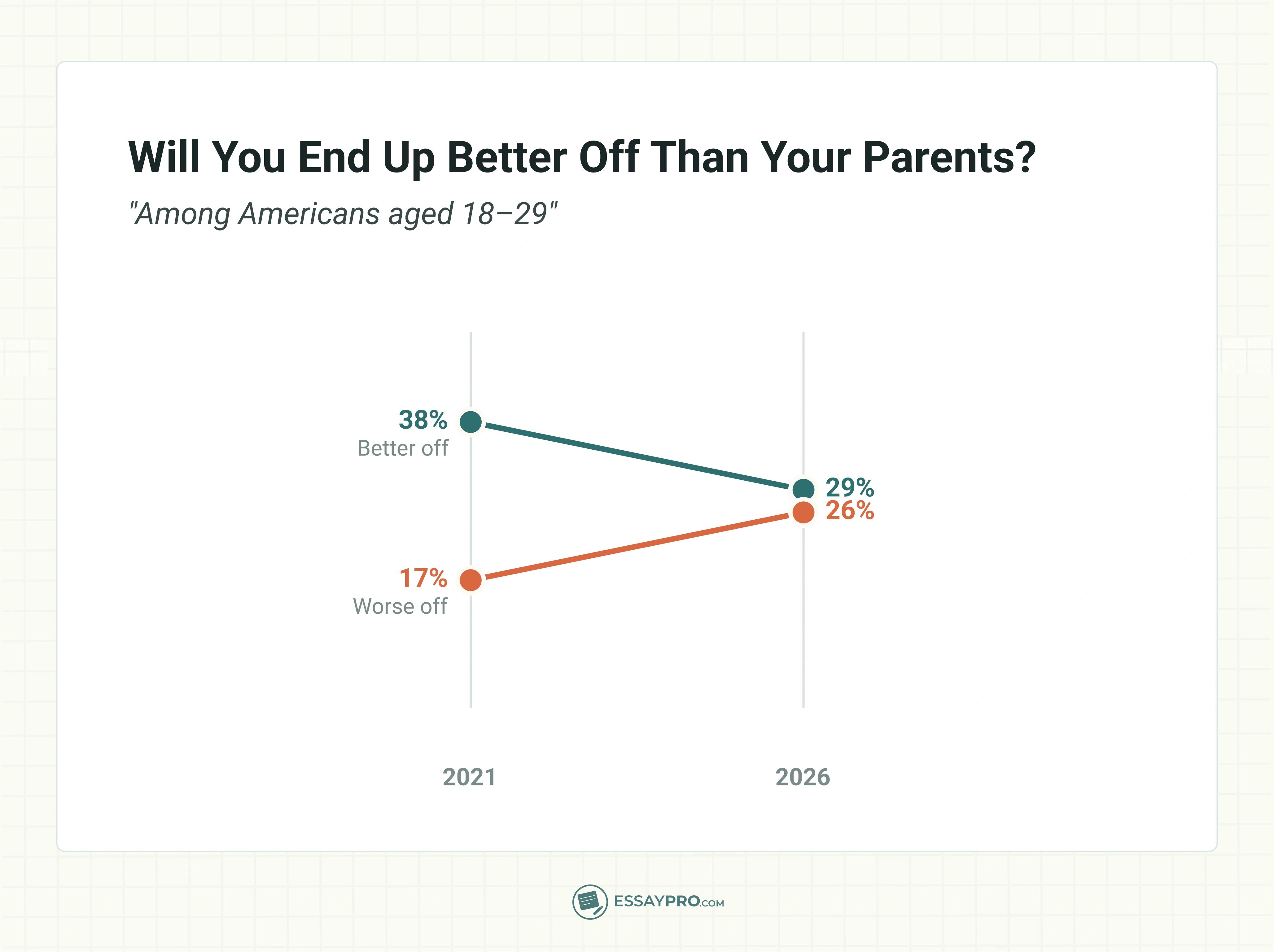
- Long-term optimism has thinned. In 2021, 38% expected to end up better off than their parents and 17% expected worse, a +21-point margin. Today, 29% say better off, and 26% say worse off, a +3-point margin.
- Health care affects 52% at least somewhat, 29% "a lot," and 38% see it as an urgent national crisis.
6. A majority (55%) say military action in Iran is not in the country's best interest, and most fear it will reach them
Young Americans read the Iran conflict as a personal risk more than a protective move, which records deep skepticism about U.S. involvement and broad worry about what comes next.
- 55% say military action in Iran is not in the best interest of the American people. 18% say it is, and 24% are unsure.
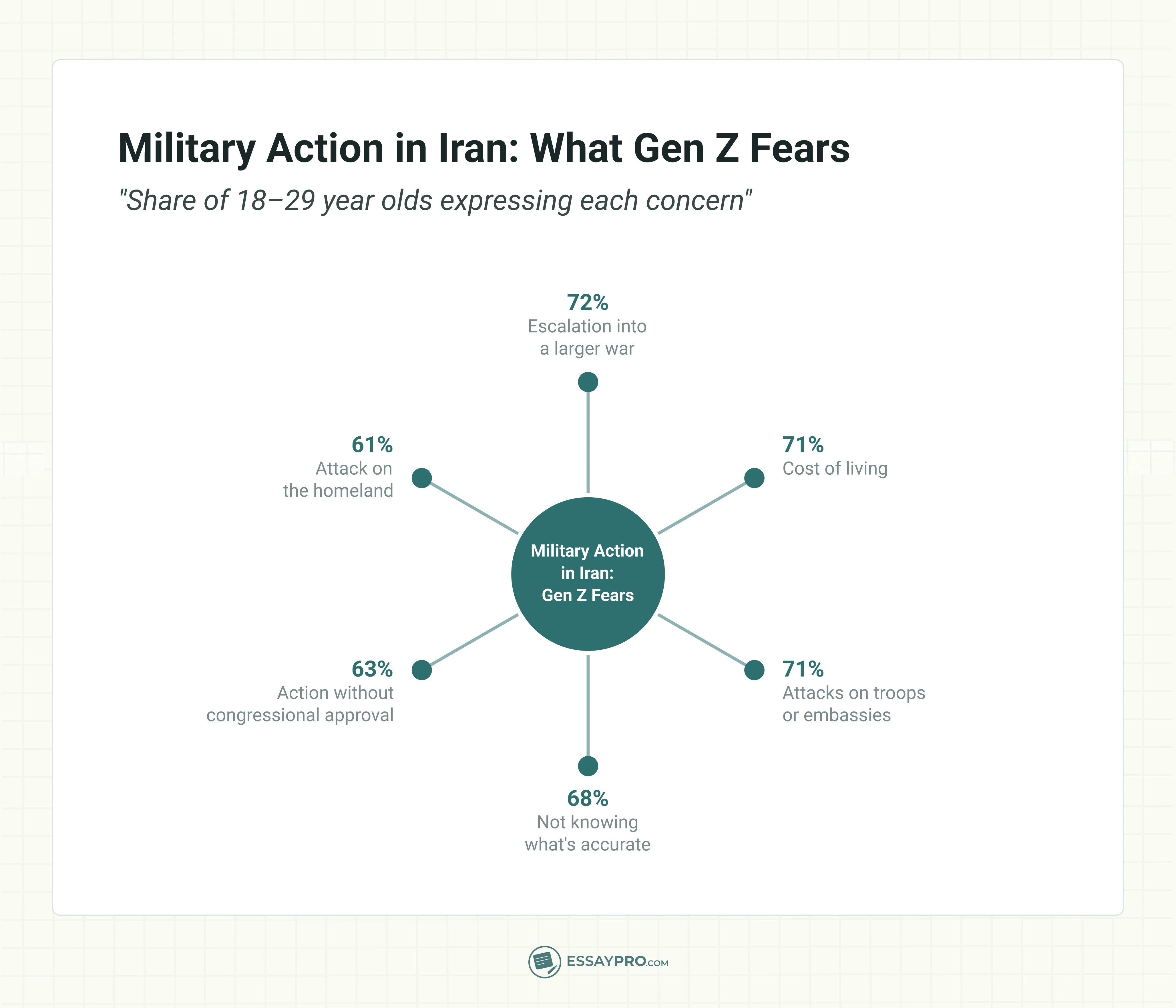
- 72% worry the conflict could escalate into a much larger war.
- 71% are concerned about the effect on the cost of living, and another 71% fear attacks on U.S. troops, embassies, or interests.
- 68% worry about not knowing what information is accurate, and 63% are uneasy about action taken without congressional approval. 61% fear a direct attack on the U.S. homeland.
- 55% still view Iran as a threat to America, a figure unchanged since 2017. That puts it near Russia (59%), China (54%), and North Korea (51%). Only international terrorist organizations (67%) and drug cartels (69%) rank higher as threats.
- 36% call the U.S. military actions in Iran an urgent crisis, and 21% call them serious but short of an emergency.
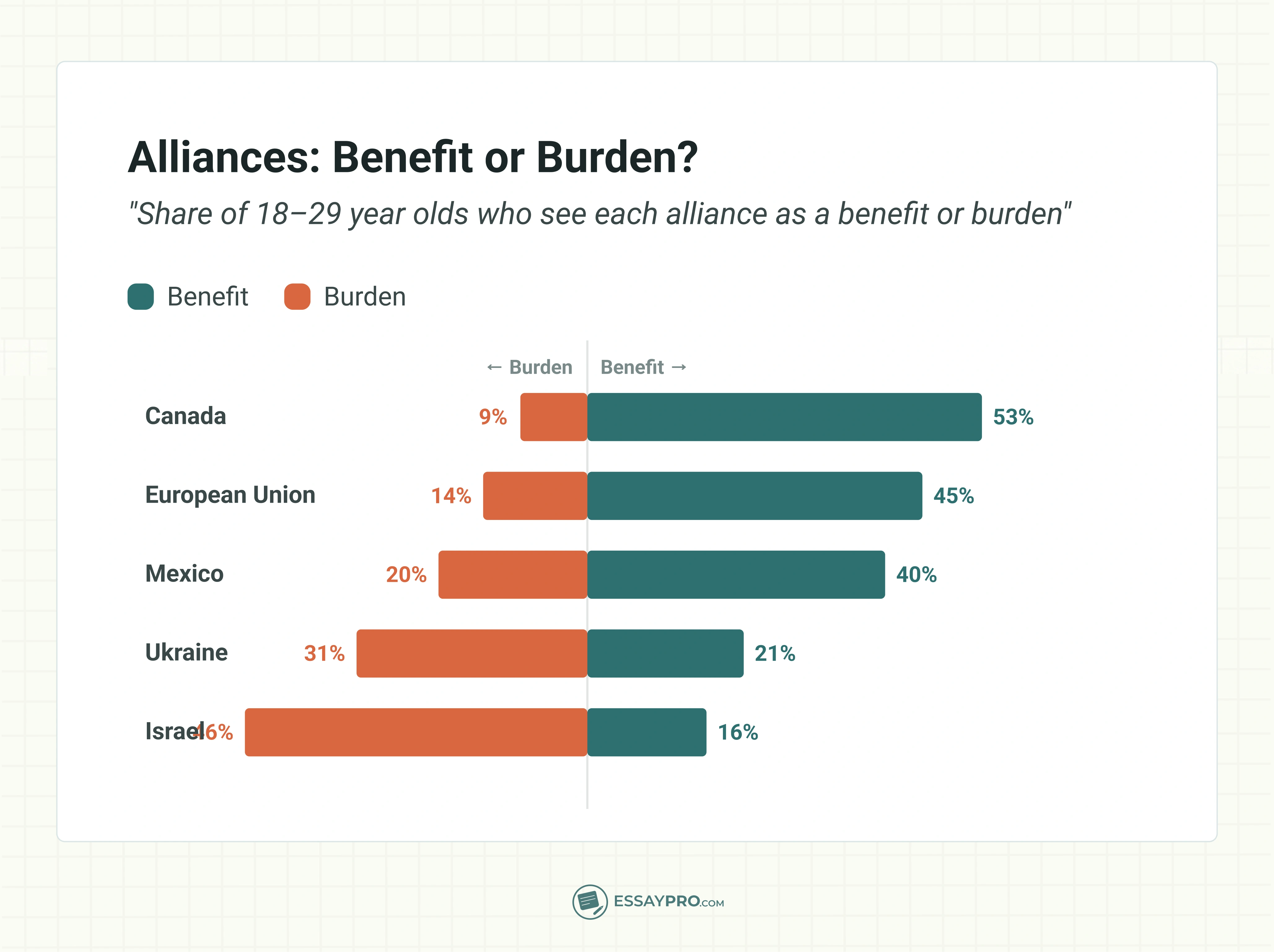
7. Young Americans draw sharp lines on alliances: Canada a clear benefit (+44), Israel a clear burden (–30)
Not every partnership reads the same way to this age group. Neighbors and economic partners are viewed as assets, while relationships tied to active conflict are marked as costs.
- Canada reads as a net benefit by +44 points, with 53% calling it a benefit and 9% a burden.
- The European Union comes out positive as well, 45% benefit against 14% burden.
- Mexico lands as a net benefit, 40% benefit, and 20% burden.
- Israel reads as a burden, 16% benefit against 46% burden, a net –30 points.
- Ukraine also registers as a net burden, 21% benefit and 31% burden.
- The distance between the ends of the list is wide. Canada registers +44 as a benefit while Israel registers -30 as a burden, a gap that shows how differently young Americans weigh these ties.
8. Young Americans reject expanding presidential power, even in a declared emergency
This generation sets firm limits on executive authority, and the limits hold across several tests.
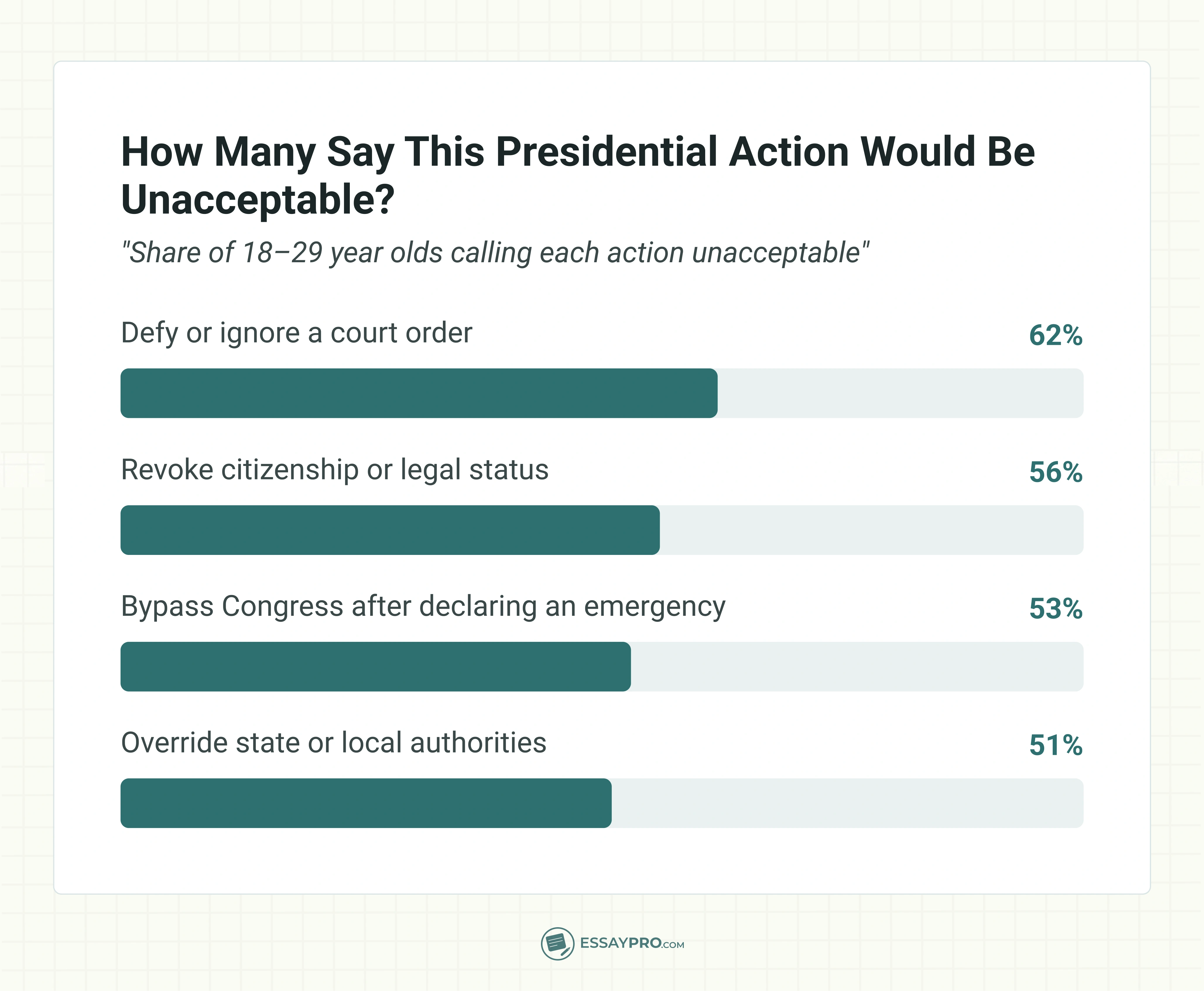
- 53% say it would be unacceptable for a president to bypass Congress after declaring a national emergency. 22% say such action would be acceptable, and 20% are unsure.
- Party splits run through that number. Among those who find bypassing Congress acceptable, the figure is 11% of Democrats, 40% of Republicans, and 19% of independents.
- 62% say it would be unacceptable for a president to defy or ignore a court order.
- 56% say revoking a person's citizenship or legal status during a national emergency would be unacceptable.
- 51% say overriding decisions made by state or local authorities would be unacceptable.
- The pattern points one way across every test: majorities of young Americans want checks on the office rather than a freer hand.
9. Trust in the federal government hits a record-low 15%, and half of young Americans say people like them have no say
2026 shows the lowest government-trust figure in the project's history, alongside a steep drop in hope.
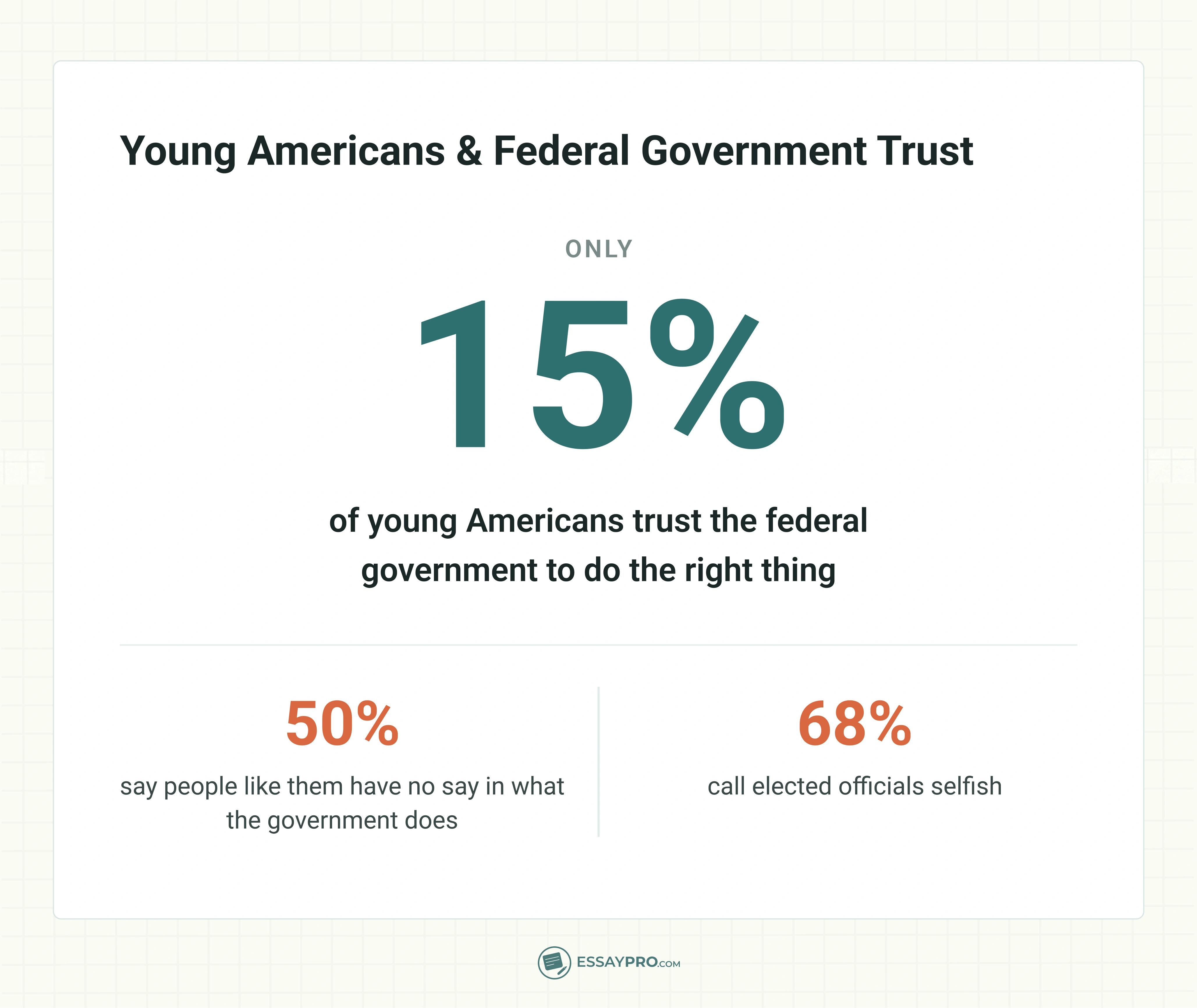
- 50% of young Americans agree that people like them have no say in what the government does, up 15 points since 2017.
- The sentiment reaches across the aisle: 53% of Democrats, 52% of independents, and 48% of Republicans feel voiceless.
- Only 15% trust the federal government to do the right thing all or most of the time, the lowest level recorded.
- 68% say elected officials are motivated by selfish reasons. The share who strongly agree was 26% in 2017 and stands at 39% today.
- Hope about the country's future is 26%. In 2021, it was 55%. Among young Democrats, the figure was 78% five years ago and is 12% now. Among young Republicans, it was 67% a year ago and is 57% now.
10. Young Americans apply the "national emergency" label sparingly, saving it for economic pressure and reading other issues as serious concerns or political spin
The word "emergency" does heavy lifting in politics, and young Americans do not hand it out freely. Section 2 above covered the credibility gap on this exact language, and what the rest of the findings add is a map of which problems earn the term in young Americans' eyes and which ones get waved off.
- Inflation and housing are the only issues that large shares of young Americans call urgent national crises, at 46% and 40%. Both figures appear in section 5 above and are noted here only to mark the top of the scale.
- Climate change registers as a serious issue at 35%.
- Drug use, particularly fentanyl, comes in at 31% on that same serious-issue measure, and crime at 25%.
- Immigration reads differently. At 27%, it ranks among the issues most often dismissed as political exaggeration rather than a genuine crisis.
11. LGBTQ youth face steep mental health disparities and persistent anti-LGBTQ hate crimes
Young LGBTQ Americans report some of the sharpest mental health strains of any group, and the gap between them and their peers is wide. That strain shows up in safety data too, where anti-LGBTQ bias remains one of the most common motives for hate crimes in the country.
- 3.3% of U.S. high school students identify as transgender and 2.2% as questioning, the first nationally representative estimate of its kind, per the CDC's 2023 Youth Risk Behavior Survey.
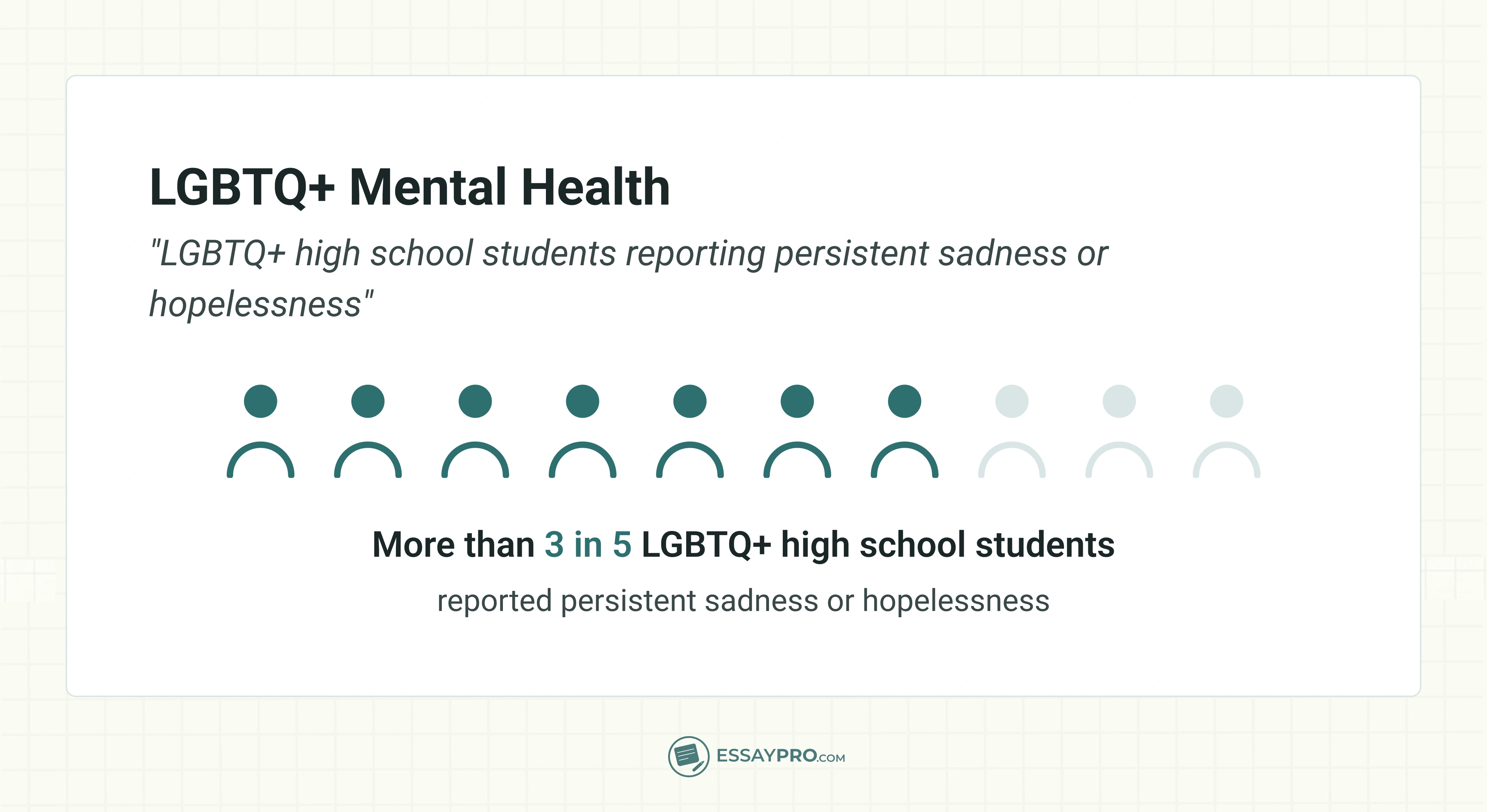
- More than three in five LGBTQ+ students reported persistent sadness or hopelessness, and over 40% seriously considered suicide.
- Transgender students reported persistent sadness at 71.9% and questioning students at 68.9%, well above the 26% among cisgender male students.
- The FBI's 2024 hate crime report counted 2,413 single-bias anti-LGBTQ incidents, keeping sexual orientation and gender identity among the most common bias categories nationwide.
- Attacks tied to sexual orientation alone made up 17.2% of all hate crimes, according to the Human Rights Campaign's read of that data.
12. K-12 achievement stays near historic lows, with no full rebound from pandemic losses
The country's own yardstick for student learning shows a system still stuck well below where it stood before 2020. Reading has slipped further, math has mostly flattened, and the lowest-performing students have fallen the hardest. The results help explain why so few young Americans express confidence in public schools.
- Reading scores for 4th and 8th graders landed 5 points below their 2019 levels, according to the 2024 Nation's Report Card.
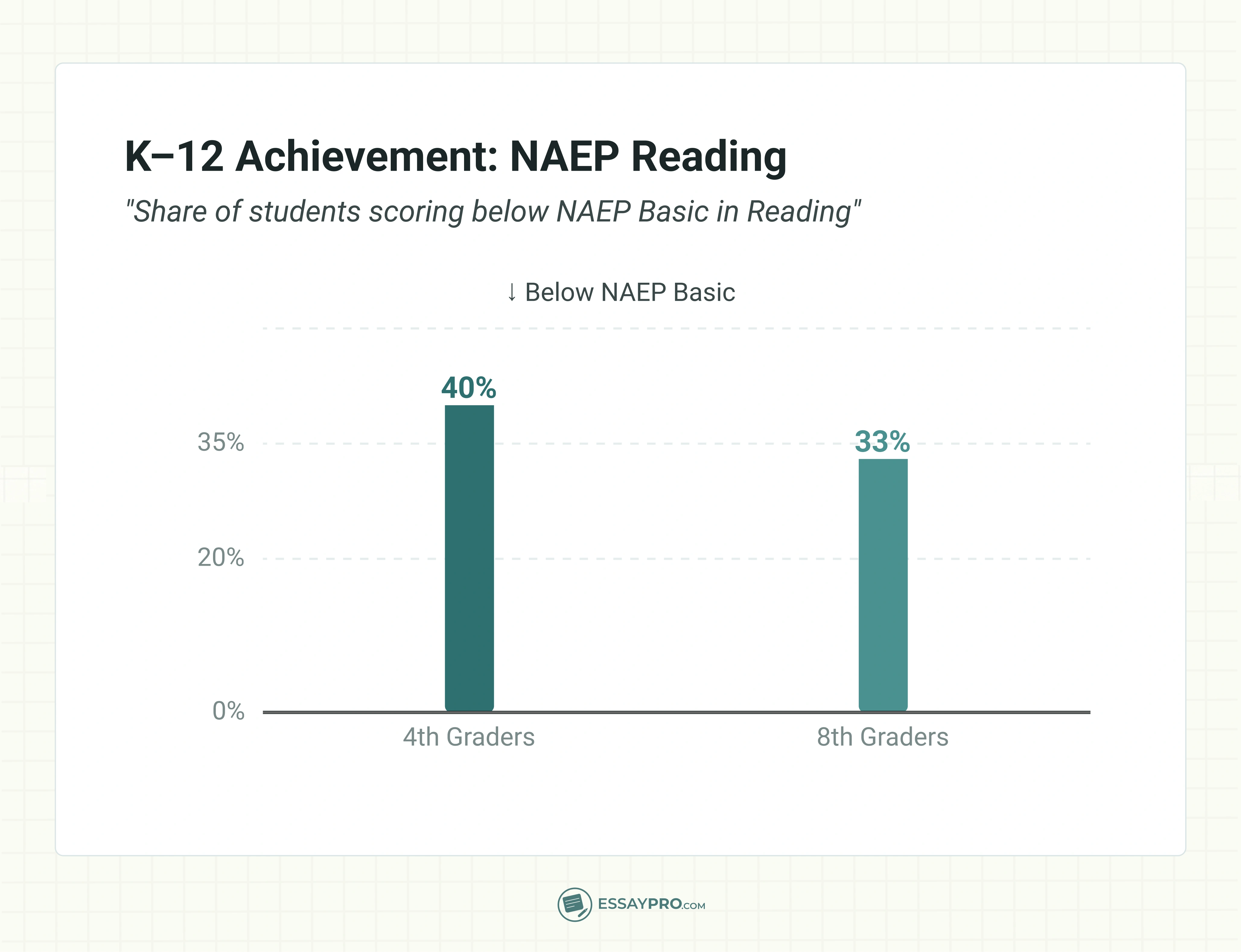
- About 40% of 4th graders scored below the NAEP Basic level in reading, the largest share since 2002.
- Roughly a third of 8th graders also fell below NAEP Basic in reading, the largest share ever recorded.
- Average 12th-grade scores in math and reading dropped to the lowest levels ever reported, every 3 points under 2019, per results released in September 2025.
- One bright spot showed up in 4th-grade math, which rose 2 points over 2022, with nearly 40% of students reaching proficiency.
13. Youth mental health stays under strain, with 40% of high schoolers reporting persistent sadness
The mental health picture for young Americans has eased slightly off its pandemic peak, though it remains far above where it stood a decade ago. Girls and several racial groups report the steepest burden. The national numbers describe high schoolers rather than the 18-to-29 group, so they read as context on the same crisis.
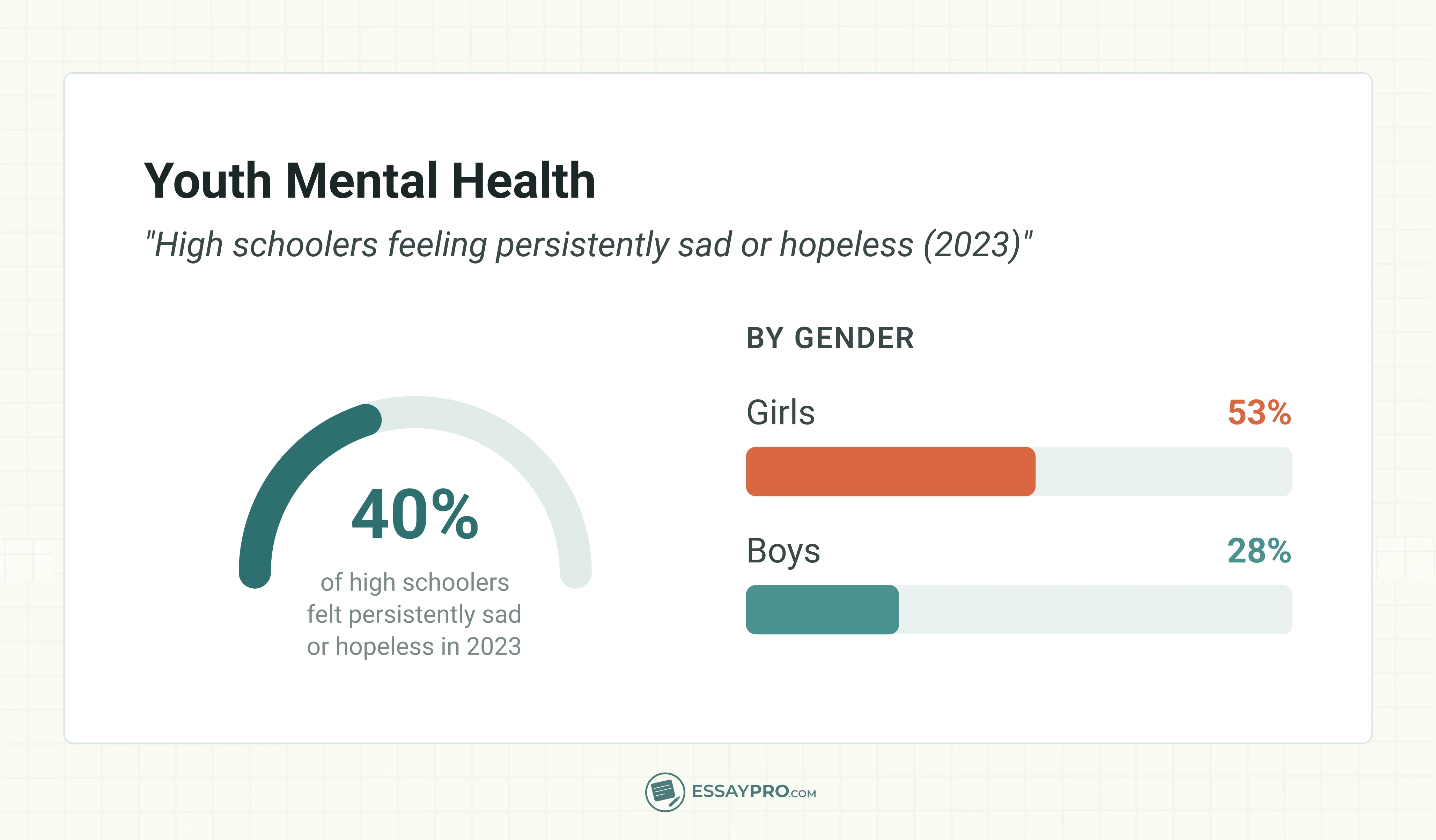
- 39.7% of high school students felt persistently sad or hopeless in 2023, according to the CDC's Youth Risk Behavior Survey.
- That figure marks a slight improvement over the 2021 peak of 42%.
- 28.5% reported poor mental health, 20.4% seriously considered suicide, and 9.5% attempted it.
- Female students reported persistent sadness at 53% and male students at 28%.
- American Indian and Alaska Native youth reported the highest rates of persistent sadness and suicidal thoughts among all racial and ethnic groups.


Ana Ratishvili
Ana is a professional literary writer with a Master’s Degree in English literature. Through critical analysis and an understanding of storytelling techniques, she can craft insightful guides on how to write literary analysis essays and their structures so students can improve their writing skills.