

Thesis and dissertation are each terms used to describe large academic documents presenting the author's original research. While the terms are closely related and often confused, they are not synonymous. One reason students and academics confuse these terms is the differences in nomenclature across countries. For example, what one country may refer to as a "thesis," another may call a dissertation. Additionally, the specific names used for these projects can vary between universities in the same country. In this article, we will discuss the difference between a thesis and a dissertation. We will also touch on how these terms are used differently around the world, and what each project actually entails.
Thesis and dissertation: How the terms change depending on location
Most of the confusion stems from differing conventions between American universities and those in other countries, particularly the United Kingdom, as Grand Canyon University's breakdown of US vs. UK terminology explains.. However, even among universities that do follow these norms, there are always exceptions that further confuse matters. Both a thesis and a dissertation are meant to be pieces of original research.
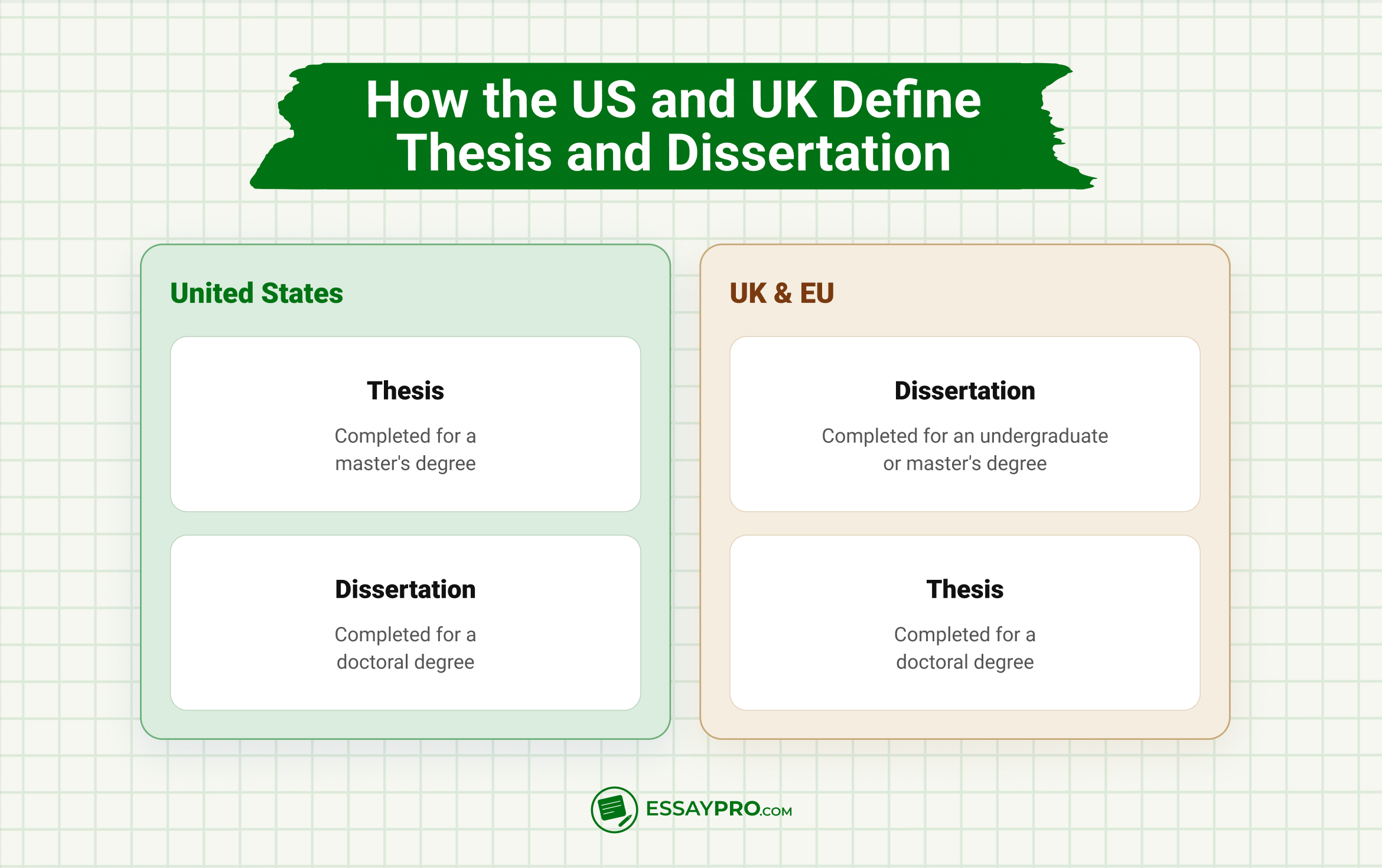
- In the United States: A thesis is typically completed at the master's level, whereas a dissertation is completed at the doctoral level.
- In the UK and much of the rest of the world: The definition is reversed. A dissertation refers to a project completed at the undergraduate or master's level, while a thesis refers solely to doctoral-level work.
So when a British master's student completes a dissertation, they are essentially completing the same type of project that an American master's student would call a thesis.
Why generalizations don't always hold
Of course, you will find American universities that just don't follow these guidelines, as well as universities in the UK that do refer to their doctoral projects as dissertations (among other variations).
- Skip the generalizations: The easiest way to avoid confusion regarding PhD thesis vs dissertation is to never make generalizations.
- Check your own program: Simply consult your university's guidelines or program handbook, or ask your academic advisor.
- Confirm the specifics: They will be able to tell you how your own project will be referred to, as well as provide you with information on length, formatting, and any other requirements that may apply.
Students working on large graduate projects can request ‘write my dissertation’ to manage research, writing, and editing.

Better Drafts Start Here
Turn rough notes into a focused, well-organized paper with help from real writers!

What is a dissertation?
A dissertation is a comprehensive research project that is completed in order to receive a doctoral degree. A dissertation requires you to make an original contribution to your academic discipline. This doesn't mean you can just summarize what's already known about a topic. It means you'll be creating information, data, analysis, or insights that were not known before you conducted your research.
Dissertations take years to complete and require you to work closely with both a faculty adviser and a dissertation committee. After you've completed your research, you'll sit down with the dissertation committee and defend your work. You'll be asked questions about many facets of your project and will need to defend your process and findings. Often, dissertations lead to conference presentations, peer-reviewed journal articles, and grant funding down the road.
Why it matters
A dissertation exists to prove you can conduct independent research from start to finish, without relying on a professor to guide every step. It demonstrates critical thinking at the highest academic level, requiring you to identify gaps in existing knowledge, design a rigorous methodology, and defend your conclusions under scrutiny. Ultimately, its purpose is to advance the field itself, adding something genuinely new to what's already known.
What is a thesis?
A thesis is the final research project completed to graduate from your master's program. It is typically the most challenging academic assignment in your career up to that point. Though much shorter and less expansive when comparing a PhD dissertation to a thesis, your thesis still requires significant time, academic rigor, and original thought. Typically, it involves a literature review that highlights what is already known about your chosen topic and previous research. You will then provide additional research, analyze research, or argue a point, depending on your specific program's guidelines. Some programs require you to conduct primary research and draw original conclusions from your data, whether through surveys, interviews, or experiments. Other programs allow you to focus on digesting and reinterpreting previous research and sources. As with a dissertation, your thesis typically concludes with a defense. During this portion of your requirements, you will share your research in front of a committee of faculty members and answer questions about your methods, sources, and findings.
Why it matters
A thesis exists to demonstrate that you've mastered your field's core concepts and can apply them through structured, independent research. It shows you can synthesize existing knowledge, form a coherent argument, and support it with evidence, skills that prepare you for either professional work or further doctoral study.
If you're completing a master's degree, you may also look for ‘write my thesis paper for me’ assistance with drafting or revisions.
Difference between thesis and dissertation
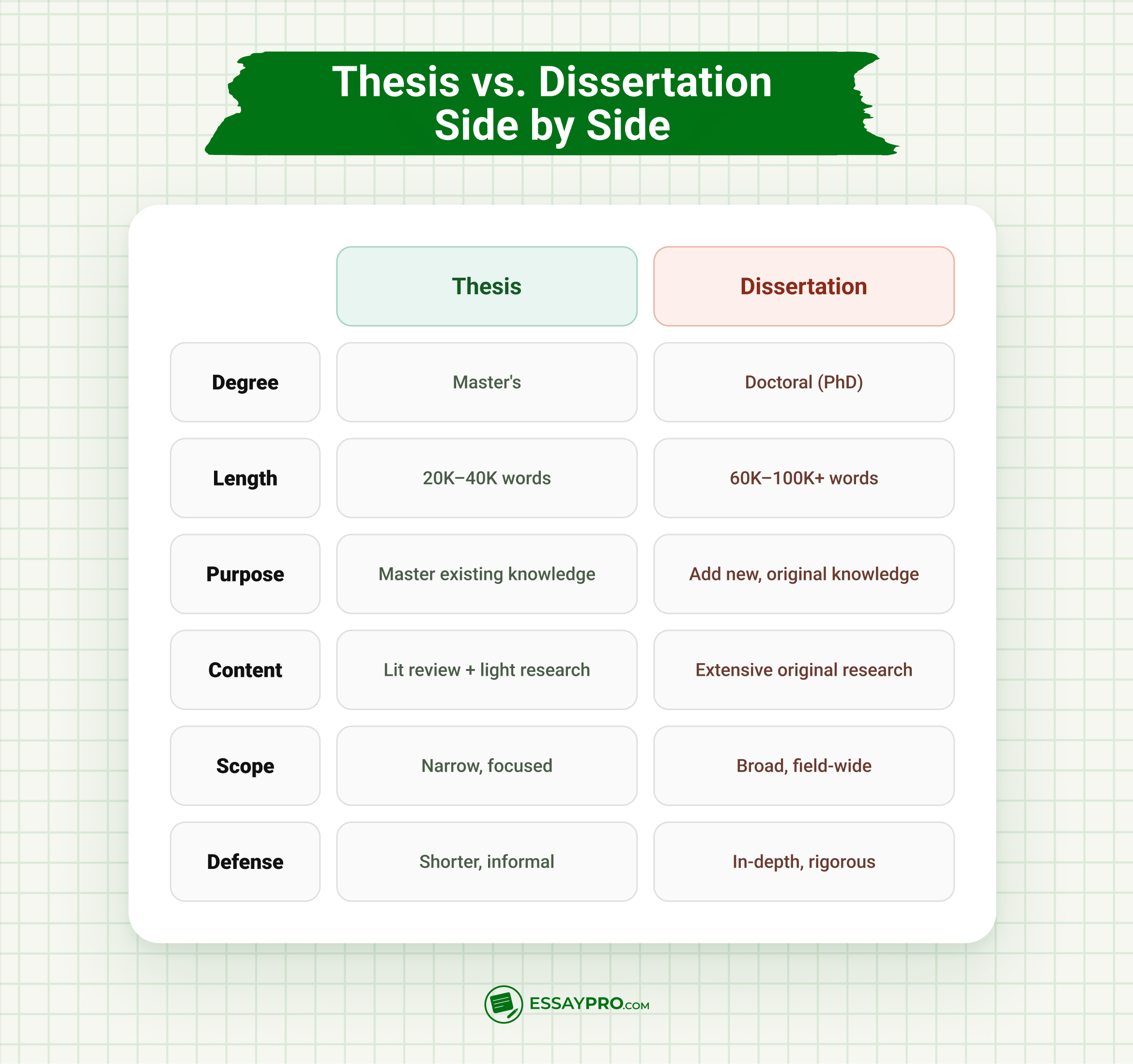
Having seen what each project entails on its own, it should now be much easier to spot the differences between dissertation vs thesis. They come down to five key areas: purpose, content, scope, structure, and length. Each is influenced by the fact that a thesis is completed for a master’s program, while a dissertation is completed for a doctorate.
Thesis and dissertation: what they have in common
Despite the differences in scope and length, a thesis and dissertation share more common ground than people often assume. Both projects represent significant academic milestones and follow a similar underlying logic, even though they are at different degree levels.
- Final project status: Both serve as the capstone requirement for their respective degrees, meaning you can't graduate without completing and defending one.
- Research depth: Both demand a genuine investigation into a specific question, going beyond a surface-level summary of existing material.
- Ethical standards: Both require strict adherence to research ethics, including proper data handling, informed consent when human subjects are involved, and transparency in methodology.
- Plagiarism standards: Both are held to the same academic integrity expectations, with original work and properly cited sources required throughout.
- Analytical rigor: Both require you to build a coherent argument supported by evidence, not just present information without interpretation or synthesis.
- Editing process: Both undergo multiple rounds of revision, receive feedback from an advisor or committee, and undergo formal proofreading before final submission.
- Formal presentation: Both typically require a structured format with clear sections, academic tone, and proper citation style throughout.
- Committee involvement: Both involve oversight from faculty, whether through regular advisor meetings or formal committee review.
Where these projects diverge is in depth and scale, not the underlying standards. A thesis holds you to the same integrity, rigor, and structural expectations as a dissertation; it simply asks for less in scope and length.
Can a thesis become a dissertation?
Not exactly. A thesis is written for one level of degree, and a PhD thesis or dissertation is written for another. Usually, these projects will not be the same even if they focus on the same general topic. However, it is certainly possible that the questions you ask or discover in your master's thesis could lead to an idea that develops into your dissertation topic. You may find something in your thesis that you want to explore more or realize you left a question unanswered. A few years down the road, you may decide to circle back and expand upon your thesis topic with the time, resources, and scope a dissertation requires. Therefore, while you cannot turn in your thesis as your dissertation (or expand upon it directly), you certainly can use it as a foundation.
Choosing the right dissertation topics is one of the most important steps in planning a successful research project.
Thesis and dissertation components
Both a master’s dissertation and thesis share the same core structure, though a thesis version is typically lighter in depth throughout.
- Introduction: Frames the research question and its significance; a thesis version is usually more concise.
- Literature Review: Surveys existing research on the topic; dissertations cover more ground and situate the work more thoroughly within the field.
- Methodology: Explains how the research was conducted; these often use simpler or smaller-scale methods.
- Results: Presents findings from the research; dissertations typically include more extensive data and multiple studies.
- Discussion: Interprets the results; dissertations delve deeper into implications and connections to broader scholarship.
- Conclusion: Summarizes key findings and their significance; both versions wrap up similarly, though dissertations often address future research directions.
- References: Lists all cited sources; dissertations generally cite far more sources, given their broader scope.
- Appendices: Include supplementary material such as raw data or survey instruments; dissertations often include more.
How the dissertation timeline typically unfolds
A doctoral dissertation usually takes two to three years to complete, broken into distinct phases.
- Year one: Centers on literature review and research design, refining your question and building the theoretical framework that will guide everything after.
- Year two: Shifts into data collection and analysis, the most time-intensive phase, where you gather results and begin interpreting what they mean.
- Year three: Focuses on drafting and finalizing chapters, incorporating advisor feedback, and preparing for the final defense.
Timelines vary by field and individual pace, but this general structure holds across most doctoral programs.
Our guide on how to write a dissertation walks you through each stage, from proposal to final submission.
The review and approval process for a dissertation
Before research even begins, most programs require a proposal defense, where you present your planned research question and methodology to a committee for approval. Once the research is complete, drafts go through multiple rounds of review, with your advisor and committee members providing feedback before the work is considered ready.
The final defense follows, where you present your completed findings and answer detailed questions about your methodology, conclusions, and contribution to the field. After a successful defense, the committee formally approves the dissertation, sometimes requiring minor revisions before final sign-off and submission to the university.
Whether you're writing a thesis or a dissertation, mastering writing a thesis statement helps establish a clear research focus.
Better Drafts Start Here
Turn rough notes into a focused, well-organized paper with help from real writers!
Common mistakes students make when choosing between the two
Mixing these two up can lead to some serious consequences, particularly when students assign the wrong expectations to their own project. These are some of the most common errors:
- Believing these terms have the same definition: When students refer to "thesis" and "dissertation" as if they're concrete terms that mean the same thing for everyone, instead of researching what their country/university means when they use them.
- Facing unexpected workload: Thinking you're writing a thesis only to find out partway through that you were actually supposed to conduct years' worth of research for a dissertation.
- Writing a novel no one asked for: Including a dissertation's worth of research in your master's thesis, unnecessarily complicating your work and spending weeks or months beyond what your program requires.
- Neglecting to check with their university: Looking up definitions online instead of double-checking their program's expectations with an advisor or graduate handbook.
- Mismanaging time: Setting deadlines for a thesis as if you have years to work on it, or struggling to finish on time with a dissertation.
Students in business programs can explore business management dissertation topics for ideas on leadership and organizational behavior.
The bottom line
Understanding the difference between a thesis and a dissertation helps graduate students set realistic expectations for scope, timeline, and workload from the start, avoiding confusion that can derail planning and add unnecessary stress later in the program.
FAQs
What is the difference between a thesis and a dissertation?
Is a dissertation the same as a thesis?
Is a thesis harder than a dissertation?
How long does it take to write a dissertation vs. a thesis?

Daniel Parker
is a seasoned educational writer focusing on scholarship guidance, research papers, and various forms of academic essays including reflective and narrative essays. His expertise also extends to detailed case studies. A scholar with a background in English Literature and Education, Daniel’s work on EssayPro blog aims to support students in achieving academic excellence and securing scholarships. His hobbies include reading classic literature and participating in academic forums.