

Cyberattacks are happening every 39 seconds somewhere in the world. That breakneck pace has elevated cybersecurity from a dusty-corner IT niche to both one of this new digital era’s biggest challenges and one of its most important opportunities. Worldwide, the cybersecurity workforce gap has ballooned to 4.8 million open jobs, even as the number of people working in cybersecurity has climbed to 5.5 million. Demand is outstripping supply.
Many students and career-switchers everywhere often wonder ‘is cybersecurity a good career?’. Here’s what you need to know: this is a field that’s quickly growing where skills are valued over credentials and where you can do work that tangibly guards against real-world harm to people, institutions, and entire economies.
Why Cybersecurity Is a Global Priority
Cybersecurity has evolved from a traditional IT issue to one of national and economic security. Statista's Market Insights predicts that cybercrime will cost the world $9.22 trillion in 2024 and will continue to increase to $13.82 trillion by 2028. That's more than many countries' entire economies. Cybercrime is the third-largest "economy" in the world if you consider it as one, behind the United States and China. Individuals, companies, and governments all face consequences as a result of a cyberattack.
Organizations can experience financial loss, business disruption, and reputational damage. If a government institution is breached, national security could be at risk, affecting power grids, voting systems, and more. As we continue to integrate technology into our everyday lives, we open ourselves up to greater risks of identity theft, financial fraud, and invasion of privacy. The World Economic Forum's Global Cybersecurity Outlook 2026 found that skills and expertise were among the most common obstacles to digital resilience across the globe.
Current Cybersecurity Threats and Trends
The threat landscape keeps shifting as attackers adapt faster than defenses can catch up. Several trends define where the risk is concentrated right now.
- Ransomware remains one of the most damaging attack types in active use. According to Verizon's 2025 Data Breach Investigations Report, which analyzed more than 22,000 incidents across 139 countries, ransomware was present in 44% of confirmed breaches, making it one of the single most common breach mechanisms organizations face today.
- AI-assisted cyberattacks are reshaping how quickly and convincingly threats can be launched. The World Economic Forum's Global Cybersecurity Outlook 2026 highlights how AI is simultaneously eroding traditional entry pathways into the profession while expanding the sophistication of attacks defenders must respond to, a dynamic that's forcing security teams to reskill faster than in previous years.
- Vulnerability exploitation continues as attackers move quickly once a weakness is disclosed, often faster than organizations can patch it, especially across legacy systems still running outdated software.
- Third-party and supply-chain risks have become a structural weak point. Breaches originating through vendors, contractors, or software dependencies expose organizations to risk well outside their direct control, a pattern that's grown as businesses rely on increasingly interconnected digital ecosystems.
- Growing dependence on cloud and connected technologies has expanded the attack surface considerably. As more infrastructure, data, and services move to cloud and IoT environments, misconfigurations and unmonitored endpoints have become common entry points for attackers, adding pressure on security teams already stretched thin by the broader workforce shortage.
The Growing Demand for Cybersecurity Professionals
Alongside the rising threat landscape sits a workforce that simply hasn't kept pace, creating one of the more striking supply-demand gaps in the modern job market.
- Cybersecurity workforce shortage remains the field's defining structural problem. According to ISC2's 2024 Cybersecurity Workforce Study, the global workforce gap reached 4.8 million unfilled positions, a 19% year-over-year increase, even as the active global workforce grew to 5.5 million professionals. Demand continues to outpace the supply of qualified candidates entering the field.
- Job growth and employment outlook remains strong despite economic headwinds elsewhere in tech. Indeed Hiring Lab data shows US security job postings sitting at 113.3% of their pre-pandemic baseline, reflecting sustained, above-baseline hiring even as postings have cooled from their 2022 peak.
- Salaries are still relatively high when it comes to cybersecurity, especially for those who continue to develop niche technical skills. For mid-level professionals, salaries tend to jump fairly quickly (looking at a 2-3 year range) as companies are fighting for limited qualified candidates. Especially for those who work in areas related to cloud security, artificial intelligence (AI) based threat detection, and compliance.
.webp)
We're seeing demand span all industries because now more than ever, every company is considered a technology company. Financial services, healthcare, government, manufacturing, critical infrastructure - you name it. Industries are increasing headcount to keep up with growing security needs due to increasing compliance requirements and the fact that every organization is now a target.
Job Titles You’ll See in Cybersecurity
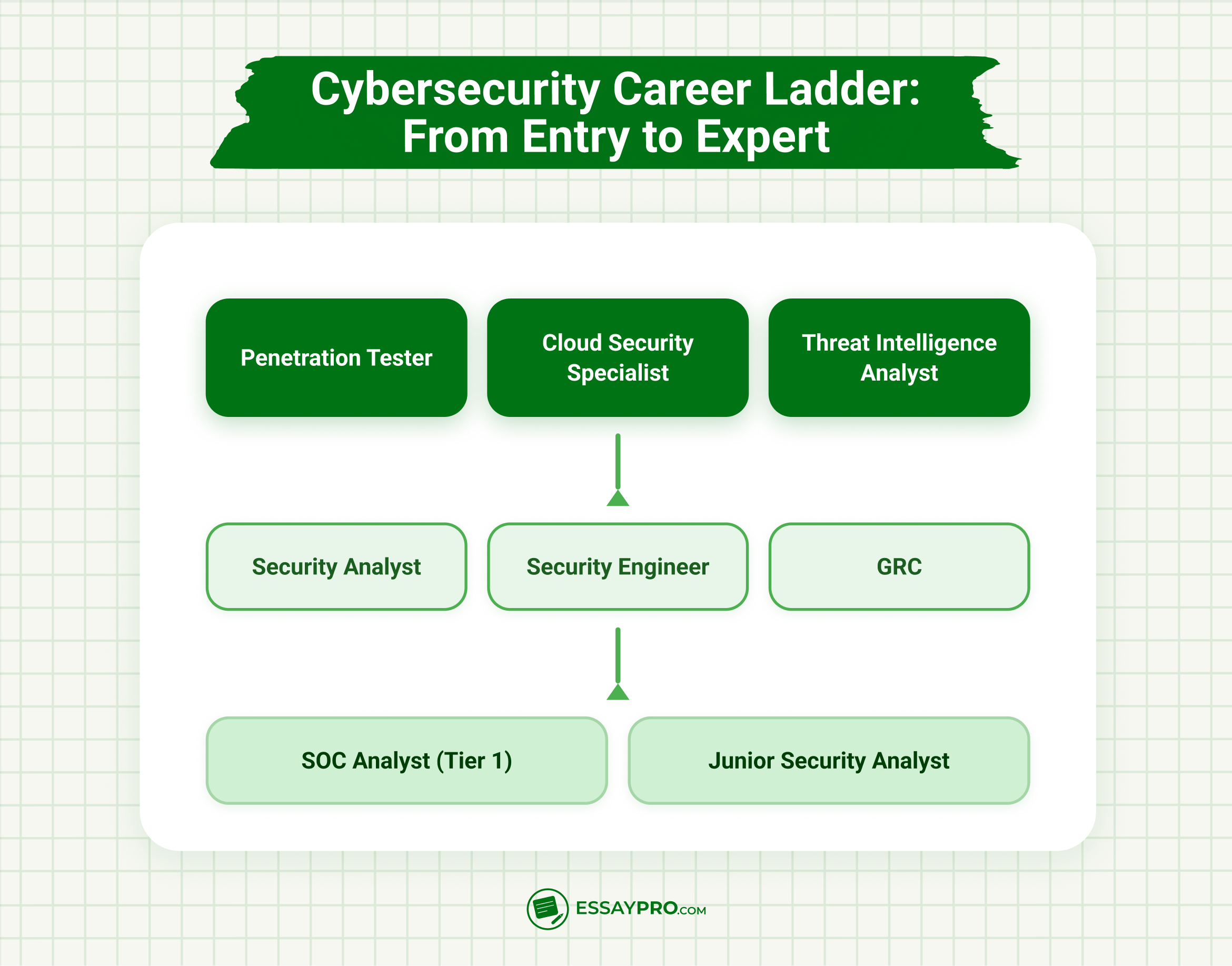
The cybersecurity skills gap also means there are cybersecurity career paths for just about anyone who’s interested in the field. Here are a few examples:
- Cybersecurity Analyst: Security analysts monitor networks for suspicious behavior, respond to warnings, and conduct assessments to provide actionable insight when threats are detected.
- Security Engineer: Security engineers focus on creating and managing the tools that keep networks safe, from firewalls to vulnerability scanning software.
- Penetration Tester: Pen testing is a more aggressive (and lucrative) cybersecurity career path. Pen testers are legally authorized to hack into networks and uncover vulnerabilities that a malicious hacker might exploit.
- Incident Responder: As the name implies, incident responders help remediate advanced attacks that have breached a network. They’ll contain breaches and conduct forensic analysis to discover how the initial attack occurred.
- Cloud Security Specialist: Tasked with securing cloud networks, specialty roles like this have increased 452% in the last 5 years.
- Threat Intelligence Analyst: Threat intelligence analysts work to predict where attacks will occur next by proactively gathering and analyzing information about emerging threats and attacks.
- Governance, Risk, and Compliance (GRC): GRC professionals develop security processes to ensure companies comply with government and industry regulations, such as GDPR, NIS2, and SEC disclosure requirements.
Cybersecurity Opportunities for Gen Z
Cybersecurity stands out as one of the rare tech fields where a traditional four-year degree isn't the only door in, which makes it especially accessible for students and career-changers navigating a shifting job market.
- Degree and non-degree career pathways have genuinely diverged in recent years. A growing share of Gen Z and Millennials are entering the field through bootcamps, college degrees, and personal projects rather than the traditional IT-to-cybersecurity route, and hiring managers increasingly accept both routes as legitimate.
- Certifications, internships, and apprenticeships offer a practical, faster on-ramp. Entry-level credentials like CompTIA Security+ or the ISC2 Certified in Cybersecurity are widely recognized starting points, and cybersecurity internships typically run 10-16 weeks, paying $18-35 per hour, while apprenticeships usually run 12-24 months and combine paid work with formal training.
- Entry-level and feeder roles give newcomers a concrete first step. Positions like SOC Analyst (Tier 1), Junior Security Analyst, and Security Support Technician are common starting points, part of what CISA's NICE Cyber Career Pathways framework organizes into distinct role communities spanning security operations, incident response, and penetration testing.
- Hands-on labs, competitions, and personal projects often matter as much as formal credentials. Building a home lab, participating in Capture the Flag competitions, and documenting projects on GitHub are visible signals of genuine skill that certifications alone don't fully capture.
- Opportunities in AI, cloud security, and emerging technologies are where the field is expanding fastest. Cloud security, AI security, identity management, and zero-trust architecture are expected to remain high-growth specializations, even as basic entry-level monitoring tasks become increasingly automated, pushing newcomers to build deeper analytical skills rather than relying on repetitive tasks alone.
- Technical and soft skills that support long-term career growth go beyond just tools and certifications. Communication ability, translating technical findings into terms non-technical stakeholders can act on, is increasingly cited as a differentiator, alongside a demonstrated pattern of continuous learning as the threat landscape keeps evolving.
Preparing for a Career in Cybersecurity
Approach a cybersecurity career as a multistep process: learn, practice, and prove your knowledge. That will serve you better than trying to obtain one qualification and hoping it will be enough to get hired.
- Build foundational knowledge of IT and security. Some career tracks can be entered without a four-year degree, but professionals still advise learning the basics of networking, operating systems, and general security. Once you’ve built that foundation, you’ll have the context and terminology you need to dive deeper into specific domains.
- Get hands-on experience. The value of practical experience can’t be overstated. Learning how to set up your own lab environment with a used server or virtual machines, or even a Raspberry Pi running security software, will give you experience that you can’t get from books alone. Be sure to document your findings and workflows, so you have something to show future employers.
- Get certified. Earning industry-recognized certifications is one of the most effective ways to show an employer you’re job-ready. There are several entry-level certifications that can help give you that boost, such as CompTIA’s Security+ or ISC2’s Certified in Cybersecurity. Many job postings now specify that applicants need “a bachelor’s degree OR experience and certifications equivalent to a degree.”
- Network with other security professionals. Just as important as gaining experience is letting others know you’re gaining experience. Joining security forums, attending local chapter events or college meetups, entering Capture the Flag competitions, and contributing to open-source projects can help you learn from your peers while also letting hiring managers know you exist. Most entry-level positions are not filled by people who simply submit their resumes.
- Never stop learning. The threats businesses face are constantly evolving, so you should, too. Think of certifications as mile-markers along your career path. Specialties like cloud security and artificial intelligence–based threat detection are growing fields that can set you apart from the competition.
The Future of Cybersecurity
Every indicator points in the same direction: cybersecurity isn't a temporary hiring surge, it's a structural shift in how the world protects its digital infrastructure, one that's only accelerating.
- Continued growth in cyber threats shows no signs of slowing. Global cybercrime costs are projected to climb well past $10 trillion annually in the coming years, and attackers are increasingly using AI to launch faster, more convincing attacks, meaning the volume and sophistication of threats organizations face will keep expanding rather than plateauing.
- The increasing importance of skilled professionals follows directly from that trajectory. As automation takes over repetitive monitoring tasks, the value of professionals who can analyze, investigate, and respond to novel threats keeps rising, and the persistent global workforce gap means qualified candidates remain in a genuinely strong negotiating position for years to come.
- Why cybersecurity offers strong long-term opportunities for Gen Z comes down to a rare combination: high demand, multiple entry pathways that don't require a traditional degree, and a skill set that only grows more valuable as digital infrastructure expands into every corner of daily life. For a generation entering the workforce during a period of real uncertainty in other tech sectors, cybersecurity remains one of the few fields where the barrier to entry is dropping even as the value of the work keeps climbing.
Recap
Cybersecurity is a pressing world need, and a real job opportunity to meet. Attacks are becoming more frequent and more complex. Companies and governments are increasingly left scrambling to respond. Qualified people to manage the response are in high demand but short supply. With routes into the field ranging from degrees to certificates to bootcamps to self-directed projects, cybersecurity is one area where grit can be just as valuable as formal education, where what you do matters.
This field won’t be slowing down any time soon either. The US Bureau of Labor Statistics projects employment of information security analysts will grow 29% from 2024 to 2034. That’s “much faster than the average for all occupations,” according to one report on the cybersecurity workforce. If you’re considering where to spend your professional life, demand carries real weight.


Sopho Miller
is an experienced content writer who specializes in digital marketing, business, and academic topics. With a Master’s degree in Digital Marketing, she combines her expertise with a practical approach to create clear, engaging, and educational content. She crafts detailed guides and resources that support students in their academic journey. Outside of work, Sopho stays current with the latest industry trends and regularly attends workshops to further sharpen her skills.