

How many hours did you spend on fresh air just this past week? For a lot of students, the number amounts to zero, maybe 1-2 hours max. Between lecture halls and the homework that doesn’t ever seem to end, the outdoor world becomes a thing you see in nature documentaries. There is no lack of research on the connection between nature and mental health. All of them (almost) land on the same point that your body needs green space to breathe out. Cortisol drops during this time, and attention refills, ultimately making both your personal and academic life better. The fix, simply getting outside into nature, costs nothing and asks for maybe 15 minutes per day.
How Spending Time in Nature Helps Students?
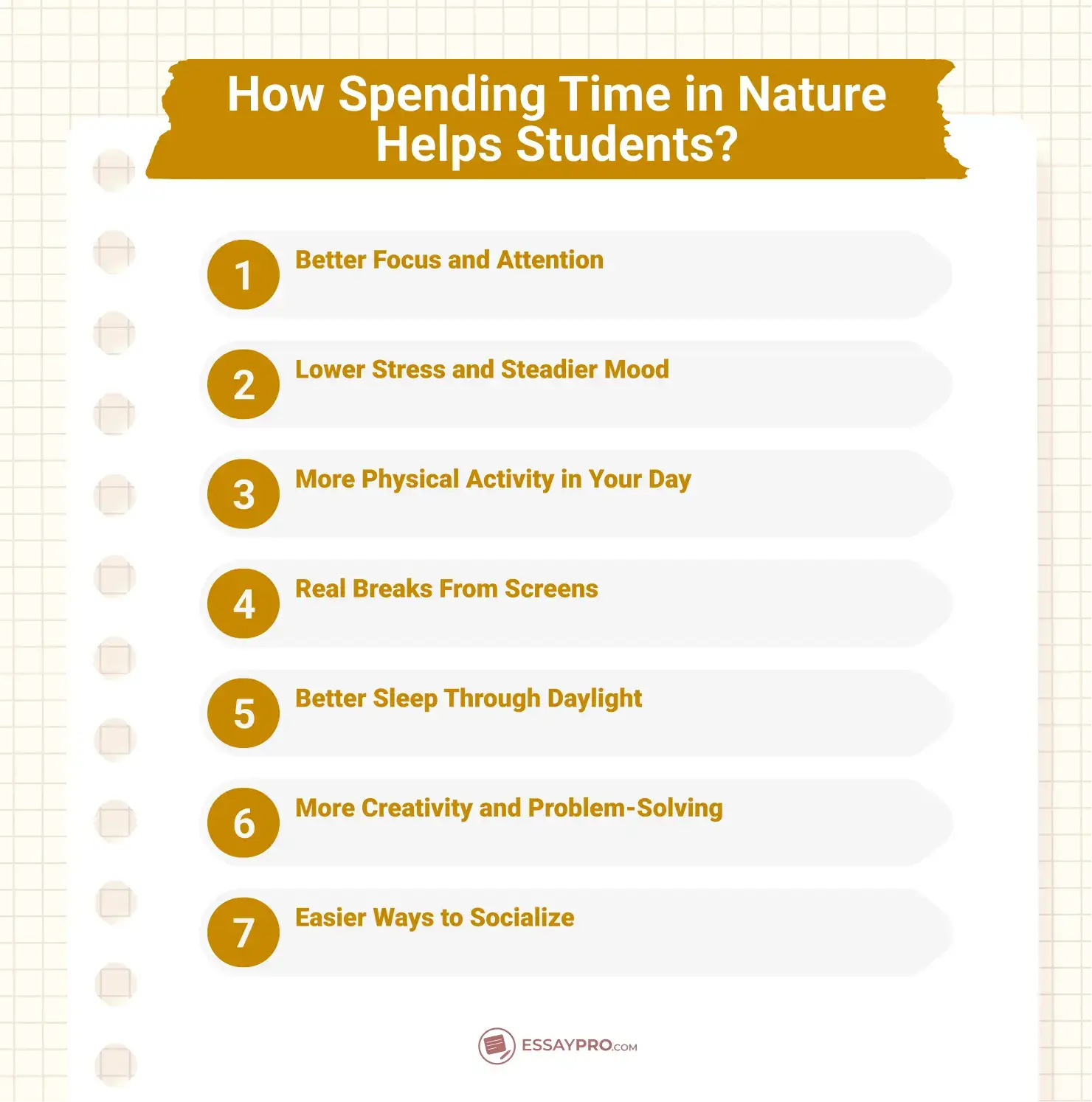
The benefits of spending time in nature are so evident that they don’t need any kind of vague “wellness” talk.
They show up in measurable ways when your week is packed with exams and deadlines. A ten-minute walk between study blocks does real work on your brain and body. Below are seven payoffs, and each one has research you can open and read.
1. Better Focus and Attention
Attention is not infinite. There's a specific kind that screens out noise and holds you to one task, and it runs out faster and faster the more and longer you push it. Nature refills it, though. In a 2024 experiment, people who took a 40-minute walk on a natural route came back with stronger executive attention, the machinery behind focus, planning, and decisions.
Ten minutes with no destination, eyes off the screen, gaze on something far away. Then come back. You will notice that the tasks read more clearly than they did before you left.
2. Lower Stress and Steadier Mood
Twenty minutes outdoors is enough to move a hormone. Adults who spent that long among trees saw their cortisol (the chemical that keeps you wired during prolonged stress) drop by roughly half after a single visit. Although a walk will not treat a mental health condition, only support it, so it belongs paired with sleep, structure, and professional help, if needed. Where you go matters far less than just getting out. All of it counts, a bench in your local part, a spot by some water, anything. On a bad day, ten minutes on that small green patch will do the job.
3. More Physical Activity in Your Day
Most days, movement loses its spot to sitting on a chair, for whatever reason. Almost 85% of students sit for more than six hours a day, and under one in ten clear the bar for active. The value of an outdoor plan is that it folds the exercise into something else.
- A walk to a park stretches into a longer loop
- A patch of grass turns into a frisbee game
- One leg of a trip goes on foot instead of on a bus
These are not grand workouts, which is exactly why they’re easier to maintain. Of all the benefits of being outside, this is the one you never have to schedule. My own rule stays simple: take the outdoor route when the day allows, and let the extra steps pile up.
4. Real Breaks From Screens
A phone is not a break from a laptop. Same circuits, different glass, and the fatigue rides straight through. The scale is what makes this worth guarding: half of teens between 12 and 17 rack up four or more hours of screens a day, and the heaviest users report more anxiety and depression. A step outdoors is one of the few resets that gives your eyes and your attention a pause at once. Three things make it land: leave the phone in your bag for the first ten minutes, kill the podcast, and let your gaze reach past arm's length. Even a short version of that does something no indoor scroll can fake.
5. Better Sleep Through Daylight
Light drives sleep. The body clock sets itself by the sun, which is why morning exposure does the heavy lifting. People who caught daylight before 10 a.m. fell asleep earlier and kept a steadier rhythm, a strong return on ten unhurried minutes. My habit is coffee on a bench, or the long way somewhere, before the first app of the day. Clouds change nothing, since an overcast sky still counts as daylight to your eyes. Front-load the light, and the tiredness arrives closer to when you want it. For anyone on an unpredictable schedule, this is the lever with the least effort attached.
6. More Creativity and Problem-Solving
Fixation is the enemy of a good idea. Stare down a stuck problem long enough and your brain digs the same dead-end groove over and over. The counterintuitive fix is to leave it. Head outdoors, let the problem rest unattended, and the answer tends to surface when you are not hunting for it. A review of research through 2024 found that time in nature lifts both creativity and mood, and it takes no expedition to get the effect. Think of the usual walls: a blank intro, a bug you have reread twenty times, an argument that won't cohere. My solution turns up around the midpoint of a walk, so a note stays in my pocket. Loosen your grip and the idea shows up.
7. Easier Ways to Socialize
Company is harder to come by than the crowded hallways suggest. Roughly 57% of students say they feel lonely, and only 15% say never. One of the underrated benefits of being in nature is how it drains the pressure out of seeing people. A walk side by side has no silences to fill, because the path and the view do some of the work. The best plans ask almost nothing: a picnic on the grass, a pickup game, a study session outdoors, a slow walk between two people. It builds up on its own, too, since students already average about 104 minutes of green space a week, right around the amount studies tie to better mental health. Round up a couple of people, pick a park, make it a habit.
Easy Ways Students Can Spend More Time Outside
The flaw in most outdoor advice is that it expects you to schedule a hike between a 9 a.m. seminar and a lab report that’s due at midnight. If you treat nature as one more project to manage, you’re defeating the entire purpose of spending time outdoors. Here's what actually fits a student timetable:
- 5 minutes: Phone in your bag. Step outside, and let your eyes rest on something far off.
- 10 minutes: Got a call to make? Take it on foot instead of at your desk, or just walk the long route to your next class.
- 15 minutes: Lunch counts as outdoor time if you eat it on a bench or a patch of grass instead of in front of a screen.
- 30 minutes: This is enough for a real study session on the green when your reading doesn't need a desk. Walking one leg of your commute fills the same slot.
- 45 minutes: Your workout works outside. A short jog, a stretch in the park, whatever moves you off the chair.
- 1 hour: Swap a text thread for a walk with a friend and cover the whole week between you.
- A free afternoon: Now you've got room for the longer dose a weekday can't hold, so block a hike or a picnic.
- Daily, any length: One phone-free nature break, however short the window happens to be.
A grey sky counts. Fifteen minutes counts. You do not need a trailhead or a flawless forecast for any of this to help your stress or your focus.
How to Fit Nature Breaks Into a Busy Study Schedule?
Big plans die as easily as they’re made. A five-hour Saturday in the woods sounds perfect and almost never survives a real week of deadlines or a fun Friday night. Start with the gaps you already have. 5-10 minutes between study blocks, or 20-30 minutes at lunch.
The reliable trick is to bolt outdoor time onto a habit you already keep. Take a phone call while you walk. Move one coffee break to a bench outside. Warm up outdoors before the gym. Do a single leg of your commute on foot. Each swap turns dead time into green time, and asks for no extra slot in your day.
Consistency is the part that pays off. Ten minutes on most days settles your stress and sleep across a term. One grand outing feels productive and fades by Monday. Pick a pairing and let it go on autopilot.
Final Thoughts
Green time is a small habit that pays off. Do it often and it sharpens focus, lowers stress, adds easy movement, breaks the screen loop, steadies sleep, and lifts creativity, plus it makes other people easier to be around. You don't need a clear forecast or a free afternoon. Ten minutes between study blocks, if you keep it up, is where the payoff lives.
FAQs

How Much Time Should Students Spend Outside?
Can Studying Outside Improve Focus?
What Are Easy Outdoor Activities for College Students?

Ana Ratishvili
Ana is a professional literary writer with a Master’s Degree in English literature. Through critical analysis and an understanding of storytelling techniques, she can craft insightful guides on how to write literary analysis essays and their structures so students can improve their writing skills.