Blue light research has evolved significantly over the past few years. One Cochrane review of 17 randomized controlled trials concluded that blue-light blocking glasses likely don’t affect eye strain, visual function or sleep quality. Its lead author, University of Melbourne Associate Professor Laura Downie, points out that the intensity of blue light making it to our eyes from screens is about a thousandth of the amount we’re exposed to from natural sunlight.
Still, a study published in 2025 in the journal SLEEP found improved sleep, decreased eye strain and better productivity among students who received regular doses of blue light after dark. We break down what’s actually legit when it comes to blue light effects on students’ eyes, sleep and general well-being.
What is blue light?
Blue light refers to high- energy visible (HEV) light. It is a part of the visible light spectrum emitted by the sun and also produced by artificial lights, such as digital screens, LED lights and fluorescent bulbs. Blue light has shorter wavelengths, higher energy, and higher frequencies than other visible light. It scatters more easily, which is why we see the blue sky.
Even though blue light from screens has become a growing concern, comprehensive research indicates that sunlight is still the primary source of blue light exposure. By comparison, excessive digital device use accounts for only a small portion of daily blue light exposure.
Does blue light have health benefits?
Yes. The benefits of blue light come from a real regulatory function tied to your circadian rhythm, the body's internal clock that controls your sleep and wake cycles.
- Keeps you alert during the day: Daytime blue light exposure helps suppress unwanted melatonin release, keeping you awake and focused.
- Supports mood: Regular daytime exposure is linked to better mood regulation.
- Reinforces a healthy sleep cycle: By timing melatonin suppression correctly, blue light helps anchor your body's natural wake and sleep pattern.
Timing is what actually matters here, not exposure itself. The authors of Cochrane's review even noted that researchers have argued back and forth about blue light for years: bright, natural light during the day is good for students, and that same light source can disrupt the same signal at night.
How harmful is blue light?
Many wonder - is blue light bad for your eyes? Well, the evidence for retinal harm is far thinner than popular claims suggest, and even the safety threshold itself has been actively debated in scientific literature.
- Where the current safety threshold comes from: The human phototoxicity threshold, 22 J/cm² for blue light near 445nm, was derived from primate studies by Van Norren and Gorgels and then reduced by a safety factor of 10 to set official exposure limits.
- Why that threshold is now in question: A 2024 study in Scientific Reports found the phototoxicity threshold for rodents may be overestimated by a factor of 50 for blue light specifically, suggesting current safety margins built on animal data may not translate cleanly to human exposure.
- What's missing from the retinal-damage claim: The 2023 Cochrane review of 17 randomized controlled trials found no evidence at all for macular or retinal outcomes, not because risk was ruled out, but because no trial has shown that screen-level exposure approaches the doses used in laboratory phototoxicity research.
- What the evidence actually supports: Short-term effects like eye strain, dryness, and disrupted evening sleep are the most consistently studied outcomes, not retinal injury.
- Even findings on eye strain are mixed: The same Cochrane review found low-certainty evidence of little or no effect of blue-light filtering lenses on short-term digital eye strain, suggesting symptoms often blamed on blue light may actually stem from reduced blinking, fixed focal distance, and poor ergonomics.
How does blue light affect sleep?
Blue light before bed emitted from screens can suppress melatonin secretion, the hormone that signals your body it's time to sleep, by interfering with your circadian rhythm, which naturally ramps up after sunset. That's why scrolling on your phone, working on a laptop, or reading on a tablet late at night can make it genuinely harder to fall asleep.
A 2025 study published in the journal SLEEP examined healthy students reporting more than an hour of daily screen exposure and eye strain, using both objective (a validated biomotion tracking device) and subjective sleep measurements. Still, the picture isn't fully settled. Cochrane's reviewers called this a genuine gray area; their meta-analysis included studies that showed inconsistent, heterogeneous results when measuring sleep quality outcomes.
Poor sleep itself carries real downstream effects, including:
- Lower concentration
- Memory problems
- Fatigue
- Reduced productivity or academic performance
Will blue light glasses help with eye strain?
Probably not, at least according to the best current evidence. The 2023 Cochrane review of 17 randomized controlled trials found that blue-light-filtering lenses may not reduce short-term digital eye strain compared with non-filtering lenses, with no clinically meaningful difference detected. Researchers point instead to more likely culprits: reduced blink rate, incomplete blinking, and sustained close-focus effort during screen use. A PMC-published eye-tracking study found that blink rate and pupil behavior shifted measurably during social media use, specifically, reinforcing the idea that strain may be more about screen behavior than blue light itself.
Are blue light glasses worth it?
Based on current evidence, not for the reasons most people buy them. Cochrane's review found no clinically meaningful benefit for eye strain, and the effects on sleep and long-term retinal health remain unclear or entirely unstudied. If wearing them genuinely makes screen time more comfortable for you, there's little evidence of harm, but they shouldn't be relied on as a proven fix.
How can I reduce the negative effects of blue light?
Since the strongest evidence points to behavioral and ergonomic factors, not the wavelength of light itself, as the real drivers of eye strain, the most effective changes target habits rather than filtering products. Here are some tips on how to reduce blue light exposure:
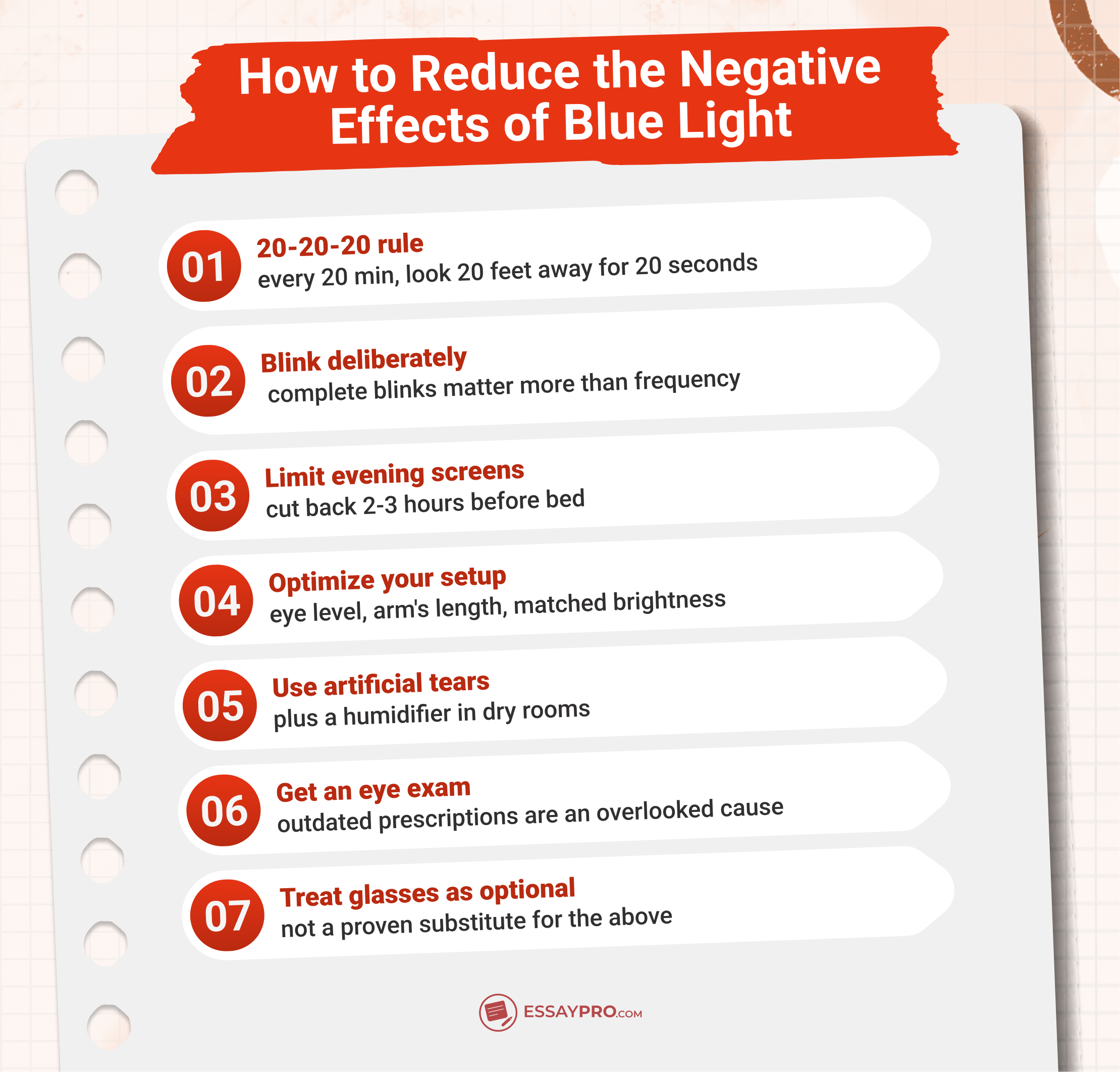
- Follow the 20-20-20 rule: Every 20 minutes, look at something 20 feet away for 20 seconds. This interrupts the sustained close-focus effort that contributes to eye fatigue, regardless of blue light exposure.
- Blink deliberately and fully: Research shows complete blinks matter more than blink frequency alone for preventing dry eye symptoms during screen use, since incomplete blinks fail to distribute tear film evenly across the eye.
- Limit screen exposure in the 2-3 hours before bed: Even with mixed findings on magnitude, research consistently shows blue light exposure close to bedtime can suppress melatonin and delay sleep onset, so shifting screen use earlier in the evening is a reasonable, low-cost precaution.
- Optimize your screen setup: Position monitors at eye level, roughly an arm's length away, and adjust brightness to match the room's lighting rather than leaving it at maximum.
- Address dry, tired eyes directly: Use artificial tears if screen time leaves your eyes dry, and consider a humidifier in dry indoor environments, both target the actual mechanism behind most reported "eye strain."
- Get an updated eye exam: Uncorrected or outdated prescriptions are a common, often overlooked cause of digital eye strain that blue-light filtering can't fix.
- Don't rely on blue light glasses as your primary fix: Given the current evidence, treat them as optional comfort items at best, not a substitute for the habits above.
Final Words
Blue light makes up a small percentage of the blue light we're exposed to compared to daylight. There is no evidence that exposure to blue light from using digital devices at normal distances and durations causes permanent eye damage. However, it may delay melatonin release, making it harder to fall asleep if you are exposed to it before bedtime. Thus, discouraging screen use before bed is still good advice. Factors that contribute to digital eye strain are less often caused by blue light itself and more often by decreased blinking, poor ergonomics and an outdated prescription. Recommendation for relief includes following the 20-20-20 rule and consciously blinking more often. It's better to ensure your screen setup is ergonomic than to opt for blue light filtering.
FAQs

Can blue light from screens damage your eyes?
Does blue light cause eye strain?
Does blue light affect sleep?

Annie Lambert
specializes in creating authoritative content on marketing, business, and finance, with a versatile ability to handle any essay type and dissertations. With a Master’s degree in Business Administration and a passion for social issues, her writing not only educates but also inspires action. On EssayPro blog, Annie delivers detailed guides and thought-provoking discussions on pressing economic and social topics. When not writing, she’s a guest speaker at various business seminars.