The college graduate job market in 2025 turned out to be a lot tougher than students expected when they applied. The pace of hiring slowed significantly, causing the market to ask more of grads than they thought based on the previous years. In the first quarter of 2025, according to the Federal Reserve Bank of New York, unemployment for recent graduates between the ages of 22 and 27 climbed to 5.8%.
What the class of 2025 job market actually brought versus what the graduates expected ultimately ended up being two completely different pictures. This report tries to describe that gap across pay, job preferences, timing, and confidence about the future, based on the survey conducted across 3,000 rising and recent graduates. We’ll compare the reality and expectations in terms of the payoff of specific majors, the reality of the job hunt, workplace expectations, salaries, and where the jobs actually are.
College Majors
A degree can look practical on paper and still lead to a rough first few years after graduation. Per the New York Fed's most recent labor market release in February 2026, recent-graduate unemployment reached 5.6% and underemployment climbed to 42% by the second quarter of 2026, both up from a year earlier. Field of study drove the spread across 73 majors, with more than seven percentage points between the safest and the riskiest.
The most useful college majors, at least if the measure is how reliably graduates find work, cluster in education, health, and applied fields. Special education leads at 0.7% unemployment, well under the 4.2% average across all fields. Elementary education, agriculture, engineering technologies, social services, and nursing round out the top.
Best majors for jobs: lowest recent-grad unemployment (NY Fed February 2026 release)
Pay tells a slightly different story. Eight of the ten lowest-unemployment majors still post early-career wages under $58,000. Nursing is the obvious exception, at a $70,000 median wage and one of the lowest underemployment rates of any field. Engineering technologies also held up well, at 1.7% unemployment and roughly $65,000 in pay.
Computer engineering and computer science surprised on the downside. Median salaries hit $90,000 and $87,000, yet unemployment climbed to 7.5% and 7.0%, a sign the AI-driven cooldown in tech hiring reached the entry-level pipeline. On the other end, 42% of recent grads work in jobs that typically do not need a degree, including 65.8% of criminal justice graduates and 63.9% of performing arts graduates.
Highest underemployment: recent grads in non-degree jobs (NY Fed February 2026 release)
This is why the best majors for jobs are not always the simplest story. Agriculture and foreign language both post low unemployment, yet each shows high underemployment. Graduates find work; many just do not land in degree-level roles. A low unemployment rate looks reassuring on its own. The second number changes that picture.
The Job Search
Most students leave college expecting the move into full-time work to be fairly quick. For the class of 2025, that transition was often slower than expected. Hiring had cooled, competition was heavier, and federal data gives a pretty clear sense of why.
Hiring weakened throughout 2025. The U.S. Bureau of Labor Statistics put the hires rate at 3.2% in October, one of the softer readings in years. Job openings were falling too, reaching 6.5 million by December. At that point, there were fewer openings than unemployed people actively looking for work, leaving close to one available job for every job seeker. For new graduates, the result was simple: more people competing for a smaller number of entry-level positions.
Recent graduates felt that slowdown more than established workers. Among graduates ages 22 to 27, unemployment reached 5.8% in the first quarter of 2025. Another 41.2% were underemployed, according to the Federal Reserve Bank of New York, meaning they were working in jobs that typically do not require a degree. College graduate employment looked considerably stronger among older degree holders, whose unemployment rate was around 2.6%. That gap captures much of the entry-level job expectations vs reality problem facing the class of 2025.
The 2025 market in federal data
Field of study made a big difference as well. Nursing graduates had the lowest underemployment rate of any major at 12.8%, so most were finding work that actually required their degree. Criminal justice sat at the opposite end, with 65.8% underemployment.
Underemployment by major, a sample (2025 data)
With roughly one opening for every person looking for work, new graduates were entering a tighter market, where searches took longer and landing that first degree-level role often required far more applications than expected.
Workplace Expectations
Ask a graduating senior to describe the ideal first job, and flexibility comes up fast: a few days at home, hours that bend around life, an employer that hands over autonomy on day one. The 2025 data cools that picture down. College graduate career expectations run one way, and the early evidence runs another.
Remote work is where that gap widens most. A new Federal Reserve Bank of New York study, which NPR covered in June 2026, found companies hire fewer recent grads for remote-capable jobs because mentorship and on-the-job learning are harder at a distance. Unemployment among college grads under 29 rose 20% after the pandemic, even as older grads' rate slipped. A separate LSE and Oxford paper that tracked hiring records from 2017 through 2025 found entry-level hiring fell by up to 29%, with the sharpest declines in remote-heavy fields, according to Fortune's June 2026 coverage. Schedule autonomy follows the same seniority-first pattern.
Three more signals sharpen the picture:
- Workplace monitoring is now standard practice. 78% of employers use some form of employee tracking, and the figure reaches 96% at fully remote companies, per Chanty's 2025 summary of the research. About 61% run AI-powered analytics on productivity data.
- Union approval among Americans 18 to 34 reached 72% in Gallup's 2025 poll, the highest of any age group. Actual membership among workers 16 to 24 was 4.3% in 2024, per the U.S. Bureau of Labor Statistics. Approval and membership are separate things.
- AI anxiety runs ahead of AI use. A 2025 Pew Research Center survey found 52% of workers worry about future AI use at work, and only 6% expect it to open more opportunities. Early-career workers 22 to 25 in roles that are most exposed to automation saw a 13% relative drop in employment after generative AI spread, per Stanford's Digital Economy Lab.
Inflation, Salaries & Loans
Expectations and arithmetic collide here more bluntly than anywhere else. The college graduate starting salary students picture tends to run well ahead of the paychecks that arrive. Recent graduates posted a median early-career wage of $58,000 in 2024, per the Federal Reserve Bank of New York. Set your own target against that number before negotiating, because the figure you absorb from internships and a roommate's outlier offer skews high nearly every time.
Prices did not help. The Consumer Price Index rose 2.7% across 2025, and food costs climbed 3.1%, per the U.S. Bureau of Labor Statistics. So the entry-level college graduate salary lost real purchasing power over the year, even when the headline number never moved.
Field of study drives most of the variation:
- Computer engineering graduates topped early-career pay at a $90,000 median.
- Pharmacy graduates came in lowest, near $40,000.
- Nursing settled around $70,000.
.webp)
The six-figure starting salary, the one that dominates headlines and campus lore, barely exists at the bachelor's level. The highest-paying major opens near $90,000, and nine of the ten best-paid fields are some form of engineering or computing. Treat any promise of $100,000 straight out of undergrad as the exception it is.
Debt is the constraint students underestimate the most, since it never appears in the salary line. A borrower counts as delinquent once a scheduled payment goes unmade past its due date, which is important for reading the numbers below:
- The median balance for borrowers with education debt outstanding landed between $20,000 and $24,999 in 2024, per the Federal Reserve.
- 28% of those borrowers owed under $10,000.
- After the pandemic payment pause ended, the share behind on payments rose, though bachelor's holders fared better, at an 11% delinquency rate.
The Gender Divide
At graduation, the gap between men and women barely shows in the paycheck. Look a year later and the picture changes. The gender pay gap for college graduates opens the moment students enter the workforce, and our survey shows the divide runs deeper than they realized while still in school.
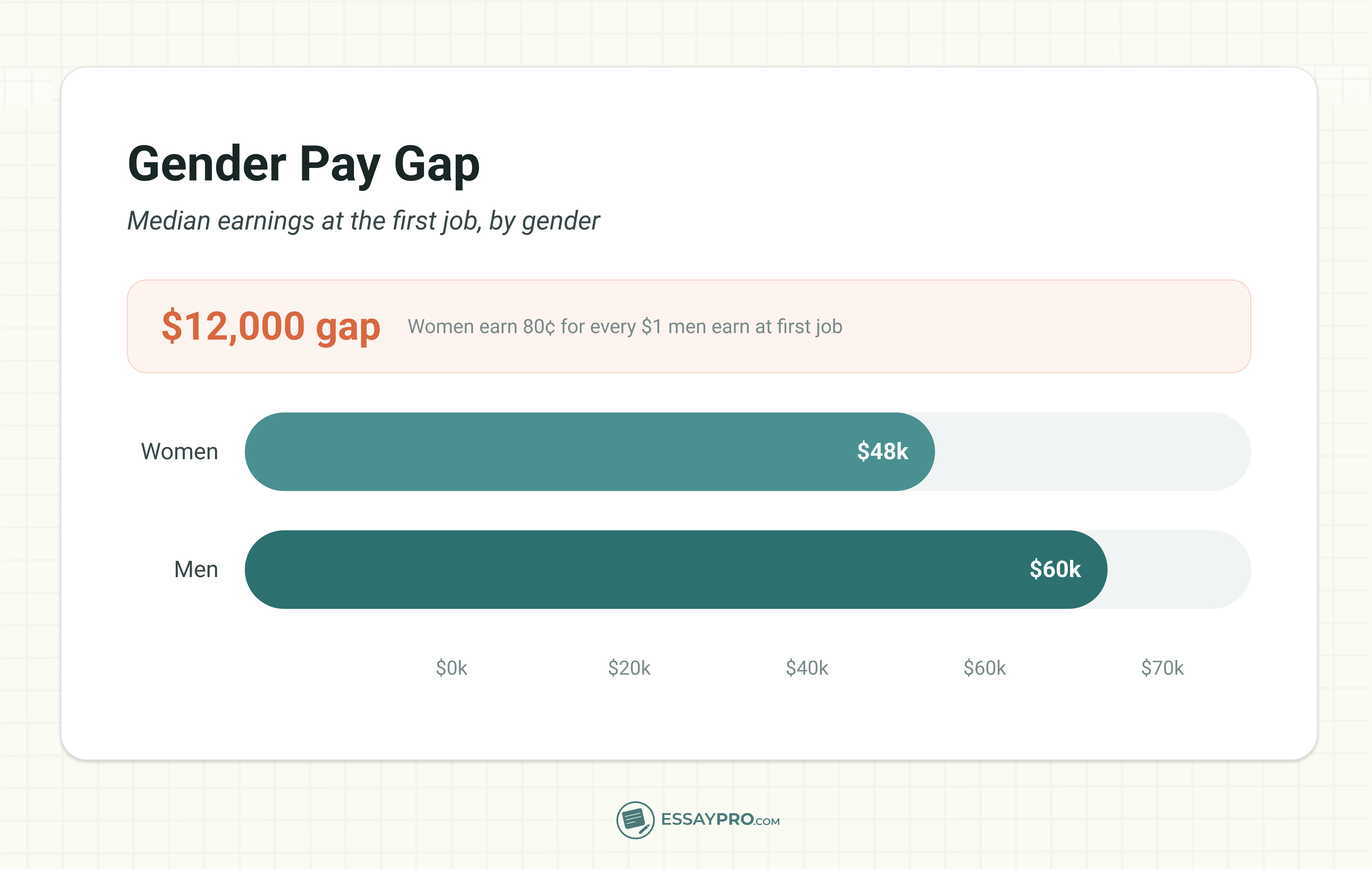
Starting salary versus expectations.
- Female graduates earn a median $48,000 in their first job, compared to $60,000 for men. That works out to 80 cents on the dollar.
- Students anticipated a much narrower split. Female rising grads expected to earn $60,000; male rising grads expected $65,000, a 92-cent gap in projection. Real life delivered 80.
- Optimism about a major's payoff drops harder for women too. 73.7% of rising female grads believed their major would be very useful for their career. Only 50.3% still felt that way after graduating.
Major regret, the job search, and interviews.
- Major regret hit 20.5% of the class of 2025, down slightly from 21.5% a year earlier. Liberal arts graduates reported the highest share, and many said they wished they had chosen nursing, engineering, or another quantitative field.
- Job hunts ran longer than planned. Just 77.2% of recent grads landed a role within three months of graduation, and 5% remained on the market when surveyed.
- Interviews exposed a credential problem. 66.8% of recent grads named lack of experience as their biggest hiring obstacle, and 48.2% said they needed additional credentials or certifications to compete for the roles they wanted.
Remote work and schedule flexibility.
- Women teleworked at roughly 25% in 2025 and men at 20%, per BLS Current Population Survey data. The difference traces to women's larger presence in office and professional roles.
- Full remote work is a minority preference among grads. Only 18.8% of recent grads prefer fully remote, and 34% prefer in-person.
- The bigger gap is around schedule flexibility. 90% of rising grads rank flexibility as very important, yet only 29% of recent grads describe their current job as very flexible.
Where to Look for Work
Openings are not spread evenly, and the government's projections point hard at one part of the economy. Healthcare and social assistance is the fastest-growing sector through 2034, on track to add roughly 2 million jobs, the largest gain of any sector, in the Bureau of Labor Statistics employment projections. Nurse practitioner ranks as the single fastest-growing occupation in the country. For bachelor's graduates, the most durable entry lanes run through health, technology, and management-track work, even after the recent cooldown in tech.
The occupations that will add the most jobs this decade, by raw count, look like this:
Occupations adding the most jobs (2024–34)
Source: U.S. Bureau of Labor Statistics, Employment Projections (2024–34).
One caution. Several of these roles do not require a degree, so read the table as a map of where hiring volume concentrates. It is not a list of bachelor's-level jobs. Software developers, registered nurses, and data scientists are the clearest four-year-degree entries on it.
The government does not rank metros by entry-level openings. What it does track is total employment, and the biggest job markets are the familiar ones:
Largest metro job markets by total employment
Soft skills are the gap in the public record. No federal series ranks the abilities employers want, so any "top skills" list traces to private job-posting analytics, not government data.
Methodology
The graduate survey behind this report was fielded online by PureSpectrum between late February and mid-March 2025. It reached more than 3,000 verified recent and rising undergraduates. Recent graduates were those who had earned a bachelor's degree within the prior year. Rising graduates were current part-time or full-time students on track to finish within the coming year. All respondents were between 20 and 29 years old and living in the United States, and the questionnaire asked about job-search experience, pay expectations, job preferences, and views of the market ahead.
The quantitative findings throughout this report, though, come from federal datasets. Employment, unemployment, underemployment, wages, hiring, prices, union membership, and degree-field figures are drawn from the Federal Reserve Bank of New York, the Bureau of Labor Statistics, the Federal Reserve Board, and the National Center for Education Statistics, with one measure of AI's early effect from Stanford's Digital Economy Lab.
Final Thoughts
The class of 2025 met a harder market than it expected. Jobs took longer to land, underemployment ran high, and pay trailed the figures students had pictured. Field of study drove most outcomes: unemployment, salary, even the gender gap. The steadiest paths ran through health, education, and licensed work, and an early start still mattered most.
FAQs

How Long Does It Take New College Graduates to Find a Job?
What Is a Realistic Starting Salary for a College Graduate?
Which College Majors Have the Best Job Prospects?

Ana Ratishvili
Ana is a professional literary writer with a Master’s Degree in English literature. Through critical analysis and an understanding of storytelling techniques, she can craft insightful guides on how to write literary analysis essays and their structures so students can improve their writing skills.