
ADHD in the classroom shows up in several ways. You will notice some common signs: difficulty focusing, answering questions before they're finished, and excessive movement. Students with ADHD behave this way because they are not wired typically. Their brains process attention and self-control differently from neurotypical brains. But students with ADHD do not have to struggle.
This article covers classroom treatments that work, federal special education rights, and accommodations to help your child succeed.
Classroom treatment strategies for ADHD students
Behavioral classroom management interventions have been some of the most studied and effective strategies for students with ADHD.
- Reward systems: Allow students to earn instant and concrete feedback for staying focused or completing assignments.
- Daily or weekly report cards: Sent home to help teachers and parents monitor student progress and create a sense of consistency across school and home settings.
- Clear, consistent expectations: For maximum effect, reward systems should have clearly defined expectations and rewards that are distributed consistently.
- Immediate reinforcement: Students with ADHD tend to have more difficulty waiting for long-term rewards, so giving students rewards immediately after they demonstrate desired behavior can be more impactful.
Explicit organizational training is the second major category among ADHD classroom strategies. Students with ADHD often fail not because they don't understand the content, but because they lose track of assignments, due dates, or materials.
- Time management instruction: Explicitly teaching students how to manage their time, breaking big assignments into multiple steps with individual deadlines, can help students from becoming overwhelmed at the last minute.
- Tracking tools: Using a planner or some other method of keeping track of assignments, whether it be a color-coded folder system or a reminder app on their phone, allows students to rely on a tangible structure when their working memory lets them down.
- In-class reinforcement: Teachers can reinforce this skill by allowing time for students to check their planners during lessons and write down what is due and when, rather than expecting students to remember lessons on their own.
- Long-term impact: With practice, these strategies will become routine and decrease everyday academic stress.
Special education services and accommodations
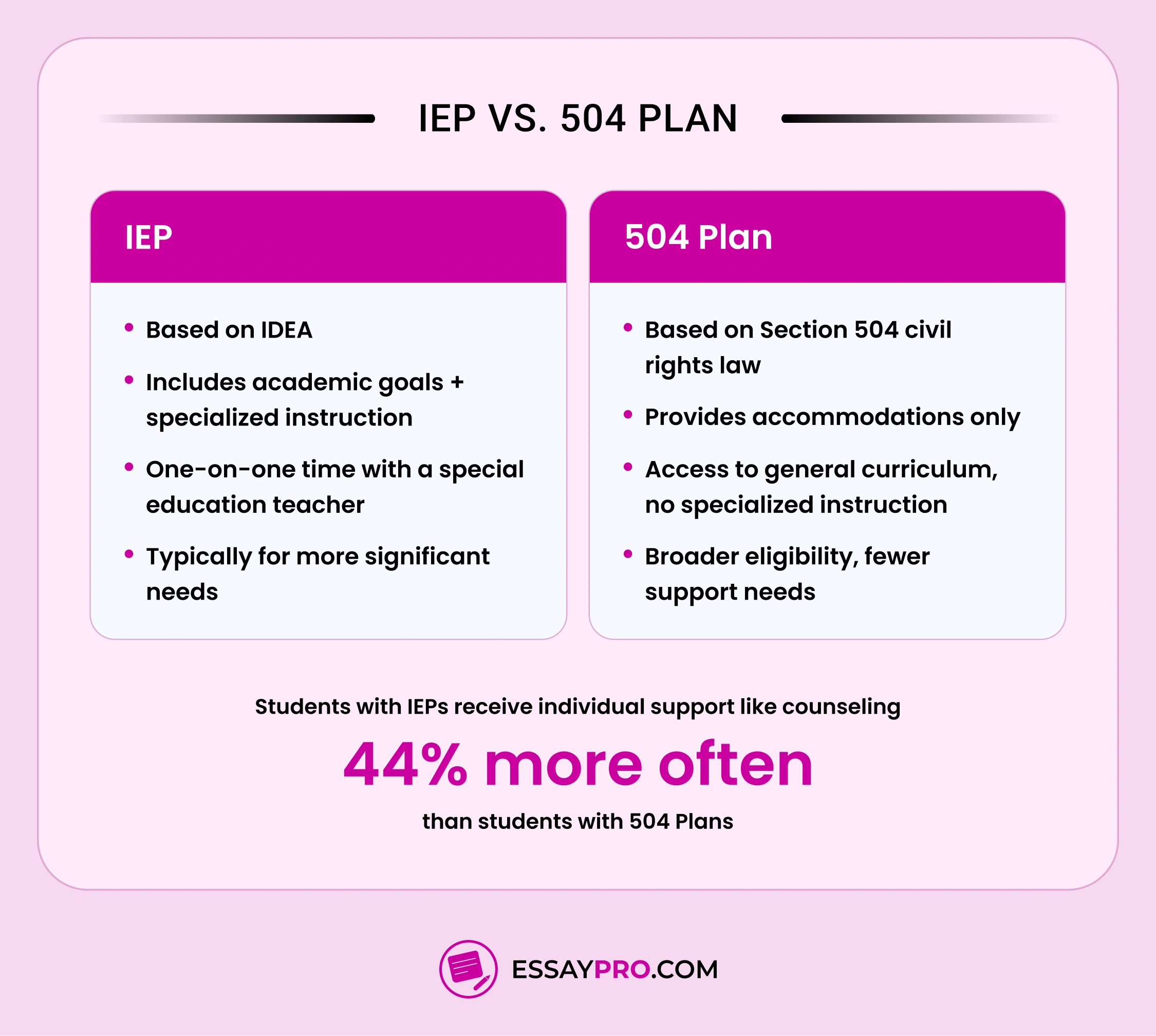
There are two federal statutes that guide the services students receive at school to support their ADHD. IDEA covers students who require an IEP, or Individualized Education Plan, to perform at grade level due to their ADHD. Section 504 provides students with disabilities whose life activities are impacted with coverage under civil rights laws.
The main distinction between the two is that an IEP contains academic goals as well as educational services to help the student learn those skills (such as one-on-one instruction with a special education teacher). A 504 Plan only provides students with accommodations to access the general education curriculum. If a student doesn't need special education services, they can receive support through a 504 Plan. Students who are eligible for an IEP usually have more significant needs than those who receive a 504 Plan.
Accommodations
Typical accommodations for students with ADHD include test-taking time extensions, teaching at their own pace, text-to-speech technology, allowing breaks to move around, and minimizing classroom distractions by seating them closer to the teacher. Students with IEP accommodations for ADHD were found to receive individual attention, such as counseling services, 44% more than students with a 504 plan. This may be because an IEP typically offers a higher level of services to the student. Overall, research found that the most effective accommodations, regardless of whether a student has an IEP or a 504 plan, occur when teachers establish clear expectations, provide consistent feedback and maintain communication with parents.
What teachers can do to help?
The majority of students diagnosed with ADHD are ineligible for special education services. However, these students still require systematic support every day to thrive in school. Often, it is not a specific program but classroom accommodations that can provide students with the most benefits. Teachers who are interested in developing their knowledge on this topic can access resources such as the National Resource Center on ADHD. This website provides research-based ADHD training for teachers, specifically for classroom management.
Communication
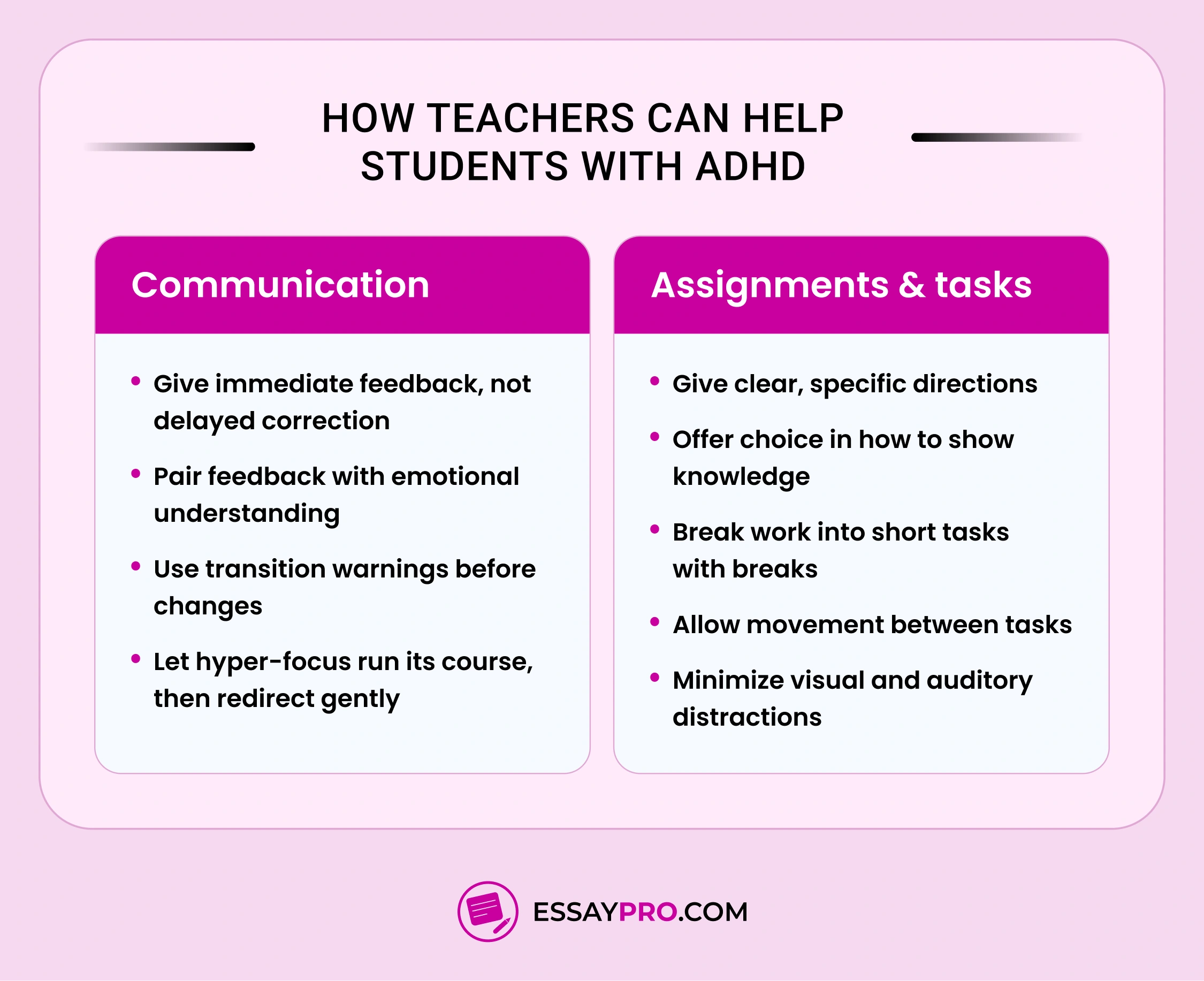
Immediate feedback is more effective than delayed correction while teaching students with ADHD. Feedback should also be paired with emotional understanding, because students get frustrated easily when they feel targeted. Transition warnings can also help with abrupt changes ("you have two more minutes"). Educators should also note when students become hyper-focused on one task and guide them back to it, rather than cutting them off and risking frustration or shutdown.
Assignments and tasks
Clear and specific directions are important for students with ADHD, often more so than their classmates. Ambiguity can lead to confusion and increased off-task behavior. Allow students with ADHD to choose how they demonstrate their knowledge. If they are given the option to speak rather than write an answer, they are more likely to be engaged with the assignment. Keep assignments short with breaks included, rather than giving one long assignment. Give students with ADHD the option to move around when going from one task to another. Movement can help focus their restlessness into getting to their next task. Limit visual and auditory distractions around the student's work area. ADHD and learning should include organizational devices such as checklists or colored folders.
Develop a plan that fits the child.
ADHD affects each student differently, so teachers should begin by assessing what distracts or annoys the student. Ongoing communication with parents will help teachers identify which strategies have been successful at home and which haven't. Meeting with counselors or school psychologists makes additional resources available to create a stronger, individualized plan if classroom management does not suffice.
Parent education and support
Parents don't have to navigate ADHD alone. The National Resource Center on ADHD, run by CHADD, offers free, evidence-based ADHD education on everything from understanding a diagnosis to building effective home routines that support school success.
How to best advocate for your child?
Effective advocacy starts with understanding the ADHD students.
- Understand the diagnosis and plan: Learn the specifics of your child's diagnosis and what an IEP or 504 Plan actually includes, since vague familiarity makes it harder to push for the right support.
- Keep detailed documentation: Report cards, teacher emails, evaluation results, and notes from meetings all build a paper trail that strengthens your case if disputes arise.
- Know your legal rights: Understand your rights under IDEA and Section 504, including the right to request evaluations and appeal decisions you disagree with.
- Stay actively involved: Participate in planning meetings rather than deferring entirely to school staff; your daily observations often reveal patterns teachers don't see.
- Invest in the school relationship: A collaborative, respectful rapport with teachers and administrators tends to produce faster, more flexible support than an adversarial one.
What should every parent know?
School support for students with ADHD is legally regulated under IDEA and Section 504, meaning your child has enforceable rights, not just optional favors from a sympathetic teacher. The U.S. Department of Education publishes clear guidance on these protections if questions come up. Beyond school, healthcare providers play a critical role, too. Pediatricians, psychologists, and psychiatrists help confirm diagnoses, recommend treatment options, and provide documentation that schools often require before formal accommodations begin.
Final Words
ADHD in the classroom presents real challenges, but with the right combination of accommodations, teacher strategies, and parent advocacy, students can thrive academically. Understanding the available legal protections and support systems makes all the difference in turning daily struggles into manageable, consistent progress.
FAQs

What does ADHD look like in a classroom?
How to help a child with ADHD in school?
What accommodations are available for students with ADHD?

Sopho Miller
is an experienced content writer who specializes in digital marketing, business, and academic topics. With a Master’s degree in Digital Marketing, she combines her expertise with a practical approach to create clear, engaging, and educational content. She crafts detailed guides and resources that support students in their academic journey. Outside of work, Sopho stays current with the latest industry trends and regularly attends workshops to further sharpen her skills.