

Key statistics at a glance
- 96% of Gen Z say a sense of purpose at work matters to their job satisfaction and well-being.
- 55% of Gen Z professionals plan to look for a new job before year-end, up from 32% a year earlier.
- Job switchers’ wage growth has fallen to 4.1%, barely above the 3.4% for those who stay put, the narrowest gap in years.
- 57% of US Gen Z do not want to be middle managers.
- 85% of the Class of 2026 use AI tools, up 31 points in two years.
- Unemployment for recent college graduates ages 22 to 27 reached 5.7% in early 2026, above the 4.2% national rate.
- Global entry-level job postings fell 29 percentage points since January 2024.
- Only 23% of Gen Z rate their mental health as excellent, compared with 34% or more of older generations.
Purpose still ranks near the top for Gen Z, named by 96% as important to their job satisfaction, but it no longer stands alone. In 2022, the story of what Gen Z wants in a job was simple: young workers would trade salary for impact and keep one foot out the door, ready to leave for a better mission. Four years later, the data tells a more mixed story. Pay, financial stability, and well-being have climbed the priority list, the reward for job-hopping has fallen to a record low, and actual job-switching has cooled even as the wish to move stays high.
This article tests the 2022 claim against 2026 survey data across job-hopping, pay versus purpose, flexibility, management, and AI, and shows where young workers have changed and where they have held firm.
Then vs now: what changed since the great resignation
Four shifts define the change since 2022: pay and stability overtook pure purpose as the loudest concern, work-life balance became one of the top Gen Z career goals, the pay premium for job-hopping collapsed, and AI went from near-absent to standard. Purpose held its ground, but it now shares the top of the list rather than owning it.
Two pressures explain the change. Housing and everyday costs climbed faster than entry-level pay, so 69% of Gen Z now say housing affordability affects where they can work. At the same time, the reward for moving shrank: the pay premium for switching jobs peaked at 16% in April 2022 and has since fallen to its lowest point on record. With entry-level openings down sharply and raises for switchers barely ahead of raises for stayers, holding a steady job looks smarter than chasing the next one.
What young workers want in a job in 2026?
Gen Z ranks six priorities in 2026, led by fair pay and financial stability, then work-life balance, skill growth, purpose, and mental-health support. The pattern favors security and sustainability over speed, a clear move away from the climb-the-ladder model.
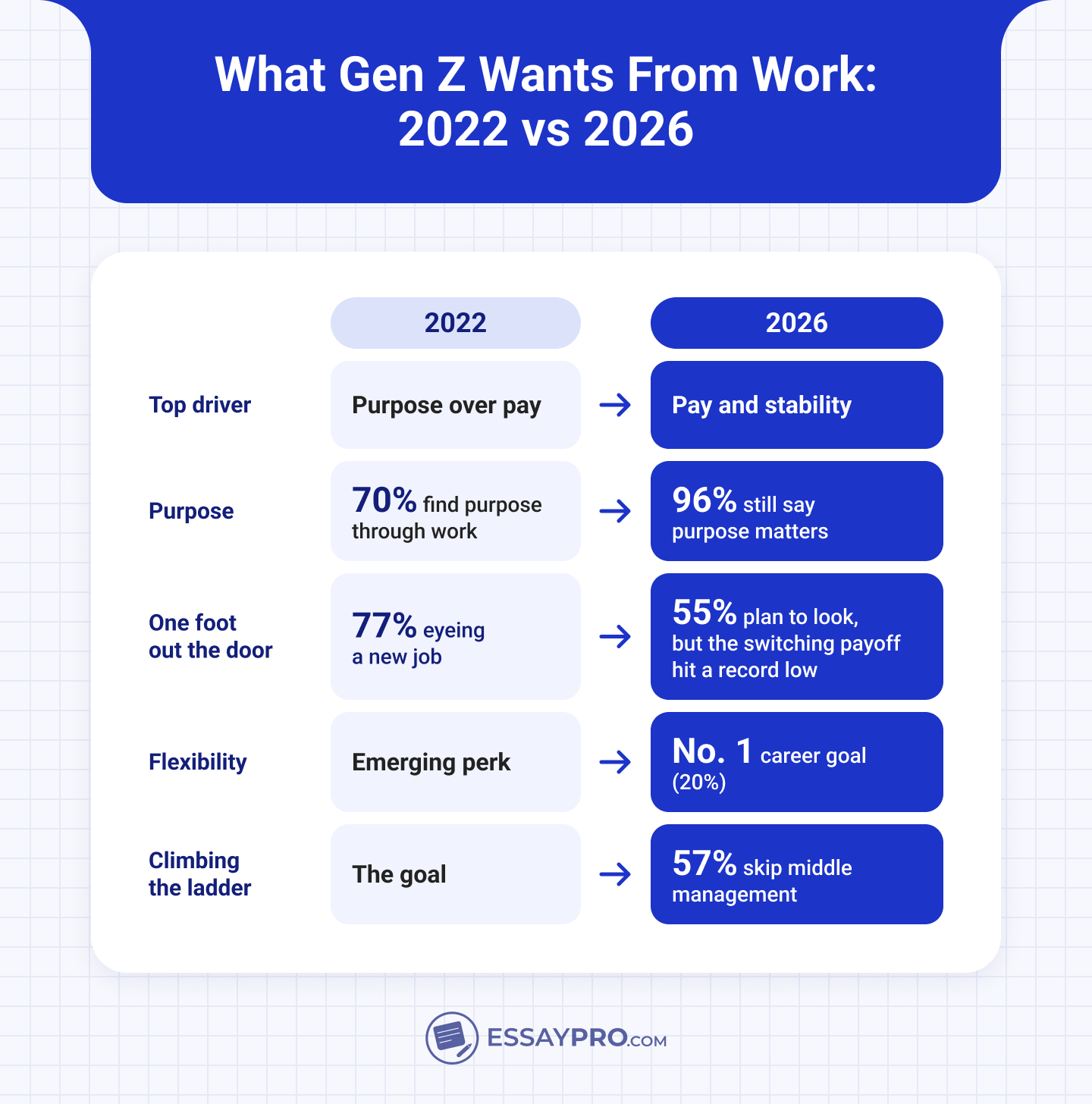
Here’s what Gen Z looks for in a job, in order:
- Fair pay and financial stability
- Work-life balance and flexibility
- Skill growth, including AI
- Purpose and values alignment
- Mental health and well-being support
- Growth without the management grind
Fair pay and financial stability
Financial pressure is Gen Z’s loudest concern in 2026:
- 55% have delayed major life decisions such as starting a family or a business because of money.
- 53% say they need higher pay to cope with the cost of living.
- 53% still expect their finances to improve within the next year.
Pay is no longer a background factor, and offers that lead with transparent salary and cost-of-living support land hardest.
Work-life balance and flexibility
Work-life balance is the single most common career goal for Gen Z in 2026, named by 20% as their top aim, ahead of financial independence at 19%. Flexibility now ranks alongside pay when young workers weigh an offer, and rigid schedules are a common reason to leave. Flexible hours and predictable boundaries do more to attract this group than a remote-work badge alone.
Learning new skills, including AI
Skill growth, especially AI fluency, is a top draw for Gen Z in 2026.
The gap between heavy use and thin training means Gen Z expects to learn these tools on the job, and roles that build AI training into the work hold them longer.
Purpose and values alignment
Purpose remains near-universal for Gen Z, with 96% calling a sense of purpose important to their job satisfaction, a figure that has held steady since 2022. The difference in 2026 is that purpose no longer outweighs pay; young workers job expectations include both. They leave when an employer’s stated values do not match its actions, which means a vague mission statement no longer attracts them without visible proof.
Mental health and well-being support
Mental-health support ranks high because Gen Z reports the weakest well-being of any generation:
- Only 23% rate their mental health as excellent, against 34% or more of older groups.
- 58% report digital fatigue from always-on work.
- Younger workers report the highest burnout rates of any generation.
Workload and boundaries move these numbers more than wellness apps do, which makes well-being a matter of workplace design.
Growth without the burnout
Ambition without the management grind defines Gen Z’s view of growth.
Interest in leadership has not vanished, but it points away from people management. Senior individual-contributor tracks fit this group, letting them grow in expertise and pay without managing others.
Deal-breakers: what makes young workers leave
Five deal-breakers drive Gen Z out of a job in 2026: burnout, rigid in-office rules with no clear reason, top-heavy hierarchy, a values mismatch, and pay that fails to cover living costs. Each maps to a gap between what the role demands and what it returns in money, growth, or well-being.
- Burnout: Chronic overwork and always-on expectations. Gen Z reaches burnout earlier than older generations and leaves to protect well-being.
- Rigid office rules with no reason given: Return-to-office mandates without a clear purpose read as control, not collaboration.
- Top-heavy hierarchy: Only 13% of Gen Z prefer a traditional hierarchical structure, and layers of management with little autonomy push them out.
- Values mismatch: When a company’s actions contradict its stated mission, Gen Z leaves rather than stays.
- Pay that doesn’t cover living costs: With cost of living the top concern, a salary that lags local expenses becomes a direct exit trigger.
What this means for students and new grads
Students and new grads can turn these trends into an edge by targeting employers that match 2026 Gen Z job priorities and proving the skills those employers now screen for. The strongest moves: ask about training and flexibility in interviews, read job ads for warning signs, and show AI and learning skills on your resume.
- Ask the right interview questions: “How does the team use AI day to day?” and “What does flexibility look like here in practice?” The answers reveal whether training and balance are real or decorative.
- Read job ads for signals: Watch for “entry-level” roles that demand 3 or more years of experience, vague mission language, and no mention of development. Clear growth paths and named tools are green flags.
- Show AI and learning skills on your resume: List specific tools and outcomes, not buzzwords. Name the task you automated or improved and the result it produced. See how to show AI skills on your resume and find internships that build them.
FAQ

What do Gen Z want most from a job?
Do young workers care more about pay or purpose?
Why don’t Gen Z want to be managers?
Is job-hopping still common among young workers?

Sopho Miller
is an experienced content writer who specializes in digital marketing, business, and academic topics. With a Master’s degree in Digital Marketing, she combines her expertise with a practical approach to create clear, engaging, and educational content. She crafts detailed guides and resources that support students in their academic journey. Outside of work, Sopho stays current with the latest industry trends and regularly attends workshops to further sharpen her skills.