Key Takeaways
- 1.9B monthly active users globally, up ~300M since early 2025
- 37% of US adults use TikTok, up from 21% in 2021
- 59% of US adults 18-29 use TikTok, vs. just 12% of those 65+
- 95% of US adult users cite entertainment as a reason for using the app
- Gen Z spends 3.2 hrs/day on social media, more than double Baby Boomers' 1.5 hrs
TikTok is way beyond its dance trend beginnings. 37% of US adults now use TikTok, according to Pew Research Center, up from 21% in 2021; adoption is far more multigenerational than most marketers realize (30%).
Usage statistics confirm that: 43% get news from TikTok regularly, up from only 9% in 2020. And it's grown far beyond entertainment: 86% of them use TikTok as a search engine each week.
Here are 20 statistics on growth, demographics, engagement, advertising, and TikTok Shop to help marketers build a strategy around where TikTok actually stands in 2026.
General TikTok stats
It's worth laying out where TikTok stands as a platform before we talk about demographics, engagement, and commerce. TikTok ranks worldwide in 2026 for user base, download growth, and as one of the most-installed apps. Keep these three digits in mind as you read on.
1. TikTok has 1.9 billion monthly active users globally
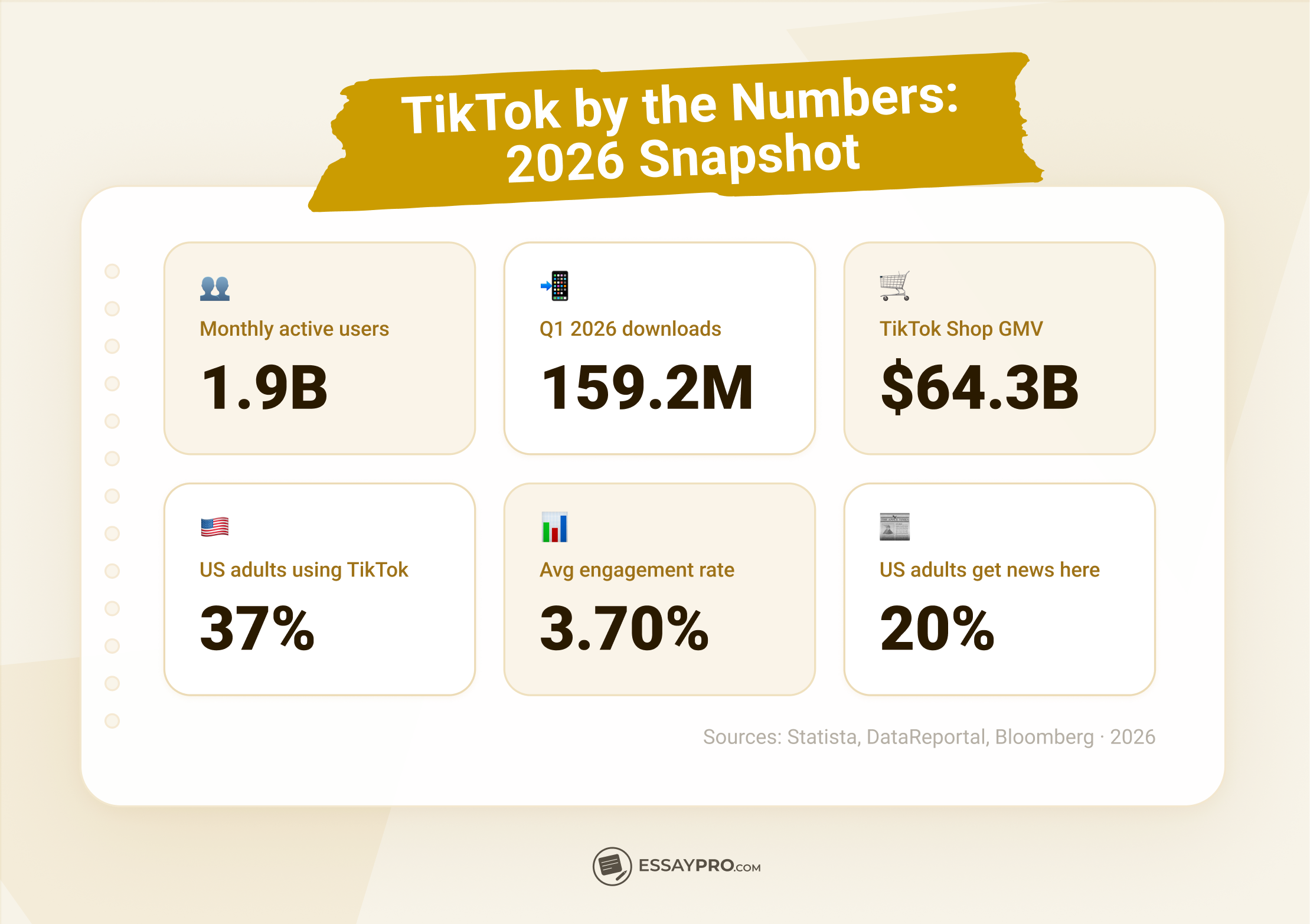
In 2026, TikTok had approximately 1.9 billion monthly active users (MAUs) globally, having grown by approximately 300 million since reaching 1.59 billion at the beginning of 2025. The platform is one of the four most ubiquitous social networks on the planet, behind Facebook, YouTube, WhatsApp and Instagram.
TikTok users spend more time on the app daily than on any other social platform, 95 minutes per day on average. [Statista]
Remarkably, this growth has remained consistent even amid ownership changes and increased regulatory pressure across its key markets. While its sizable audience should demand marketers’ attention, it’s the intensity of engagement on TikTok, rather than its size alone, that distinguishes the platform from its peers.
2. TikTok recorded 159.2 million downloads in Q1 2026
Download momentum remains strong heading into 2026, with TikTok recording 159.2 million downloads in the first quarter alone. This demonstrates continued demand, even in saturated markets where TikTok has strong penetration, indicating that new installs aren’t solely from new users in developing markets but also from reinstalls/renewed interest in regions such as the US and EU.
Consistent quarterly downloads of this magnitude demonstrate that TikTok has not yet reached a user growth plateau, which is important for marketers to consider when assessing the longevity of investing in native TikTok content creation and advertising.
3. TikTok ranked among the top downloaded apps of 2025, competing directly with ChatGPT
Until recently, TikTok had been the indisputable holder of the crown for the most downloaded app worldwide. However, in 2025, depending on who you ask, ChatGPT surpassed TikTok for year-over-year downloads worldwide.
ChatGPT recorded around 845 million downloads in 2025, rivaling TikTok’s total, whilst its competitor Sensor Tower still had TikTok surpassing ChatGPT. Even accounting for which company you believe in, TikTok remains one of the two most downloaded apps in the world.
The takeaway for student marketers? While TikTok's user growth continues to skyrocket, AI-focused tools are quickly becoming legitimate competitors for attention and real estate within app stores.
TikTok audience demographic stats
While TikTok once had “teenager” stamped all over it, the app’s demographic has expanded significantly in recent years. Here’s what the latest demographics data from 2026 can tell you about who’s using TikTok.
Keep in mind that this growth indicates that TikTok has not plateaued, which is an important factor for marketers considering investing in TikTok-dedicated content and advertising efforts moving forward.
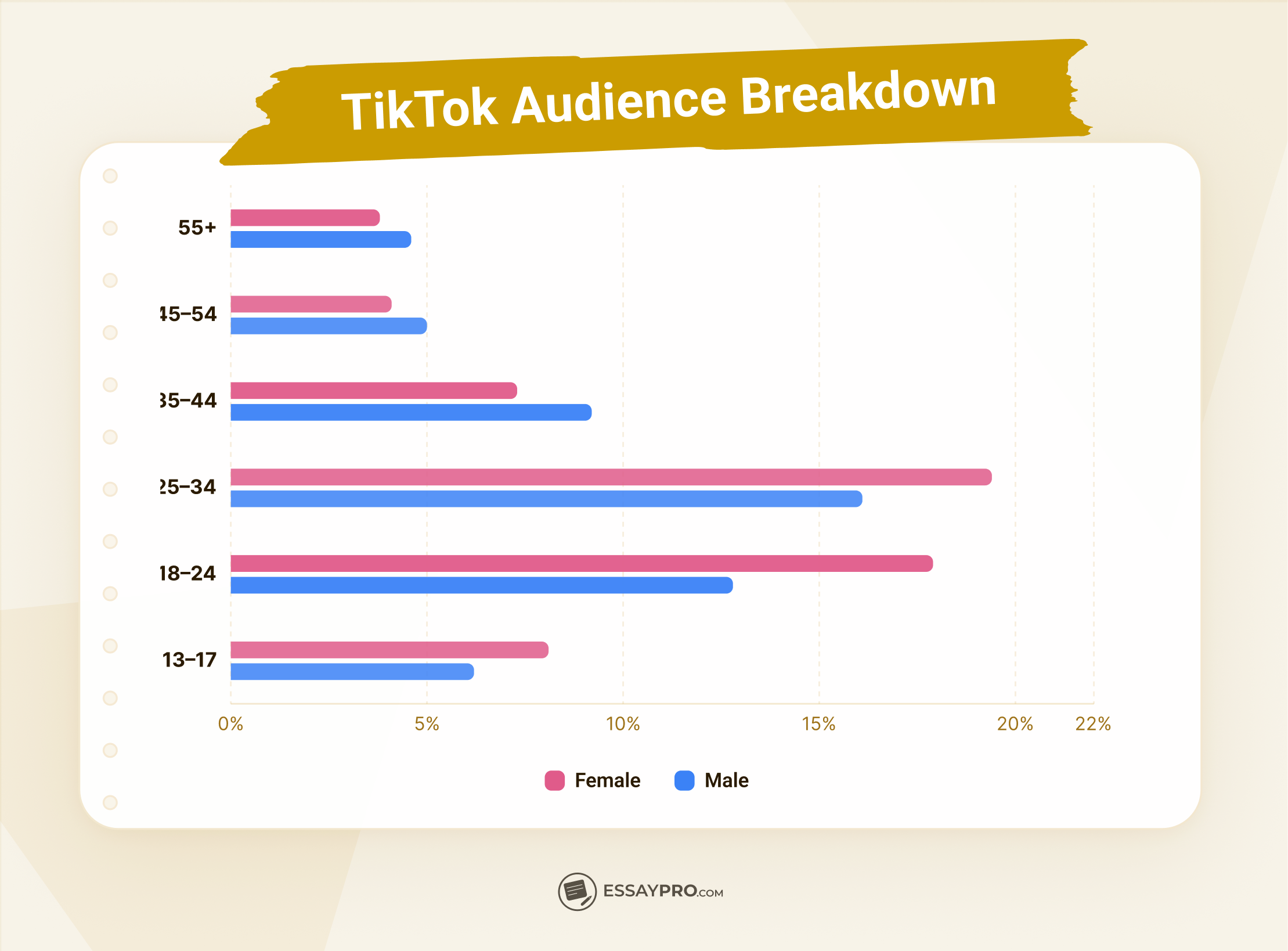
4. 14.1% of TikTok's global audience is women aged 18-24
As of April 2026, Statista's global audience data shows women aged 18 to 24 make up 14.1% of TikTok's total user base, making this the platform's most female-skewed adult age bracket. Separate audience research confirms this pattern holds broadly: the 18-24 age group shows the strongest female skew of any cohort globally, at 58.2% female within that age band. For marketers running beauty, fashion, or lifestyle campaigns, this remains TikTok's demographic core.
5. Men aged 25-34 make up TikTok's single largest audience segment
Contrary to assumptions that TikTok skews young and female overall, men aged 25-34 form the platform's largest individual segment globally, accounting for 20.7% of all users. This reflects TikTok's broader shift away from a teen-only platform toward a mainstream channel with real purchasing power across both genders. Brands targeting working professionals or higher-income consumers increasingly find this cohort worth building dedicated campaigns around.
6. In at least three countries, TikTok penetration exceeds 100% of the adult population
Penetration figures in some markets have moved past the theoretical ceiling of "all adults," a sign of multiple accounts per user or broad definitions of active accounts. In Saudi Arabia, the UAE, and Malaysia, TikTok penetration exceeds 100% of the official adult population. For marketers running Gulf-region or Southeast Asian campaigns, this signals near-total market saturation rather than untapped growth potential.
7. 59% of US adults aged 18-29 use TikTok
According to Pew Research Center's most recent data, 59% of US adults aged 18 to 29 report using TikTok, making it one of the most-used platforms among young American adults. Usage drops steadily with age, 44% among 30-49 year-olds, 30% among 50-64, and just 12% among those 65 and older, confirming that while TikTok has broadened its reach, age remains the strongest predictor of US adoption.
8. US women use TikTok at notably higher rates than US men
TikTok's US gender gap is one of the more pronounced splits among major platforms. In the United States, women make up approximately 61% of TikTok's user base, a considerably wider gap than the platform sees globally, where the split runs closer to 54% female overall. Campaigns built around beauty, wellness, or lifestyle content should account for this skew, while brands targeting male US audiences may find better reach on platforms with a more even gender split.
9. Middle-income households make up TikTok's largest US income bracket
TikTok's users in the United States have also become more economically diverse as it has aged. Based on a Pew Research Center survey of social media use across household income levels, TikTok ranks highest among middle-income groups rather than at the high or low ends of the spectrum. This trend aligns with TikTok reaching users beyond teens and college students, as it has grown to include working adults across all income levels.
10. TikTok remains more popular among Americans without a college degree
Education level continues to shape platform preference in the US. Pew Research Center's 2025 data found that Americans with some college or less education are more likely to use TikTok than those with at least a college degree, a pattern that has held consistently across Pew's recent survey waves. This matters for marketers building messaging strategy, campaigns leaning on more accessible, entertainment-first content tend to perform better with TikTok's core US demographic than dense, jargon-heavy messaging aimed at highly credentialed audiences.
TikTok usage statistics
Beyond who's on the platform, how people actually use TikTok, and why, reveals just as much for marketers building a content strategy.
11. TikTok is where entertainment consumption is highest of any major platform
While exact average daily minutes vary by source and methodology, what's consistent across 2026 data is TikTok's position as the platform where users spend the most concentrated time relative to its user base, driven almost entirely by entertainment consumption rather than utility use. This distinguishes it clearly from platforms like Facebook or LinkedIn, where usage is more transactional.
12. 57% of US teens use TikTok daily
According to Pew Research Center's most recent teen survey, 57% of US teens say they visit TikTok daily, placing it second only to YouTube for daily teen engagement. Roughly one in five teens report being on TikTok "almost constantly," a figure that has ticked up to 21% this year, from 16% in 2022, underscoring how deeply embedded the app has become in daily teen routines.
13. Entertainment remains TikTok's core use case among teens
Rather than a single dominant hashtag, what stands out in 2026 data is why teens open the app at all. Roughly eight in ten teen TikTok users cite entertainment as a major reason for using the platform, more than any other reason tested, including staying in touch with friends or following influencers.
14. Product reviews are a significant content draw for teens on TikTok
Content consumption on TikTok extends well past entertainment alone. Roughly six in ten teen TikTok users say they go to the platform for product reviews or recommendations, a notably higher share than on Instagram or Snapchat. That makes product-focused and review-style content a genuine growth lane for brands, not just an afterthought.
15. Adults are increasingly using TikTok as a search tool
TikTok's function as a discovery engine has grown considerably. Pew Research Center notes that adults, particularly younger ones, are increasingly turning to TikTok for information beyond entertainment, a pattern that lines up with broader industry data showing large shares of Gen Z bypassing traditional search engines in favor of TikTok's video-based results.
16. Most US TikTok accounts are viewers, not creators
The overwhelming majority of the platform's user base consumes rather than posts. This "silent majority" dynamic is common across most social platforms, but it's especially pronounced on TikTok, where a relatively small creator base drives the vast bulk of content that a much larger audience simply watches and shares.
17. 95% of US adult TikTok users say entertainment is a reason they use the app
Among adults, the pattern mirrors what Pew found with teens: 95% of adult TikTok users say entertainment is a reason they use the platform, including 81% who call it a major reason. By comparison, 65% use it to connect with people who share their interests, and 62% use it for product reviews, entertainment remains the clear top driver.
18. 20% of all US adults regularly get news from TikTok
News consumption on TikTok has grown sharply. Just over half of US adult TikTok users (55%) say they regularly get news on the platform, which works out to 20% of all US adults, up dramatically from just 3% in 2020. That growth is concentrated among younger users: 43% of adults aged 18 to 29 regularly get news on TikTok, compared with just 3% of those 65 and older.
19. Nearly half of teen TikTok users engage with celebrity and athlete content
Beyond core entertainment, TikTok functions as a hub for following public figures. Majorities of teens on TikTok say they use the platform to keep up with athletes or celebrities, a considerably higher share than on Snapchat, where the figure drops to 37%. This behavior pattern closely tracks content-sharing habits among the same demographic.
20. TikTok users engage with a broad mix of video-first and static content
TikTok's content mix has diversified well beyond short-form dance videos. The platform now supports photo carousels, longer-form video, livestreams, and text posts alongside its original short video format, and user engagement spans all of them, reinforcing that a single content type no longer defines the platform the way it did in its early years.
Millennials vs. Gen Z on TikTok
Millennials may not have been part of TikTok's original Gen Z branding, but data from 2026 has proven they're a legitimately competitive audience on TikTok, not just an increasingly large sidenote. Millennials and Gen Z aren't just split in adoption. They're split in how they use TikTok, why they open the app, and how much of their day they spend in it.
Daily penetration and overall platform usage still skews heavily towards Gen Z. However, for marketers, TikTok is no longer "A Gen Z platform with a Millennial footnote." Millennials exhibit nearly identical posting rates as younger generations, and their household income levels create real purchasing power, making them a legitimate target for businesses utilizing TikTok Shop or those looking to reach customers at the consideration stage, rather than an afterthought generation tagging along after Gen Z.
How TikTok affects Gen Z
Gen Z's relationship with TikTok looks meaningfully different from how older generations engage with the platform, both in intensity and in impact. The data points to a generation that's more embedded in the app but also more self-aware, and often more conflicted, about what that means.
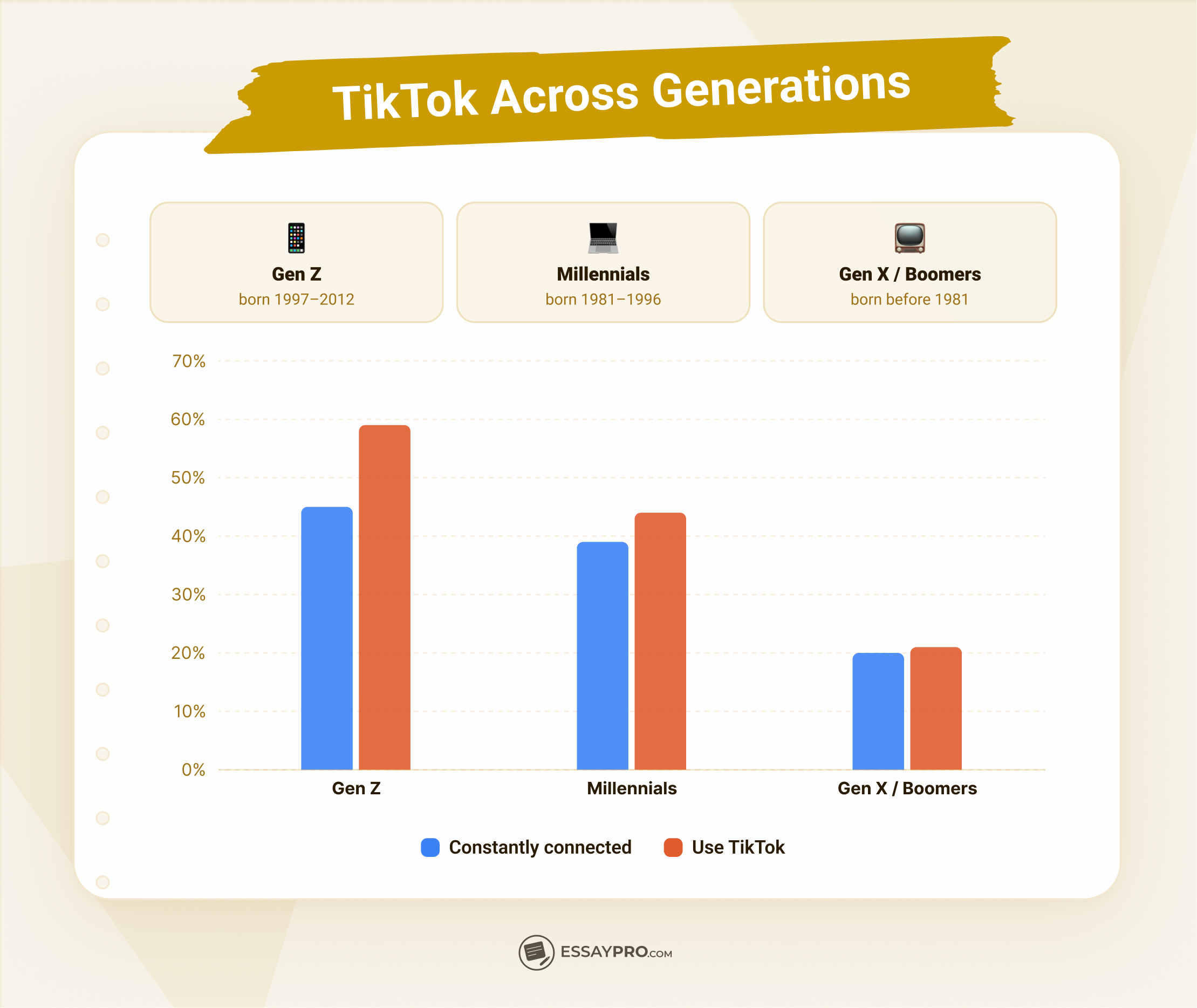
Time spent is the clearest gap. Gen Z averages 3.2 hours of daily social media use, more than double the 1.5 hours Baby Boomers spend, and Millennials sit in between, still active on the platforms that defined their coming-of-age but with less daily volume than Gen Z. Nearly 45% of Gen Z report being "constantly connected" to social media, compared with 39% of Millennials, 25% of Gen X, and just 14% of Baby Boomers. That gap extends to self-identification too: 80% of Gen Z respondents describe themselves as "chronically online," versus 69% of Millennials.
TikTok specifically shows up as a double-edged habit for young users. Over 73% of TikTok users agree the platform is addictive, and Gen Z users were the most likely of any generation to say so.
Yet perceptions of harm don't map cleanly onto usage: Pew Research Center found that most teen users say TikTok neither hurts nor helps their mental health, and teens on TikTok were actually slightly more likely to say the platform helps rather than hurts. At the same time, a meaningful share of Gen Z has genuine reservations about the platform's role in their lives: 47% of Gen Z say they wish TikTok had never been created, even as they continue using it daily.
The generational split extends to what social media is used for, not just how much. 34% of Gen Z teens at least sometimes use social media to find mental health information, with TikTok being the single most common platform for that purpose at 43%. That's a use case that barely registers among Millennials and older generations, who are far more likely to treat these platforms as entertainment or networking tools rather than informational or emotional resources.
Final words
For marketers, the takeaway is nuanced: Gen Z's deeper engagement with TikTok isn't unambiguous enthusiasm. It's a generation that spends more time on the platform, relies on it more heavily for information and even emotional support, and simultaneously holds more complicated, sometimes openly critical, views about what that dependence costs them.


Sopho Miller
is an experienced content writer who specializes in digital marketing, business, and academic topics. With a Master’s degree in Digital Marketing, she combines her expertise with a practical approach to create clear, engaging, and educational content. She crafts detailed guides and resources that support students in their academic journey. Outside of work, Sopho stays current with the latest industry trends and regularly attends workshops to further sharpen her skills.