

On paper, teacher pay has recovered well since 2020. The national average moved from roughly $65,000 that year to $74,495 in 2024-25, and NEA expects it to reach $76,552 in 2025-26. Numbers like that read as progress until inflation enters the picture and quietly claims most of the gain.
Adjust for what prices actually did over the decade, and the typical classroom teacher now takes home about 4.6% less than a teacher did ten years ago. As for the average teacher salary by state, the last two years widened the distance between the states that pay well and the ones that don't.
National Averages
The national average teacher pay by state reached $74,495 in 2024-25, up 3.5% from the $71,985 that teachers earned a year earlier, and NEA expects that figure to keep climbing to $76,552 in 2025-26. New teachers gained ground as well, with the average first-year salary rising to $48,112, a 3.4% increase that ranks among the stronger raises NEA has recorded in the past decade. That number looks better before inflation enters the math, because once rising prices are factored in, the real gain shrinks to roughly 0.7%. The specifics fill in what the average leaves out:
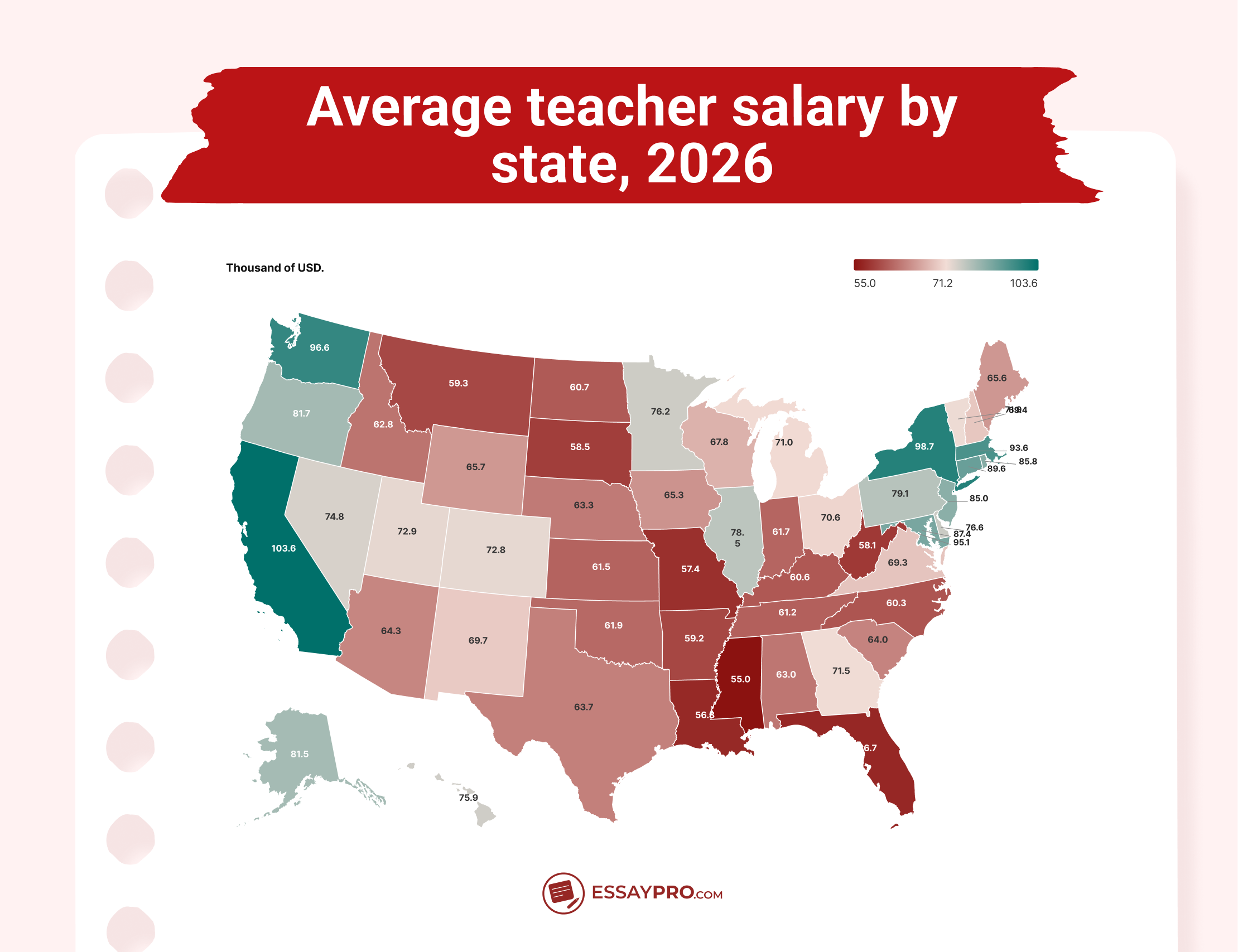
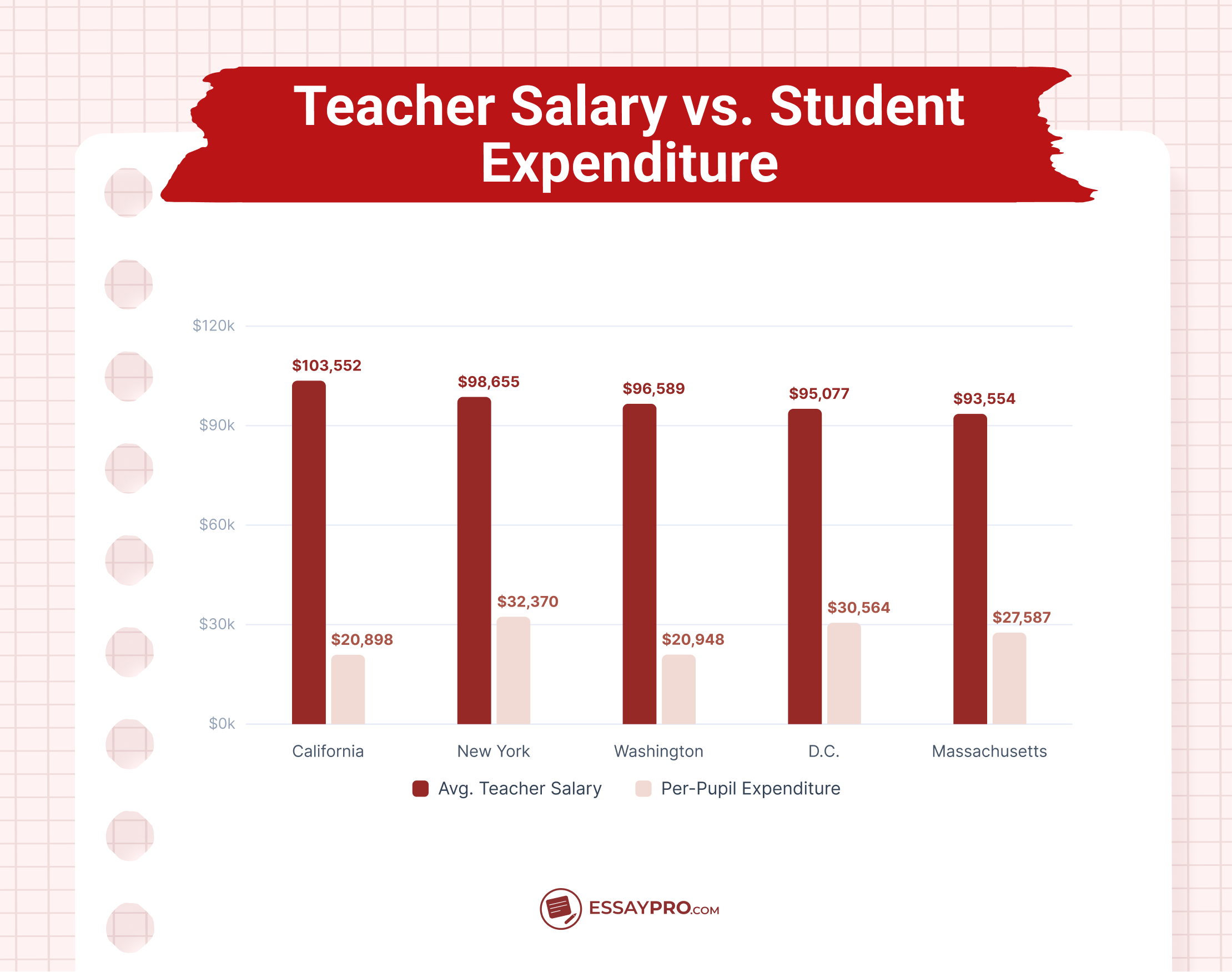
- California tops every state at $103,552, trailed closely by New York ($98,655) and Washington ($96,589).
- At the bottom are Mississippi ($54,975), Florida ($56,663), and Louisiana ($56,785).
- Nevada logged the steepest single-year raise at 11.8%, then the District of Columbia (9.7%) and Delaware (7.6%).
- Fifteen states now report an average starting salary of $50,000 or better, two more than last year's 13.
- About 7% of districts still hold top-of-scale pay below $60,000, regardless of how many years or degrees a teacher has earned.
The gap between the highest and lowest state averages is nearly $50,000, a spread wide enough that two teachers with identical experience and credentials can earn vastly different livings depending only on which state lines they happen to teach within.
Student Enrollment and Attendance
Enrollment and attendance underpin every per-student figure in this report. The most recent verified federal data comes from the National Center for Education Statistics, covering school year 2024-25:
- NCES counted 49,269,882 students in public elementary and secondary schools nationwide for 2024-25 (a figure that includes pre-K through grade 13). The United States total student membership for the school year 2024-25 was 49,269,882.
- Texas and California ran the largest systems, at 5,545,640 and 5,805,510 students. California enrolled 5,805,510 students and Texas 5,545,640 in 2024-25.
- At the other end, Vermont (81,398), Wyoming (89,915), and North Dakota (119,792) had the smallest state enrollments. Vermont enrolled 81,398 students, Wyoming 89,915, and North Dakota 119,792 in 2024-25.
Average daily attendance moved less dramatically:
- ADA edged up from 44,881,434 in 2023-24 to 44,899,200 in 2024-25, a change under 0.1%.
- The 2025-26 projection shows ADA declining 0.9% to 44,509,880.
The trend heading into 2025-26 points downward:
- NEA projects fall 2025 enrollment falls 0.9% to 48,357,996 students, extending a slide that has held for several years.
- Average daily attendance moved the opposite way in the latest measured year, rising slightly from 44,881,434 in 2023-24 to 44,899,200 in 2024-25.
- For 2025-26, NEA projects ADA declines 0.9% to 44,509,880.
Number of Teachers in Public Schools
Public schools employed 3,231,992 teachers in 2024-25, which was actually a small decrease, 0.29%, from the 3,241,231 on payroll a year earlier. The workforce has barely moved in either direction for a while now. NEA's 2025-26 estimate raises the count only a little, to 3,232,905, a 0.03% change that rounds to almost nothing.
Texas carries the largest teaching corps at 369,791, followed by California (270,067) and New York (218,424), while Alaska (6,680), Wyoming (7,311), and Vermont (7,882) employ the fewest. What stands out is the flatness: enrollment keeps slipping, yet the number of teachers remains close to steady.
Average Teacher Salary by State
Geography do§es a lot of the work in teacher salaries. California, New York, and Washington hold the top of the scale, each projected above $99,000 for 2026, while Mississippi, Louisiana, and Florida stay stuck under $60,000.
States With the Highest Average Salaries
The highest teacher salary by state lands where you'd probably guess, and 2025-26 does almost nothing to shuffle the usual names. California keeps first place at a projected $105,726. New York ($100,367) and Washington ($99,649) are the only other two states that break $99,000, and after them, the numbers taper off fast. Before anyone reads those figures as a straightforward win, though, the cost of living deserves a seat in the conversation:
- California's six-figure average competes against a living wage of about $73,311 for a single adult with one child in the state's most affordable metro, so the paycheck goes less far than the number suggests.
- Starting salaries reorder the leaderboard entirely. Washington, D.C. tops new-teacher pay at $64,640, then Washington state ($60,658) and California ($59,424).
- A high starting figure sometimes means a district front-loads its scale, paying newcomers well but slowing raises for veterans, which is why the top-average states and top-starting states never quite match.
States With the Lowest Average Salaries
The lowest teacher salary by state has barely changed in years, and 2025-26 keeps the same names locked at the bottom. Mississippi projects last at roughly $56,504, with Louisiana and Florida just above it. These three anchored the floor in 2024-25, too, and the year-over-year math explains why they haven't budged:
- Mississippi averaged $54,975 in 2024-25, Florida $56,663, and Louisiana $56,785, all far below the national $74,495.
- Mississippi's 2.78% and Florida's 2.48% both beat their prior-year pace, yet neither was large enough to climb the ranking.
- Cost of living softens the picture a little, since a dollar reaches further in Jackson than in Boston, though only up to a point.
Here's the number that should worry lawmakers in these states more than the ranking does: NEA estimates Mississippi's living wage for one adult and one child at $65,167, roughly $10,000 above what the average Mississippi teacher actually earns.
Average Expenditure per Student
What a state spends per student tracks loosely with what it pays teachers, though the two don't move in perfect lockstep. The national average per-student expenditure reached $17,873 in 2024-25, a 3.6% increase over the prior year's $17,250, and NEA projects it climbs to $18,898 for 2025-26. Here are the states at the top:
- New York led every state at $32,370 per student, well ahead of the pack.
- The District of Columbia ($30,564) and Vermont ($29,534) rounded out the top three.
- All three spent more than double the national average, a gap that reflects both cost of living and local funding structures.
And the states spending the least:
- Idaho came in lowest at $11,578 per student.
- Arizona ($11,987) and Utah ($12,029) followed close behind.
- Each of these three spent under $12,100, roughly a third of what New York put toward every student.
The distance between Idaho and New York, nearly $21,000 per child, is one of the widest disparities in American public education.


Ana Ratishvili
Ana is a professional literary writer with a Master’s Degree in English literature. Through critical analysis and an understanding of storytelling techniques, she can craft insightful guides on how to write literary analysis essays and their structures so students can improve their writing skills.