
A strong psychology dissertation topic pairs one measurable question with a validated instrument and a sample that is realistic to recruit. “Social media and mental health” fails all three. “Does daily Instagram use predict GAD-7 anxiety scores in UK undergraduates?” passes.
This guide sorts 190 psychology dissertation topics and psychology dissertation ideas by subfield.
What makes a good psychology dissertation topic?
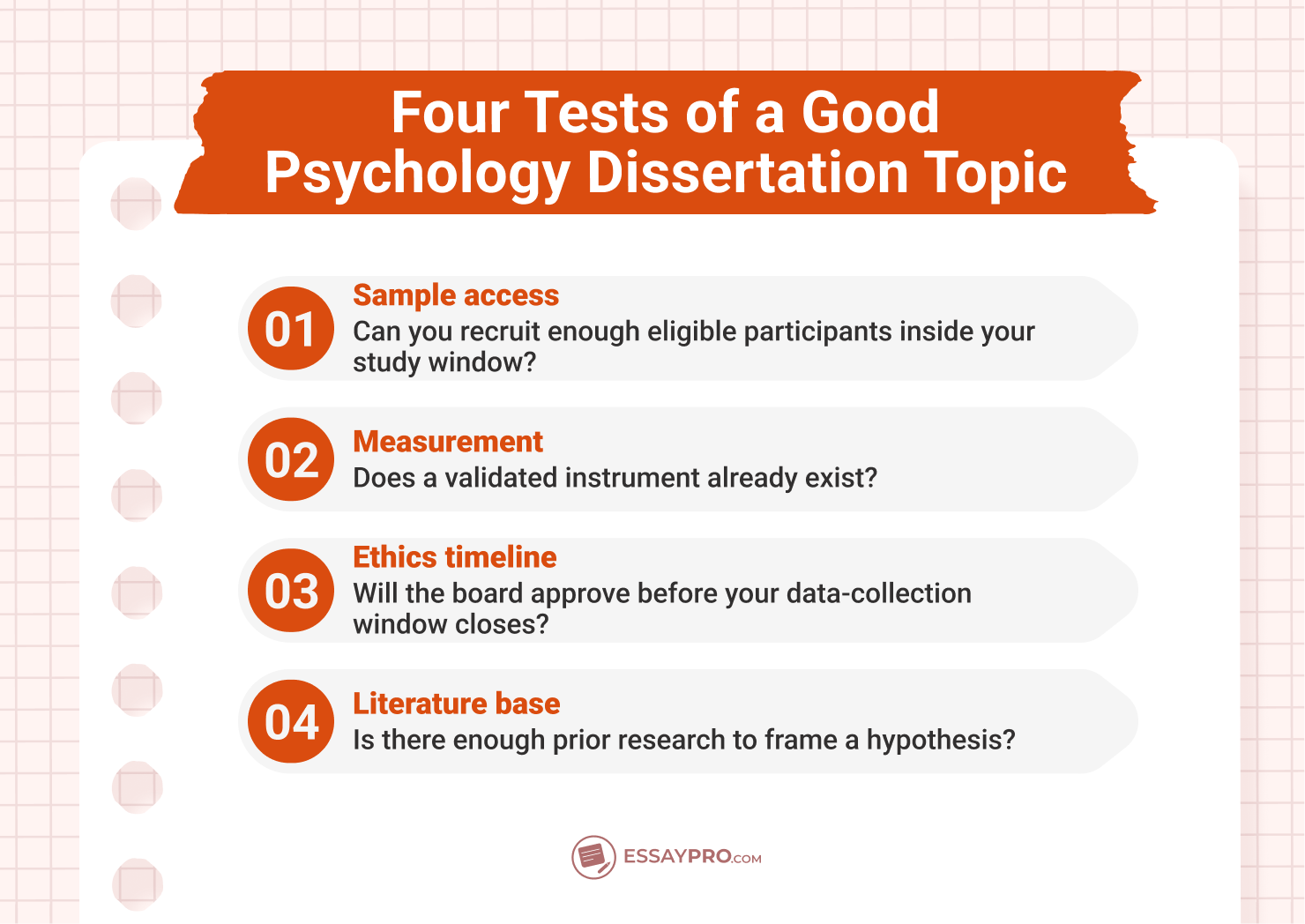
A good psychology dissertation topic meets a few practical tests. Topics that fail even one of the four ones below tend to stall before data collection begins.
- Sample access. Can enough eligible participants be reached within the study window? A topic that needs 200 practicing clinicians sets a high recruitment bar. A first-year student pool can be filled in a week.
- Measurement. Does a published, validated instrument already exist for the construct? Construction and validation of a new scale is a full dissertation on its own. For most student timelines, an existing measure is the only realistic option.
- Ethics timeline. Will the ethics board approve the design before the data-collection window closes? Vulnerable populations, deception, and clinical samples add months to approval.
- Literature base. Is there enough prior research to frame a hypothesis and position the study? A topic with three published papers gives almost nothing to argue against.
How do you narrow a psychology dissertation topic?
Narrowing a psychology dissertation topic means turning a broad construct into one testable question through four steps: pick a single construct, attach a reachable population, add a second variable that has a published measure, then lock the research design. The process takes one afternoon and prevents months of scope creep.
The same four steps work for any of the psychology dissertation ideas in this guide. Here is the sequence applied to one non-overused example, loneliness in later life.
- Pick one construct. Choose a single measurable construct, not a broad theme that covers too much ground for one study. For example: Loneliness in older adults.
- Attach a reachable population. Narrow to a group you can actually access, and note any ethics flags it raises. Example: Loneliness in retirement-community residents, a potentially vulnerable group that needs gatekeeper consent.
- Add a second variable with a published measure. Introduce a second variable that already has a validated instrument. Example: Nostalgia proneness and loneliness in retirement-community residents, measured with the Southampton Nostalgia Scale and the UCLA Loneliness Scale, Version 3.
- Lock the research design. State the design and the single hypothesis. Finished topic: “Does nostalgia proneness predict loneliness among retirement-community residents?”, a cross-sectional correlational survey testing that higher nostalgia proneness predicts lower loneliness.
Where do you find measures and participants for a psychology dissertation?
Three kinds of resource cover almost every psychology dissertation: a database of instruments, a set of free validated scales, and a participant platform. These three are the first stop for most projects, since good questions so often stall at the recruitment stage. Each link below goes straight to the source.
- APA PsycTests. A searchable database of published instruments; each record lists its permissions and scoring. The permissions field alone saves a week of emailing authors.
- PHQ-9 and GAD-7. Free, heavily validated screens for depression and anxiety; Pfizer provides them with no copyright restriction for reproduction. Two of the safest choices for a clinical-adjacent topic.
- PANAS, the Rosenberg Self-Esteem Scale, and the Perceived Stress Scale. Three free, heavily cited measures for affect, self-esteem, and perceived stress. The Rosenberg scale is public domain, so no permission request is needed at all.
- IPIP. A public-domain pool of personality items, usable with no fee and no permission request. The proprietary Big Five inventories charge per administration.
- OSF, ICPSR, and the UK Data Service. Archives of existing datasets for secondary analysis, which removes recruitment from the project entirely. A good route when the timeline is tight.
- SONA and Prolific. An undergraduate research pool (SONA) and a paid participant panel (Prolific). Prolific returns responses in hours, though the participant fees add up fast.

Psychology Dissertation Due Soon?
Hand the hard part to expert sand get back a polished, ready-to-submit paper on time!

What are psychology dissertation topics by subfield?
The 190 psychology dissertation topics below are grouped into 10 subfields. Every topic is distinct, and each maps to one of six research designs for the next section.
Clinical psychology
- Perfectionism predicts early dropout from outpatient depression treatment.
- Does a daily expressive-writing task reduce intrusive memories in trauma-exposed students?
- Smartphone self-help apps show only small effects on postnatal depression symptoms.
- How do adults with OCD describe the first time symptoms disrupted their daily life?
- Adults who report childhood emotional neglect show greater emotion-regulation difficulty.
- What stops men with depression from seeking help, and what would bring them in sooner?
- Among UK adults, does problem debt predict higher rates of common mental disorder?
- Night-time rumination is associated with poorer sleep quality in generalized anxiety.
- Cognitive behavioral therapy produces moderate reductions in health anxiety across trials.
- Does self-compassion buffer the link between shame and self-harm urges in young adults?
- How do adults in recovery from anorexia make sense of a relapse?
- Can a ten-minute mindfulness induction raise distress tolerance during a stress task?
- Insecure attachment predicts a weaker therapeutic alliance early in psychotherapy.
- What do people in long-term remission from psychosis credit for keeping their recovery stable?
- Nurse-delivered behavioral activation lowers depression severity in primary-care patients.
Counseling and psychotherapy
- What do bereaved clients point to as the most helpful moment in grief counseling?
- Counselor empathy ratings predict how deep clients find each session.
- Does a brief therapist self-disclosure strengthen the alliance in a first session?
- How large is the effect of the therapeutic alliance on counseling outcomes?
- How do clients experience the ending of long-term therapy?
- Clients with avoidant attachment prefer more directive counseling styles.
- Regular clinical supervision is linked to lower burnout in early-career therapists.
- Can a short breathing exercise before a session lower client anxiety?
- Early dropout after one or two sessions is predicted by a weak first-session alliance.
- How do minority-ethnic clients describe feeling understood by a counselor of a different background?
- How satisfied are clients with video-based counseling?
- More frequent sessions are associated with lower dropout in low-intensity counseling.
- How do trainee counselors respond to a client’s first mention of suicidal thoughts?
- Before a first session, what do new clients expect counseling to involve?
- Peer support protects experienced counselors from compassion fatigue.
Cognitive psychology
- Does faster background music slow reading comprehension in students?
- People with lower working memory capacity form more false memories.
- Does retrieval practice strengthen long-term retention of course material?
- How do expert chess players decide on a move when time is short?
- Under time pressure, people switch between tasks more slowly.
- Frequent mind-wandering predicts lower exam marks in undergraduates.
- Word-frequency effects on recognition speed differ between older and younger adults.
- Can harder-to-read fonts make statements seem less true?
- How strong is the link between bilingualism and inhibitory control?
- What tricks do people use to remember multiple passwords?
- People high in trait anxiety attend more to threatening words.
- Shorter sleep the night before predicts weaker sustained attention in shift workers.
- Heavy cognitive load pushes people toward utilitarian moral choices.
- Spaced study sessions improve exam performance in secondary-school students.
- Does strong emotion at encoding improve memory for central details?
Developmental psychology
- Does more screen time before age two predict a smaller vocabulary at age five?
- Parental warmth predicts higher self-esteem in early adolescence.
- How do first-generation university students experience their first term away from home?
- Harsh parenting is linked to more risk-taking in teenagers.
- Can a short self-control game improve persistence in four-year-olds?
- Children bullied by peers report more emotional problems three years later.
- How much does shared book reading at home support early reading skills?
- What role do grandparents play in the well-being of children in three-generation households?
- When teenagers picture their own future, what do they expect?
- Easy infant temperament predicts stronger social skills at preschool age.
- Does early joint attention in toddlers forecast later language ability?
- School readiness is similar for children in single-parent and two-parent homes.
- Teenagers who do more extracurricular activities report higher life satisfaction.
- Can a storytelling program build emotion vocabulary in young children?
- How do adopted adolescents make sense of their identity?
Social psychology
- Does contact with another group lower prejudice toward it?
- People comply more with a request from someone who shares their birthday.
- Perceived social support predicts lower loneliness in recent migrants.
- How do people explain a change of heart after a public argument?
- Across European countries, social trust predicts higher civic participation.
- A good deed can license more selfish behavior soon afterward.
- Belief in conspiracy theories is associated with a stronger need for certainty.
- What makes an apology feel sincere to the person receiving it?
- Larger bystander groups make individuals slower to help.
- Shared nostalgia for a group’s past strengthens identification with it.
- How do people describe everyday moments of casual discrimination?
- Do regular expressions of gratitude help new friendships deepen?
- Messages about neighbors’ recycling raise household recycling rates.
- Materialistic young adults report lower life satisfaction.
- What reduces loneliness most in older adults who live alone?
Health psychology
- How do people with long COVID describe living with daily fatigue?
- Illness beliefs predict medication adherence in type 2 diabetes.
- Does if-then planning increase weekly physical activity in inactive adults?
- Text-message reminders modestly improve smoking-cessation rates.
- Shorter sleep is associated with higher body-mass index in adults.
- People with lower health literacy are less likely to attend cervical screening.
- What tips the decision to attend cardiac rehabilitation after a heart attack?
- Does the framing of a health message change how often people use sunscreen?
- Self-efficacy predicts recovery speed after knee replacement.
- Do workplace wellness programs reduce sickness absence?
- Perceived stress predicts more physical symptoms in family caregivers.
- Can a two-minute video raise willingness to register as an organ donor?
- How do regular gym-goers talk about body image and their reasons for training?
- What helps people keep weight off in the years after bariatric surgery?
- Mindfulness practice produces small reductions in chronic pain.
Forensic and criminal psychology
- Psychopathic traits predict more rule-breaking at work.
- Does the presence of a weapon narrow what eyewitnesses remember?
- How do former gang members describe the process of leaving?
- Cognitive-behavioral programs modestly cut reoffending among violent offenders.
- Fear of crime runs higher among older adults than their actual risk warrants.
- Do clearer jury instructions make verdicts more confident?
- Which early risk factors predict stalking behavior?
- How do women rebuild daily life in the year after leaving prison?
- Childhood adversity predicts higher reoffending among young people.
- Does hearing a confession bias mock jurors even when they are told to ignore it?
- People who are treated fairly by police cooperate more later.
- Prison officers differ widely in their attitudes toward rehabilitation.
- How satisfied do victims feel after taking part in restorative justice?
- What helps young people on probation trust their supervising officer?
- Domestic abuse is reported to the police more often in deprived neighborhoods.
Educational and school psychology
- How do teaching assistants view their role in including pupils with additional needs?
- Higher teacher expectations predict higher pupil achievement.
- Does retrieval practice in class raise end-of-term test scores?
- Growth-mindset lessons produce only small gains in attainment.
- How do autistic pupils experience the move to secondary school?
- More homework is linked to higher family stress on school nights.
- Across countries, reading enjoyment predicts reading attainment.
- Test anxiety predicts poorer working-memory performance in exam students.
- Does peer tutoring build maths confidence among primary pupils?
- Specific praise raises how long pupils stay on task.
- Parental involvement predicts how often homework gets completed.
- A weaker sense of belonging predicts stronger dropout intentions in first-year students.
- What makes anti-bullying programs work in primary schools?
- Can a weekly gratitude journal improve classroom climate?
- How do young carers manage school alongside caring for a relative?
Occupational and organizational psychology
- Psychological safety predicts how often team members speak up.
- Does a structured interview reduce bias in hiring decisions?
- How do employees experience the return to the office after remote work?
- How strongly does transformational leadership lift team performance?
- Longer commutes predict lower job satisfaction.
- Job autonomy predicts work engagement among knowledge workers.
- What helps nurses recover from burnout, and what gets in the way?
- Does framing a goal as a gain increase persistence on a work task?
- What does meaningful work mean to gig-economy couriers?
- Do four-day-week trials improve employee wellbeing?
- Perceived overqualification predicts stronger intentions to quit.
- Onboarding quality predicts commitment among new hires.
- Can rephrasing feedback make criticism easier to accept?
- Workplace ostracism predicts more counterproductive behavior.
- How do older workers experience age stereotypes at work?
Neuropsychology and biological psychology
- Does morning bright-light exposure improve daytime alertness?
- Heart-rate variability predicts emotion-regulation ability.
- Cognitive problems often persist for months after a mild brain injury.
- How do stroke survivors describe changes in their sense of self?
- Longer habitual sleep predicts stronger memory performance in middle-aged adults.
- Does caffeine improve sustained attention during a long vigilance task?
- The brain’s right side dominates recognition of emotional faces.
- A larger cortisol awakening response predicts higher perceived stress in students.
- What is daily life like for someone recently diagnosed with early-onset dementia?
- Does a short bout of aerobic exercise boost working memory straight afterward?
- Left-handed adults complete mental rotation faster.
- Neurofeedback training produces mixed results for attention problems.
- Night-shift nurses with poorer sleep show weaker executive function.
- What helps recovery feel possible during rehabilitation after a brain injury?
- How do adults with aphasia manage conversations at work?
What are psychology dissertation topics for undergraduate, master’s, and PhD students?
Psychology dissertation topics for undergraduates, master’s, and PhD students differ mainly in scope and ethics load. Undergraduate projects use convenience samples and low-risk designs. Master’s projects reach community samples and mixed methods. PhD projects tackle unresolved questions across several studies.
Undergraduate
Keep it to a convenience sample, a free validated scale, and a design the ethics committee can wave through on a light-touch review..
- Does daily Instagram use predict body-image concern in undergraduates?
- Procrastination predicts higher perceived stress among university students.
- Do lyrics in study music lower reading comprehension in a student task?
- Caffeine intake is associated with poorer self-reported sleep in students.
- Can a two-minute gratitude list lift mood in a student sample?
- Extraverted students report a stronger preference for group study.
- More frequent phone-checking predicts lower self-rated focus in lectures.
- Does background noise reduce short-term recall in a student memory task?
- Social-media comparison predicts lower self-esteem in undergraduates.
- Morning-type students report stronger study discipline.
Master’s
Here you can recruit a specific group, workers in one firm or members of one club, and you can pair a survey with a handful of interviews, or lean on a dataset someone else already collected. Ethics review is standard for non-vulnerable adults, which keeps the approval timeline sane.
- Does job autonomy predict burnout among hospital administrative staff?
- How do new parents describe returning to work after parental leave?
- Perceived manager support predicts turnover intention in hospitality workers.
- Does a four-week online CBT module reduce exam anxiety in college students?
- Loneliness and volunteering frequency among retired adults in one town.
- What helps first-time managers feel confident in their first six months?
- Sleep quality predicts emotional eating in shift-working adults.
- Does a structured gratitude intervention improve team morale in a small firm?
- Neighborhood deprivation and adolescent well-being in an existing cohort dataset.
- How do amateur runners describe the mental side of training for a first marathon?
PhD
A doctorate is a multi-year program of linked studies, and it usually needs longitudinal data or a sample that most researchers cannot easily reach. Every topic here is a genuine open question, the kind where the honest state of the literature is still “we do not know yet.”
- Does early intervention in first-episode psychosis change long-term functional outcomes?
- What biological mechanisms link childhood adversity to adult inflammation?
- Can psychological interventions produce lasting change in implicit bias, and does behavior follow?
- How stable are personality traits across the lifespan, and what drives the change?
- Does loneliness accelerate cognitive decline over time?
- What is the long-term cognitive trajectory after COVID-19 infection?
- Do psychedelic-assisted therapies produce durable benefits beyond expectancy effects?
- Which components of psychotherapy are the active ingredients?
- How do gene-environment interactions contribute to depression risk?
- Can scalable digital interventions match face-to-face therapy at the population level?
What are trending psychology dissertation topics?
Most of what counts as a trending psychology dissertation topic right now traces back to three pressures since 2020: new technology, a run of health shocks, and a change in how people argue online.
- Does a mental-health chatbot reduce loneliness in adults on a therapy waiting list?
- Heavier use of messaging apps predicts greater loneliness in young adults.
- Long COVID predicts measurable attention problems six months after infection.
- Higher climate anxiety predicts more pro-environmental behavior in young adults.
- How durable are the benefits of psychedelic-assisted therapy for depression?
- Algorithmic feeds shorten sustained attention straight after scrolling.
- Does the amount of remote work predict employee well-being?
- How do people describe being drawn into extremist online communities?
- Does online public shaming heighten moral outrage in observers?
- What predicts continued use of a mental-health app past two weeks?
Which psychology dissertation topics should you avoid?
Avoid psychology dissertation ideas that your timeline and permissions cannot support. The usual traps:
- Clinical populations with no placement or gatekeeper lined up. Patient access runs through a clinician or a service manager, and that relationship takes time to build.
- Children or teenagers, unless your program already has a route. Parental consent, enhanced background checks, and a school’s own sign-off stack up fast, and each step adds weeks.
- Trauma and active suicidality. These topics need specialist supervision and a safeguarding protocol, which most undergraduate programs, and plenty of master’s ones, cannot provide.
- Deception on a tight ethics clock. Boards scrutinize these designs and tend to request a debrief procedure and rewrites, so approval drifts past the deadline.
- A proprietary instrument that is out of budget. Some respected scales bill per administration, a cost that a student grant rarely covers.
- A sample bigger than you can reach. Calculate the number your analysis needs first, because a design that demands 300 practicing nurses will not get finished.
Psychology Dissertation Due Soon?
Hand the hard part to expert sand get back a polished, ready-to-submit paper on time!
Final thoughts
Four things decide it: a question you can measure, an instrument that already exists, a sample within reach, and ethics that clear on time. Narrow a broad idea in four steps, fit the scope to your level, and name the design before you commit. Settle the measure early, and most recruitment headaches never arrive.
FAQ
What is a good psychology dissertation topic?
What are current psychology dissertation topics?
How do you choose a psychology dissertation topic?
What are easy psychology dissertation topics?
Do you need ethics approval for a psychology dissertation?
Where can you find validated psychology measures?
How long is a psychology dissertation?
Can you do a psychology dissertation without collecting data?

Ana Ratishvili
Ana is a professional literary writer with a Master’s Degree in English literature. Through critical analysis and an understanding of storytelling techniques, she can craft insightful guides on how to write literary analysis essays and their structures so students can improve their writing skills.