Every January, millions of Americans promise that this year will be different. For 2026, about 31% of adults planned a resolution, and those who did planned roughly six of them on average. Adults under 45 were about twice as likely as older adults to set one.
Keeping them is a harder matter. Only 39% of resolution-makers say they are very likely to stick with their goals all year, and just 27% of adults kept their financial resolutions in 2025. Even so, the habit seems to feel worthwhile. Among people who make resolutions, 63% say it helps make the year better, compared with 14% of those who skip them. The sections below break the numbers down by gender and generation.
How many Americans will make a New Year’s resolution?
Roughly three to four in ten. About 30% of adults made a resolution for 2024, and the figure for 2026 sits at 31%. Estimates shift from poll to poll because the question is worded in different ways, and one January 2026 poll found that 52% of Americans made no resolution at all.
Among those who do set goals, exercise leads one 2026 list at 25%. Being happier follows at 23%, then eating healthier at 22%, and saving money and improving physical health at 21% each. A year earlier, saving money held the top spot at 26%. When respondents could pick several answers from a list, saving money and exercise tied at 45%, with physical health at 41%.
Gender
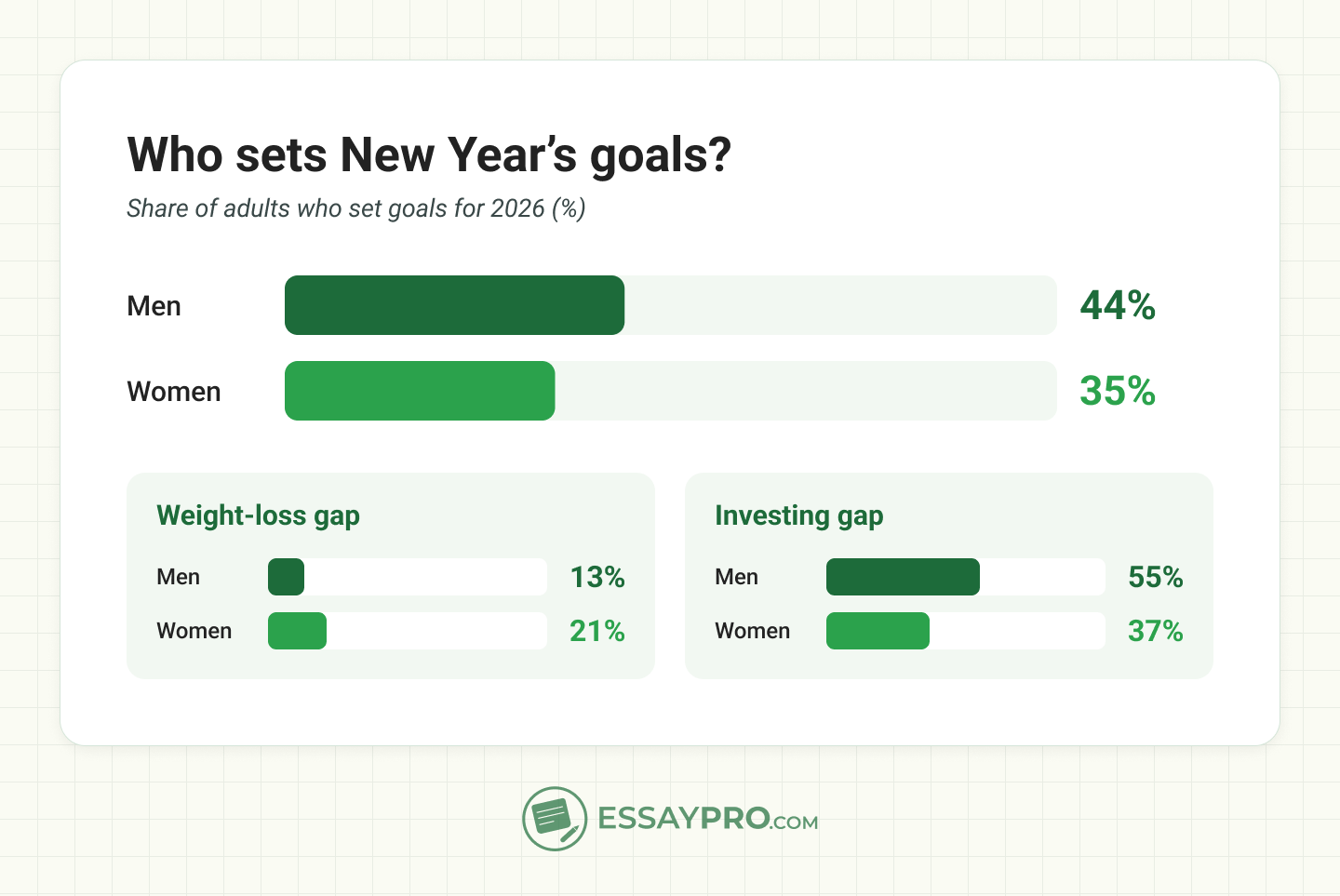
Men are more likely to set goals. In one survey, 44% of men planned resolutions, against 35% of women. The goals differ as well. Women are more likely to resolve to lose weight (21% vs. 13%) and to be happier (26% vs. 20%).
Money plans split along gender lines too. A financial goal comes first for 73% of men and women who make resolutions, but 55% of men plan to invest, against 37% of women.
Generation
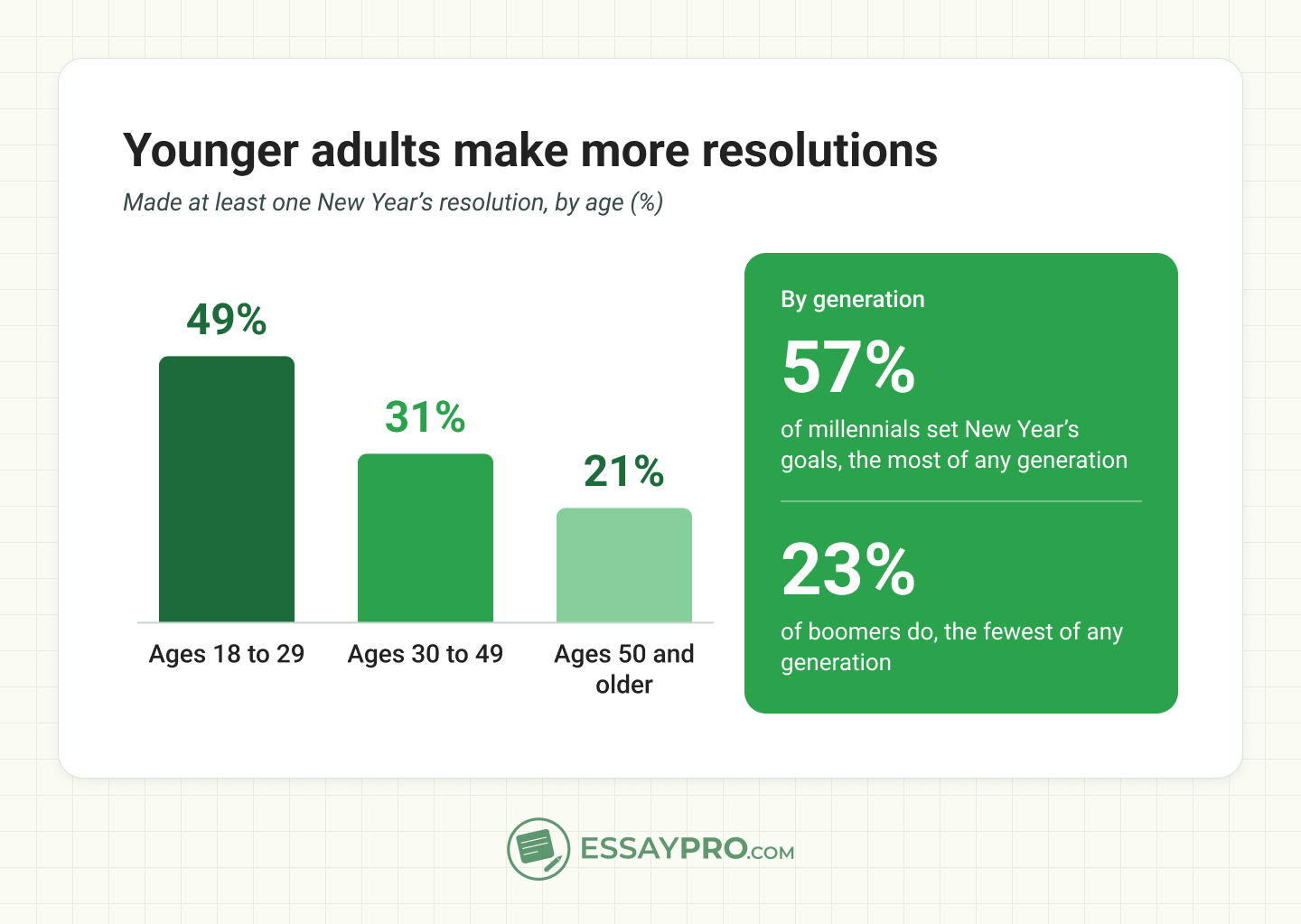
Younger adults lead. Millennials are the most likely to set resolutions (57%) and baby boomers the least (23%). Another poll shows a similar spread by age: 49% of adults 18 to 29 made a resolution, compared with 31% of those 30 to 49 and 21% of those 50 and older.
The gap is easy to see in the goals themselves. Adults under 45 are far more likely to resolve to save money (30% vs. 14%), pursue a career goal (17% vs. 2%), improve their mental health (24% vs. 10%), and learn something new (23% vs. 9%). Mental health shows the widest divide: 58% of 18- to 34-year-olds plan a resolution in this area, against 11% of those 65 and older.
How many Americans think they will fail their resolution?
Few expect to fail, yet confidence is shaky. Among resolution-makers, 39% say it is very likely they will keep their goals, 50% say somewhat likely, and 7% say not very or not at all likely.
Doubt runs higher for money goals, where only 43% of adults expect to stick with their plan. In a survey of adults 25 and older living in households that earn under $100,000, 14% of those planning financial resolutions described themselves as not very confident. Anxiety plays a part as well, with 30% of Americans feeling anxious about keeping their resolutions.
History gives some reason for the worry. Fitness-tracking data from around the world points to January 12 as the day people are most likely to break a resolution, and one 2023 survey put the average life of a resolution at 3.74 months.
Gender
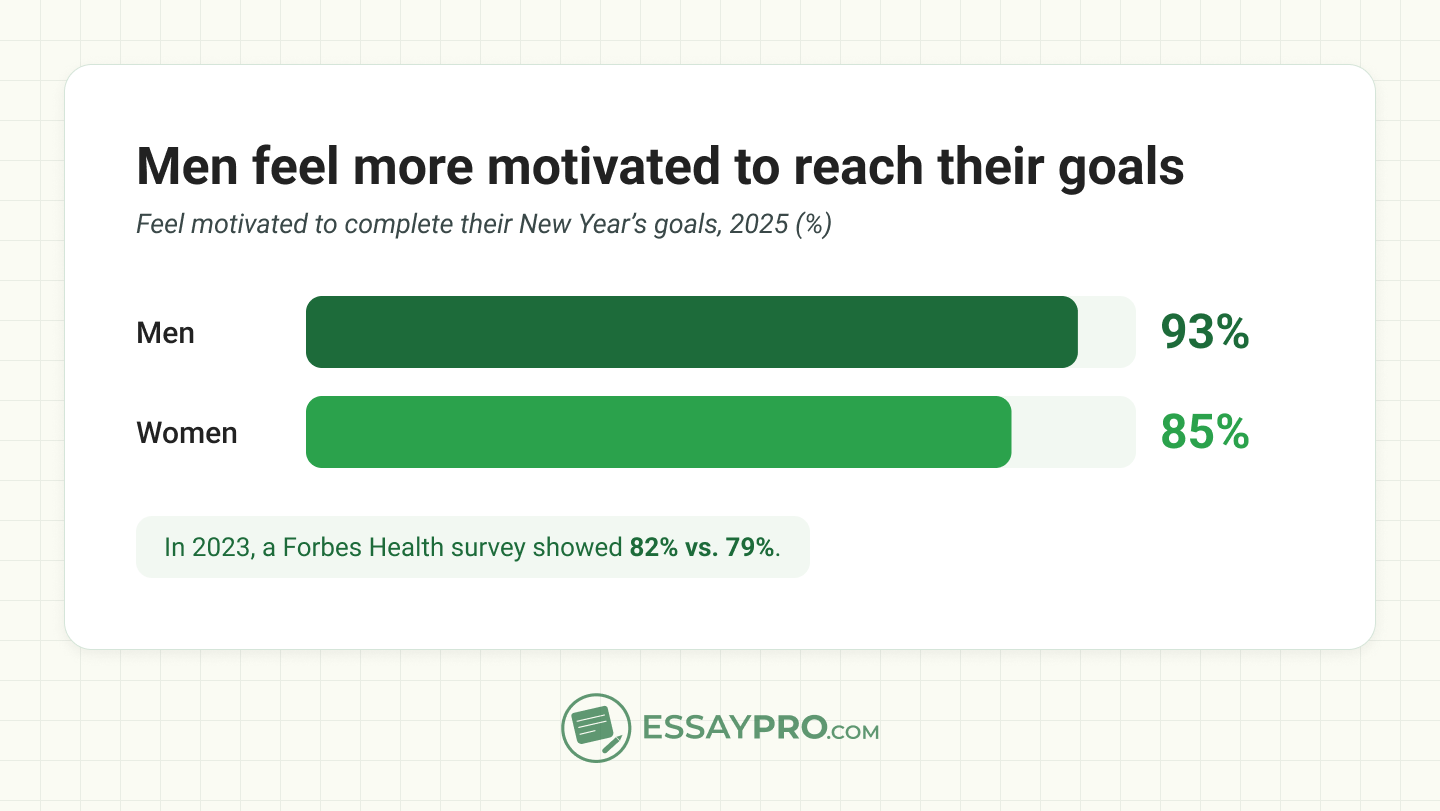
Men report slightly more confidence. In one survey, 93% of men felt motivated to complete their goals, compared with 85% of women. A 2023 survey showed the same direction, with 82% of men and 79% of women confident they would reach their goals. The gap is small, so it is better read as a tilt than a divide.
Generation
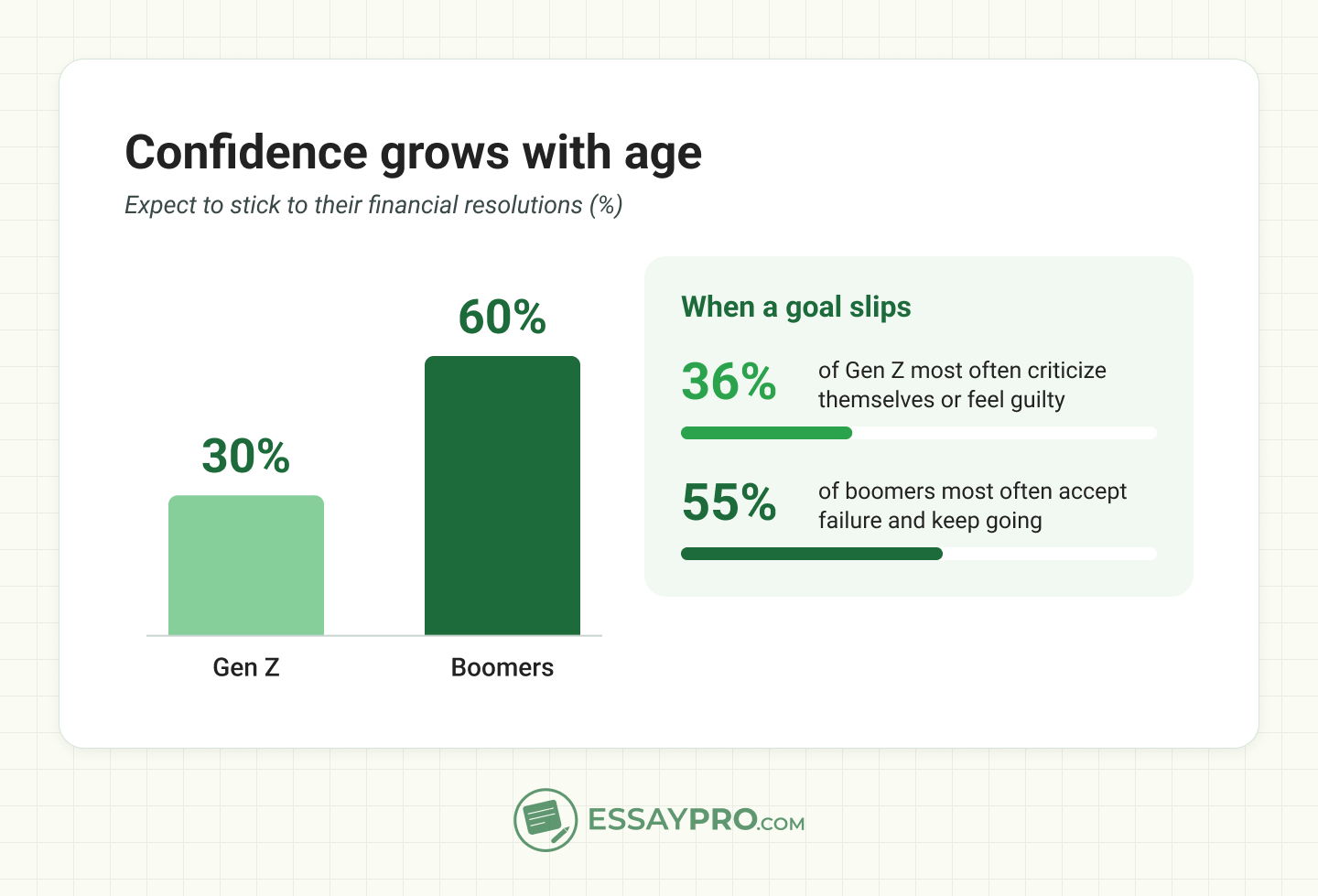
Confidence rises with age. Among people who set financial resolutions, confidence in sticking with the plan is 60% for baby boomers and 30% for Gen Z, against 43% overall.
Setbacks also seem to hit younger people harder. When a goal slips, 36% of Gen Z respond with self-criticism or guilt, while 42% of millennials, 48% of Gen X, and 55% of boomers accept the setback and keep going. That difference may matter more than the plan itself, since quitting after one bad week can make it much harder to return to the goal.
What are the excuses for failed New Year’s resolutions?
Money tops the list of obstacles, followed by mental health and time. In one survey, 28% of respondents named mental health challenges as a reason for falling short, and 22% named lack of time.
For financial goals, the leading barriers are rising costs (39%), trouble maintaining habits (30%), lack of time (17%), insufficient knowledge (7%), and limited support from family or friends (7%). About 64% agree that setting a financial goal is easy but sticking to it is hard. Results from 2025 tell a similar story. Of the people who set financial resolutions, 10% gave up because of rising costs and 7% could not keep up the habits.
Gender
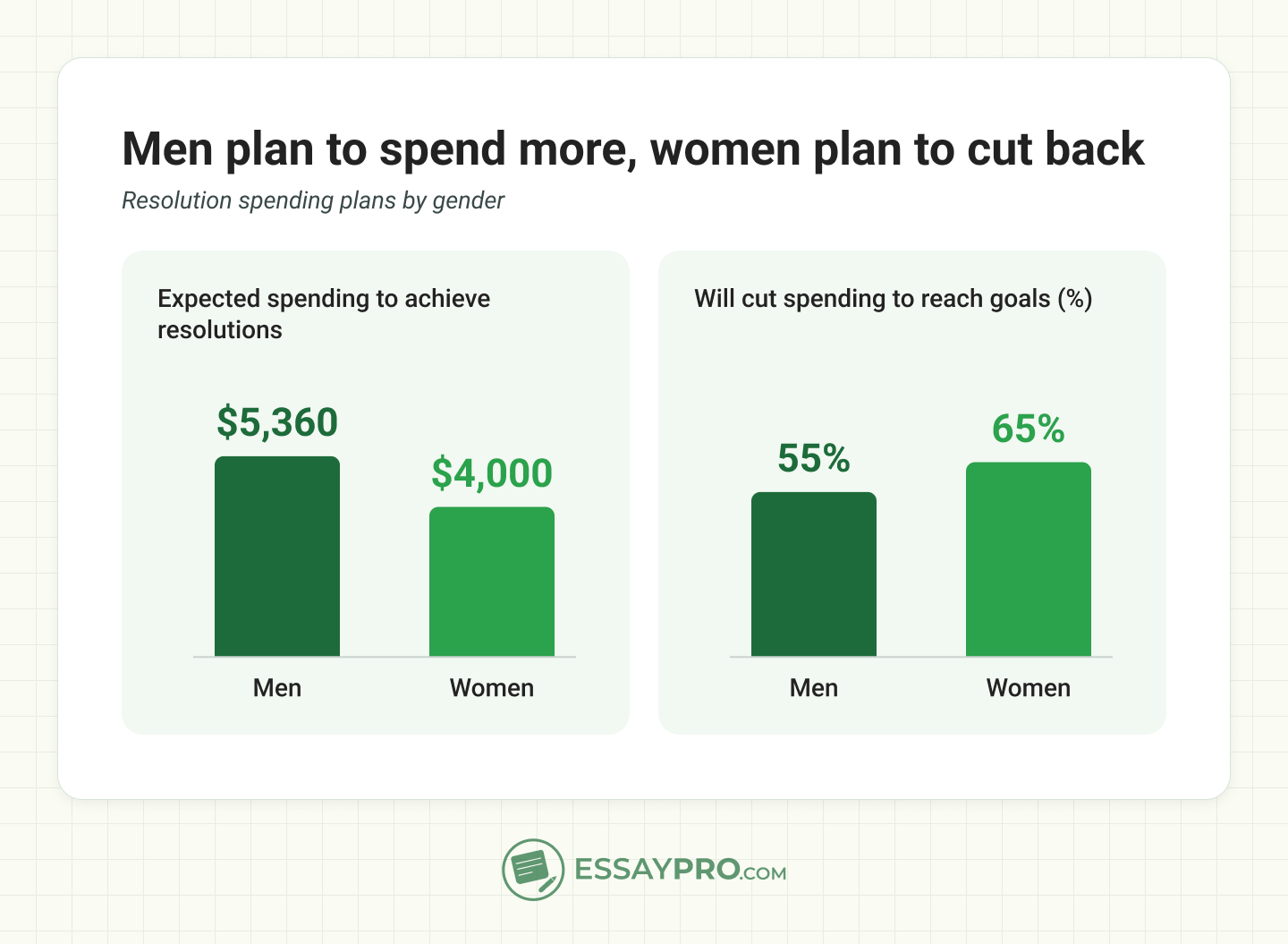
Reasons for quitting are rarely split by gender in US polling, but cost appears in the data. Men expect to spend about $5,360 on their resolutions, against $4,000 for women, and men aged 35 to 54 expect to spend more than $6,000. Women are more likely to cut spending elsewhere to reach their goals (65% vs. 55%), which suggests that a tight budget may shape their plans in a different way.
Generation
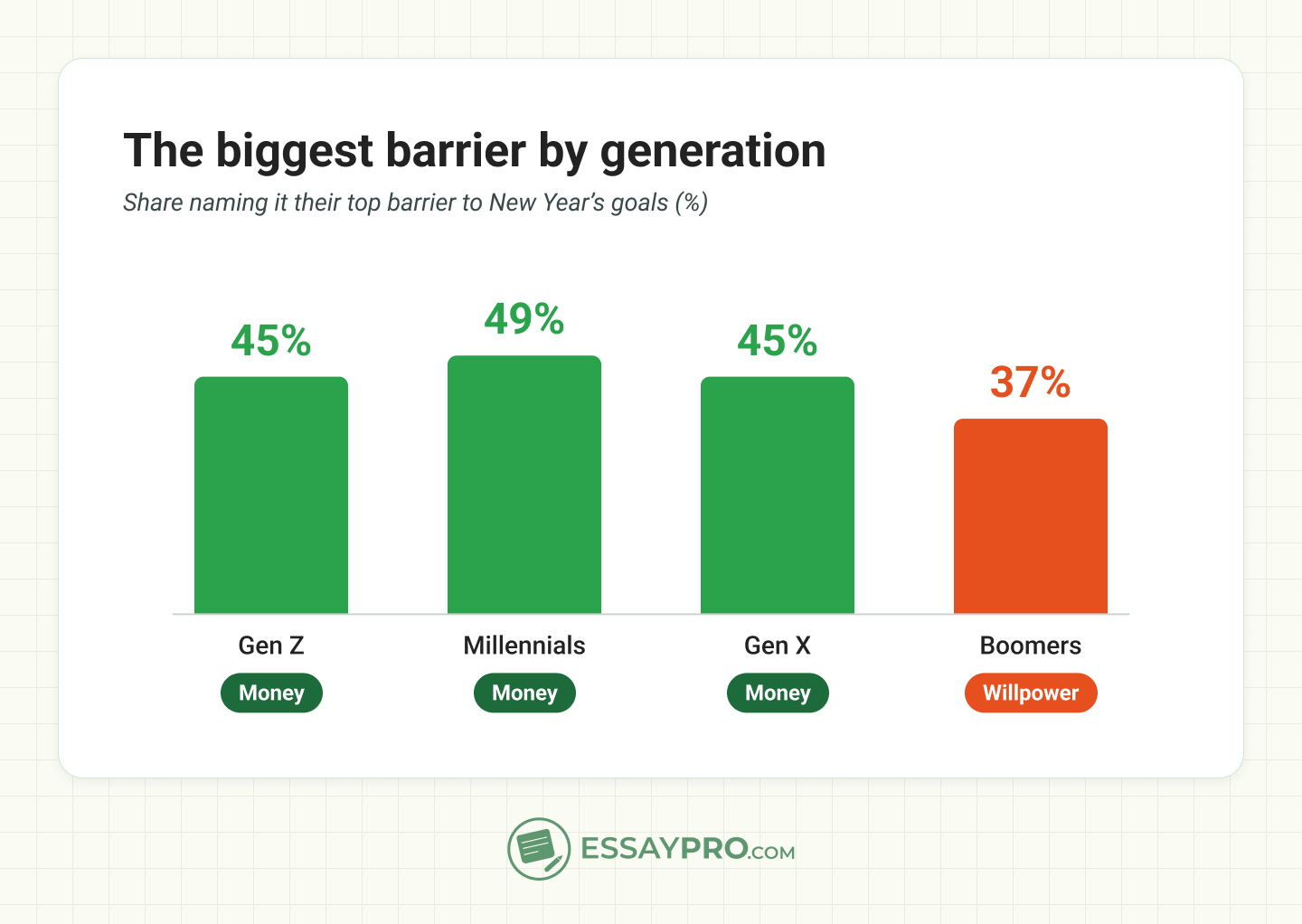
Money blocks three generations, while boomers point to willpower. Not having enough money is the biggest barrier for 45% of Gen Z, 49% of millennials, and 45% of Gen X, while 37% of baby boomers blame a lack of willpower.
The money goals themselves differ by age. Gen Z focuses on saving for a milestone (23%), millennials and Gen X on paying off debt (26% and 28%), and boomers on retirement savings (18%).
Some New Year’s resolutions
Pick a few and keep them small. The ideas below draw on our list of new year resolutions for students, plus a few extras, and each one comes with a first step.
School and study
- Submit assignments two days early. Write that earlier deadline in your planner.
- Try a new study method each month. Start with flashcards and move on to mind maps.
- Go to office hours twice a month. Bring one question each time.
- Review your notes every weekend. Set aside 30 minutes on Sunday.
- Take a practice test each month. Start with your hardest class.
Personal growth
- Read one self-development book a month. Keep the e-book on your phone for spare minutes.
- Journal for five minutes each evening. Aim for three lines, nothing more.
- Take a public speaking course. A free campus workshop is a good place to look.
- Ask for feedback once a month. Pick one person and one question.
Health and wellness
- Walk 10,000 steps a day. Check your current average, then add 1,000.
- Sleep seven to eight hours. Fix a bedtime and set a wind-down alarm.
- Cook one meal from scratch every week. Begin with a recipe you already like.
- Swap sugary drinks for water. Keep a bottle in your bag.
- Meditate for 10 minutes a day. Use a free app right after breakfast.
Money
- Set a monthly budget. Review it every Friday.
- Save a fixed share of your income. Transfer it on payday.
- Cancel unused subscriptions. Go through your bank statement tonight.
- Pay off your costliest debt first. List your balances by interest rate.
- Build an emergency fund. Start with one month of basic costs.
Social life
- Reconnect with an old friend each month. Send a short message today.
- Join a club. Try one meeting before you decide.
- Volunteer once a month. Pick a cause you already care about.
- Call family on a schedule. Choose a weekly time and stick to it.
Lifestyle
- Declutter one room. Take it one shelf at a time.
- Plan meals for the week. Write the shopping list on Sunday.
- Keep one screen-free hour before bed. Charge your phone in another room.
- Spend 30 minutes outdoors daily. Take a walk on your lunch break.
- Cut your screen time. Check your weekly report, then trim it by 10%.
Final words
For 2026, roughly three to four in ten Americans planned a resolution, with men, millennials, and adults under 45 leading the way. Exercise, saving money, and happiness top the lists. Most resolution-makers expect to keep their goals, yet only 39% say it is very likely, and confidence in money goals drops to 43%. Gen Z reports the lowest confidence (30% on financial goals) and the most self-criticism when a goal slips. Money, mental health, and lack of time are the most common reasons for falling short. The simplest fix is a small, specific goal with a first step you can take this week.

Daniel Parker
is a seasoned educational writer focusing on scholarship guidance, research papers, and various forms of academic essays including reflective and narrative essays. His expertise also extends to detailed case studies. A scholar with a background in English Literature and Education, Daniel’s work on EssayPro blog aims to support students in achieving academic excellence and securing scholarships. His hobbies include reading classic literature and participating in academic forums.