A useful lesson plan answers three questions: What should students learn? How will they learn it? What evidence will show that they learned it? Start with those answers, then choose activities, materials, and timing.
This guide explains how to write a lesson plan step by step, with a practical format, a worked example, and ways to adapt instruction for different learners. If you're balancing coursework with student teaching, our writers at EssayPro can also help with your academic writing tasks.
What is a lesson plan?
A lesson plan is a teacher’s written guide to a specific lesson. It identifies the learning objective, instructional sequence, materials, assessment, and supports students need to participate.
It should be detailed enough that you can teach from it without having to reconstruct your decisions during class. It does not need to be a word-for-word script. Include essential questions, directions, examples, and checks for understanding; leave room to respond to students’ work.

Importance of lesson planning
Lesson planning connects your teaching decisions to student learning. It helps you:
- Prioritize the goal. Choose activities because they support the objective, not just because they are entertaining.
- Anticipate difficulties. Prepare explanations for likely misconceptions and check prerequisite knowledge.
- Organize materials. Have texts, supplies, technology, and accessible alternatives ready.
- Manage time. Protect time for practice and assessment rather than letting the introduction consume the period.
- Plan access and challenge. Prepare required accommodations, targeted supports, and meaningful extensions.
- Decide what comes next. Use student work to determine whether to reteach, provide more practice, or move forward.
The plan is useful when it supports decisions during teaching—not merely when every box is filled in.
Lesson plan format
Use your school’s required lesson plan template if it has one. Otherwise, copy this format and adjust it to your subject and grade level.
Standards and objectives serve different purposes. A standard describes a broader learning expectation. A lesson objective identifies the specific learning students will demonstrate in this lesson.
Lesson plan template
Copy this template into your own document and fill in each field. Keep each answer short, since the plan only needs to be detailed enough to teach from.
Lesson information
- Teacher:
- Subject and grade:
- Topic:
- Date:
- Lesson length: ___ minutes
Part 1: Plan
Part 2: Lesson flow
Part 3: Reflection (after the lesson)
- Who met the objective?
- What errors appeared?
- Which choices helped?
- What will I change next time?
- Next step: reteach, practice, extend, or move on
How to write a lesson plan: creative steps
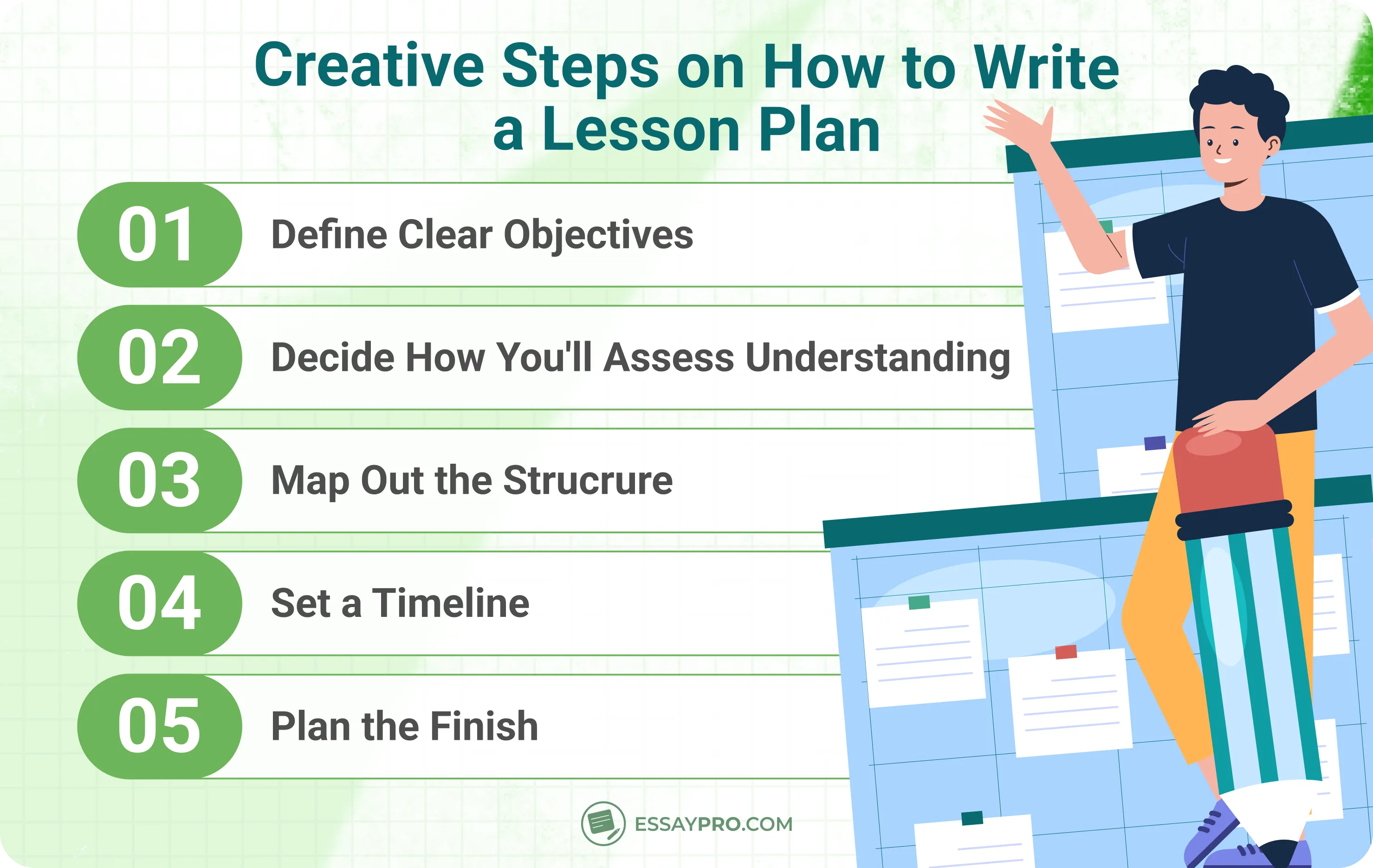
To write a lesson plan, define the learning objective, decide what evidence will demonstrate success, sequence instruction and practice, allocate time, and plan the closing check.
Choose creative activities after establishing the goal. A game, discussion, or hands-on task earns its place when it helps students learn or demonstrate something specific.
Define clear learning objectives
Start with the relevant standard and what students already know. Then write an objective using an observable action, such as identify, explain, compare, solve, construct, or justify.
“Understand fractions” does not specify what students will do. A clearer objective is: “Students will partition shapes into equal parts and label one part as a unit fraction.”
Add success criteria so students know what accurate work looks like.
Decide how you'll measure understanding
Plan the assessment before selecting activities. Ask: What would students say, write, make, or do if they met this objective?
If the objective is to explain, students need to produce an explanation. If it is to solve a problem, they need to solve one, not simply report feeling confident.
For a fractions lesson, an exit ticket might ask students to draw a rectangle divided into four equal parts, shade one part, and label it 1/4. Check the equal partitions, shading, and fraction label separately to identify the source of an error.
Decide how you will respond to results: a brief correction, a small-group reteach, additional practice, or an extension.
Map out the lesson flow
Sequence the lesson so students receive the preparation they need before working independently.
- Activate or check prior knowledge. Use a short question or task directly related to the objective.
- Explain and model. Demonstrate the skill, including the thinking behind each step.
- Guide practice. Work through an example together and check students’ responses.
- Assign independent practice. Give students a task that reveals what they can do without your help.
- Assess and close. Collect evidence and return to the main learning.
For a fractions lesson, begin by showing shapes with equal and unequal partitions. Model how to divide a whole into equal parts, label one part, and explain what the denominator represents. Then have students create and label their own models.
Plan one likely misconception explicitly. In this example, students may count parts without checking whether they are equal. Include a non-example and ask students to explain why it does not represent fourths.
Set a realistic yet flexible timeline
Assign minutes to each segment, including distributing materials and moving between tasks. Identify an optional activity you can shorten or remove without sacrificing the objective.
Here is a complete 45-minute third-grade fractions lesson example:
- Objective: Students will partition shapes into equal parts and label one part as a unit fraction.
- Success criteria: Parts are equal in area, one part is identified, and the denominator matches the number of equal parts.
- Materials: Paper rectangles, pencils, crayons, prepared partition diagrams, and exit tickets.
- Support: Provide pre-partitioned shapes and the sentence frame, “One of __ equal parts is __.”
- Extension: Ask students to represent the same unit fraction using differently shaped wholes and explain each model.
Use our AI paragraph rewriter to revise wordy lesson-plan paragraphs into clearer directions.
Plan the finish
Closure should bring students back to the objective. Plan a short task that captures the essential learning, rather than introducing new material at the end of class.
A reflection such as “What surprised you?” can encourage discussion, but use an objective-aligned response when you need evidence of learning.
Presenting your lesson plan during class
Keep the plan accessible, but focus on students’ responses rather than reading it aloud.
- State the objective in student-friendly language. For example: “Today you’ll show and label one equal part of a whole.”
- Show what success looks like. Use a model, checklist, or worked example.
- Give clear directions. State the task, materials, expected product, and available time.
- Check directions before starting. Ask a student to explain the first step.
- Use evidence to adjust. Review answers and work samples instead of relying on expressions or silence.
- Make transitions explicit. Explain what students should stop, keep, put away, or begin.
- Protect the assessment. Shorten an optional activity if necessary so students still have time to demonstrate learning.
If several students make the same error, pause for a targeted explanation and another attempt. If a few need help, provide support while others continue.
Reflecting on the lesson after class
Use student work to evaluate the lesson while the details are fresh. Brief notes are enough if they lead to a clear next step.
Ask:
- Who met the objective? Use the success criteria to review individual responses.
- What errors appeared? Distinguish a conceptual misunderstanding from a calculation, reading, or directions error.
- Which instructional choices helped? Identify useful models, questions, and supports.
- Was the timing realistic? Note where transitions or explanations took longer than planned.
- What should happen next? Choose reteaching, targeted practice, extension, or the next lesson.
- What should change in the plan? Record the specific example, direction, or activity to revise.
A useful reflection is actionable: “Several students labeled unequal parts as fourths. Begin tomorrow with equal-area examples and nonexamples, then check individual models.”
Lesson plans for different grade levels
The same planning principles apply across grades: clear objectives, aligned assessment, purposeful instruction, and accessible practice. Adjust the text complexity, task demands, directions, and independence to your students’ current knowledge and skills.
Elementary school
Elementary lesson plans work best with short instructional segments, predictable routines, and concrete materials that students can see, touch, or act out.
Instruction. Model each skill explicitly and think aloud as you work. Use a gradual release sequence: you demonstrate, the class tries it together, then students try it alone. Break directions into single steps, and show each one rather than only describing it.
Practice. Plan short tasks with clear endpoints, and build in purposeful movement, such as sorting cards, using manipulatives, or moving to a partner. Routines matter: when students know how activities work, more of their attention is available for the content.
Assessment. Much of your evidence will come from watching and listening. Circulate during practice, ask students to explain their thinking aloud, and use drawings or quick demonstrations instead of long written responses. Make success criteria visual, for example, with a picture checklist.
Example objective: "Students will retell the beginning, middle, and end of a story using picture cards."
Planning tip: Expect to reteach. Revisiting a skill across several days is normal at this age, so plan brief reviews into upcoming lessons.
Middle school
Middle school lesson plans need firm structure with room for interaction. Students at this age are ready for more independent thinking, but they benefit from clear routines, defined roles, and frequent checkpoints.
Instruction. Keep explanations focused, and connect the content to something students recognize. Model the skill, then shorten guided practice as students show readiness.
Practice. Use partner and small-group work with structure: assigned roles, a specific task, a time limit, and a product to share. Sentence stems such as "I think __ because __" keep discussions on topic and help students who are reluctant to speak.
Assessment. Exit tickets, short written responses, and partner explanations work well. Check individual work regularly. Group products can hide students who are confused.
Mini lesson example: Here's how a 45-minute lesson on subordinating conjunctions might flow:
- Objective: Students will combine two simple sentences using a subordinating conjunction (because, although, when) and punctuate the result correctly.
- Warm-up: Display two choppy sentences on a topic students care about and ask what's missing in how they connect.
- Modeling: Combine the sentences to show how the conjunction changes the relationship between ideas and when a comma is needed.
- Guided practice: Partners sort sentence cards into correct and incorrect combinations, explaining each choice.
- Independent practice: Students revise three sentences from their own recent writing.
- Exit ticket: Students write one sentence beginning with "Although" and punctuate it correctly.
Planning tip: Plan transitions carefully. Middle school lessons often lose time between activities, so give exact directions for what students should stop, keep, and start.
High school
High school lesson plans can include longer independent work, more complex texts and problems, and multi-day tasks. Students still need explicit modeling and frequent checks, especially for complex or unfamiliar skills.
Instruction. Model how experts in your subject think. Annotate a primary source, talk through a proof, or show how you evaluate evidence. Connect the content to real contexts, such as current events, careers, or questions students are already asking.
Practice. Give students extended time to apply skills independently, and include structured discussions such as seminars, debates, or peer review against clear criteria. For longer projects, plan checkpoints so you can catch problems before the final product is delivered.
Assessment. Use tasks that require reasoning: analytical paragraphs, multi-step problems, or evidence-based discussions. High school students often won't tell you when they're lost, so check understanding more often than seems necessary. A quick written response reveals more than asking, "Any questions?"
Example objective: "Students will evaluate the credibility of two news sources reporting the same event, using a criteria checklist."
Planning tip: Leave space for students to contribute. A well-timed pause, a relevant story, or a moment of humor can open the discussion, especially for quieter students.

Unsure how to make a lesson plan?
Rely on our experts to steer you toward an engaging lesson plan.
Lesson planning inspiration
Start with the objective, then look for material that gives students a meaningful reason to use the skill.
- Ask students about their interests. Use relevant topics without changing the learning goal.
- Use a news story. Build a source-evaluation or argument lesson around reporting that students can examine.
- Choose a short film scene. Analyze dialogue, characterization, tone, or visual evidence.
- Use music or art. Ask students to support interpretations with specific details.
- Consult teacher communities. Adapt shared activities to your standards, time, and learners.
- Revisit strong texts. A short passage can support close reading, vocabulary, and writing.
- Review curriculum resources. Look for worked examples, misconceptions, and assessment items.
- Use student work. An anonymous error or contrasting pair of responses can launch a focused lesson.
Before using a resource, check its accuracy, accessibility, age appropriateness, and connection to the objective. Preview media and prepare a backup for technology-dependent activities.
Final thoughts
Learning how to write a lesson plan starts with alignment: the objective, instruction, practice, and assessment should point toward the same learning.
Keep the plan practical. Specify what students will do, what successful work looks like, and how you will respond when they need more support or challenge. After teaching, use their work to improve the next lesson.
If student teaching leaves little time for coursework, our writers at EssayPro can help with your academic writing tasks.
FAQs
What is the format for a lesson plan?
How to write lesson plans?
What is an example of a lesson plan?

Ana Ratishvili
Ana is a professional literary writer with a Master’s Degree in English literature. Through critical analysis and an understanding of storytelling techniques, she can craft insightful guides on how to write literary analysis essays and their structures so students can improve their writing skills.