
Education technology trends 2026 point one direction: consolidation. After years of buying anything new, schools and campuses now ask what works before they spend. The global EdTech market was valued near $200 billion in 2025 and is forecast to reach between $348 billion by 2030 at 13.3% annual growth and $456 billion at 17.9%, a gap that reflects how differently analysts read the same decade. AI drives most of that spending. Immersive hardware, verifiable credentials, and flexible delivery split the rest. This guide covers the twelve trends defining classrooms and campuses through 2027.
EdTech Trends 2026
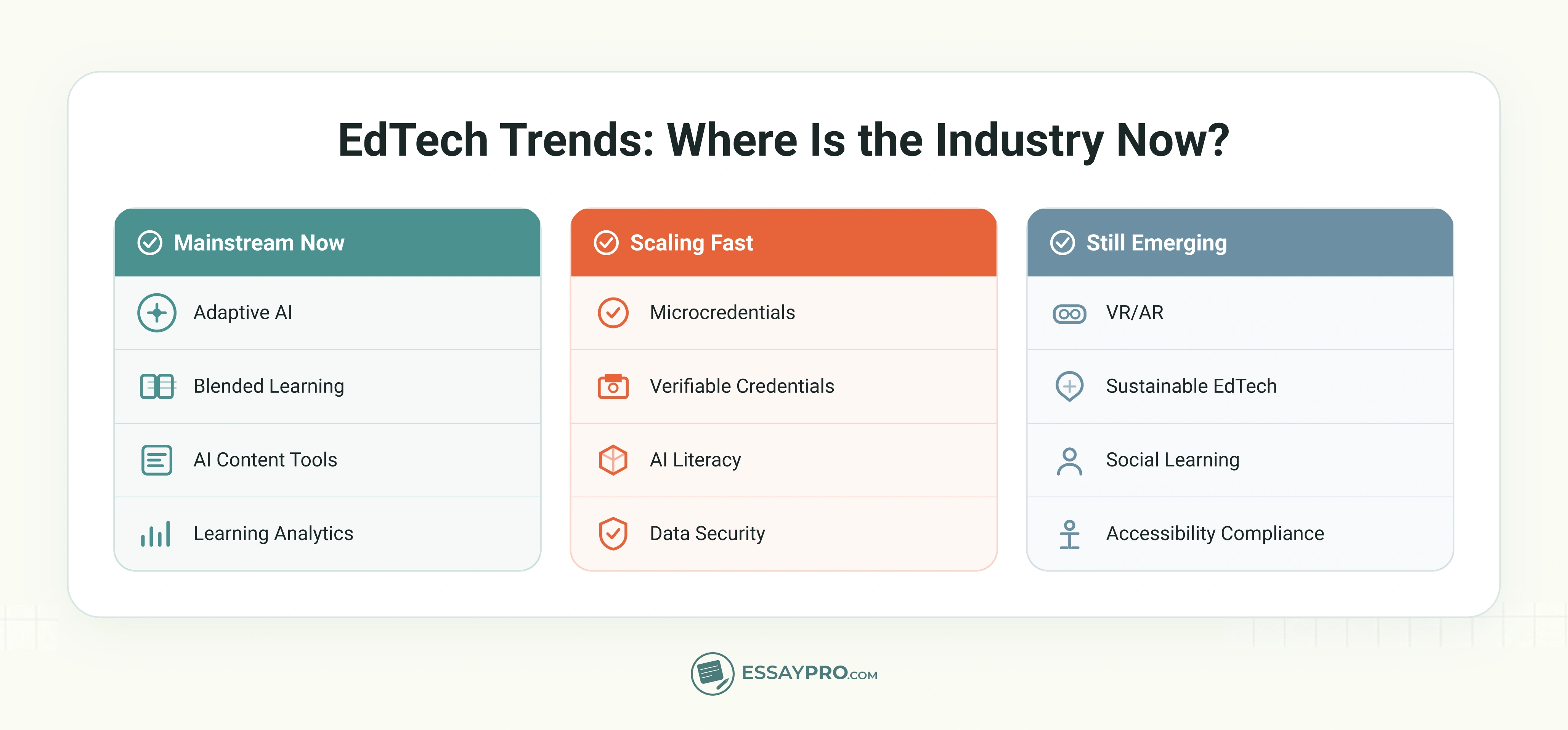
The technology trends in education below run in order of current adoption and near-term impact. Every figure comes from a study published in 2025 or 2026.
Adaptive Learning Powered by AI
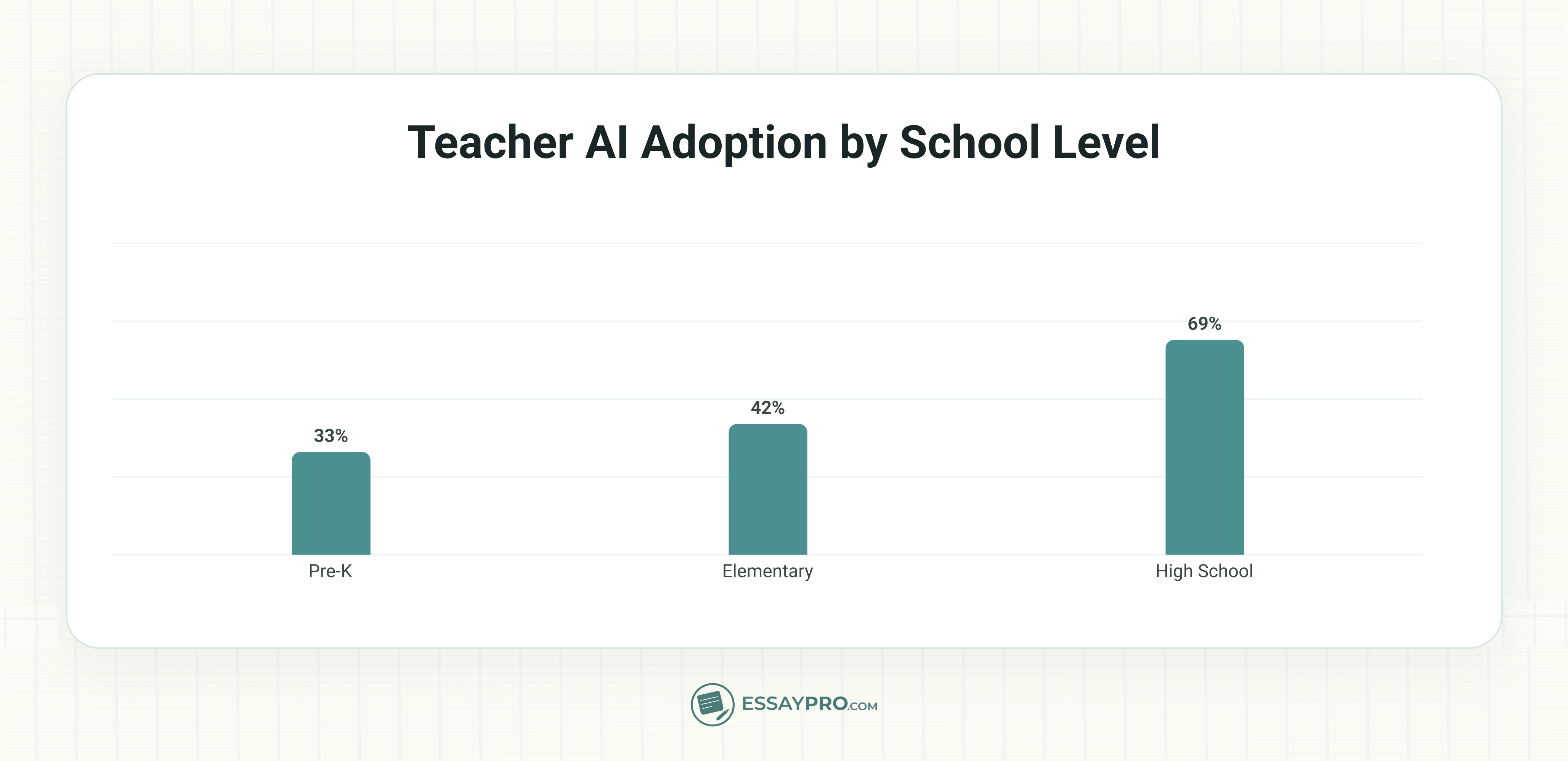
6 in 10 US public school teachers reached for an AI tool at some point in 2024-25, and three in 10 now use one every week. The weekly users say it buys them back about 5.9 hours a week, which works out to roughly six weeks over a school year. So adoption is settled. Whether any of it teaches better is the part still being argued, and one 2025 trial is the most-cited piece of evidence either way: 194 physics students learned more than twice as much from a purpose-built AI tutor, in 49 minutes against the classroom's 60. Worth keeping in view, though: it covered two topics, one course, a single session. A teacher looking to start should treat adaptive tools as a drafting and practice aid, not a replacement for the parts of the lesson that need a person in the room.
Game-Based and Immersive VR/AR Learning
Immersive learning is the technology trend in higher education where the pitch keeps running ahead of what campuses actually do. Across universities, VR adoption stays low, and the evidence for real learning gains stays thin, stuck on cost, technical support, and results that refuse to hold steady from one study to the next. The places it does earn its keep are the ones where failing for real is expensive or dangerous:
- Surgery
- Aviation
- Chemistry labs
Cheaper headsets have taken some of the sting out of the upfront bill. The thing that still kills most rollouts is that there’s not enough curriculum-grade content, and no clean way to fit a headset session into a syllabus, which is why pilots so often die in the department that started them. If you are weighing a program, cost it by the content and the staff time, never by the hardware alone.
The Rise of Microcredentials and Skill Badges
A microcredential is a short, skill-specific certification, something like a data analytics or project management module, finished in weeks instead of years and issued as a digital badge the learner can drop onto a LinkedIn profile or a résumé. The pull is coming from employers, and it is specific rather than vague enthusiasm. 94% of employers say they would put more on a starting salary for a candidate who holds a relevant one, and 92% say those hires do better in their first year on the job. 82% trust credentials built with an industry partner more than those a university puts together on its own.
Blended and On-Demand Learning Models
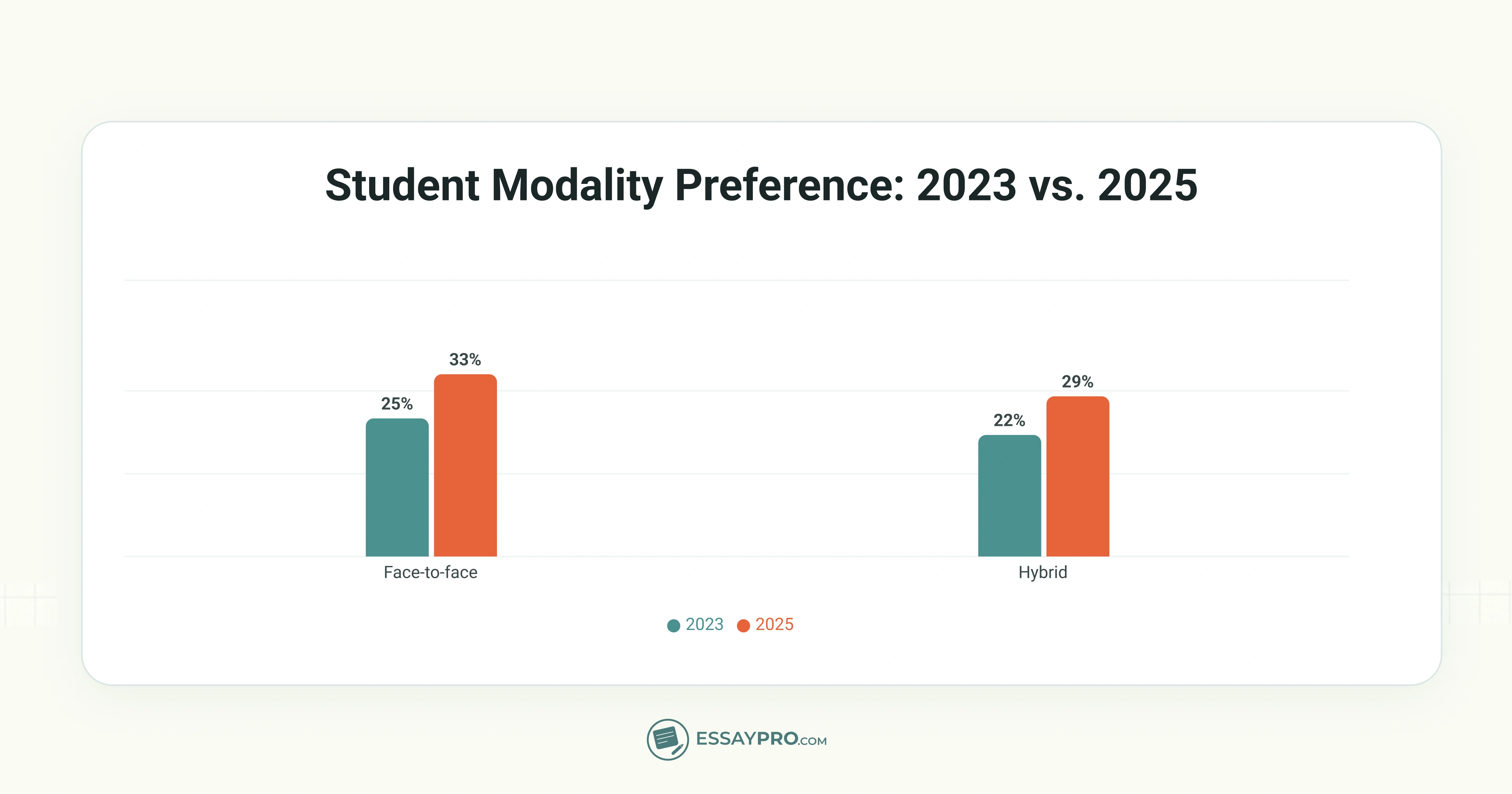
Blended and on-demand formats have hardened into a permanent fixture among trends in technology for education, not the temporary workaround everyone assumed in 2021. By fall 2024, 54.8% of US students were taking at least one online course, comfortably above where the pre-pandemic line would have put it. What it is not is a one-way trip online. Fully online undergraduate enrollment has leveled off near 24%, down from the 2021 high, and students themselves are edging back toward the room: the share who say they prefer face-to-face climbed to 33% from 25%, with another 29% wanting a hybrid mix. So the market and its users are walking in opposite directions, platforms and budgets still expanding, while degree-seekers quietly vote for the classroom. The format that wins is usually a hybrid done deliberately, not online by default.
AI Literacy on the Curriculum
AI literacy stopped being a nice-to-have and became written policy in 2026. That June, a framework for primary and secondary schools laid out 19 competences across four domains:
- Engage with AI
- Create with AI
- Manage AI
- Shape AI
Those same competences are set to feed PISA 2029, the first international assessment to measure AI literacy head-on, which is the moment it starts getting counted like reading or maths. On top of that, the EU AI Act has obliged organizations to ensure a baseline of AI literacy since February 2025. The policy is well ahead of the practice, though: only 18% of US teachers get any formal guidance on using AI at work, which leaves most of them working it out, or steering clear of it, on their own read of the situation.
Verifiable Digital Credentials
Here is the awkward truth behind the microcredential boom: a badge only counts if the person reading it can confirm you earned it, and for years, that meant emailing a registrar and waiting. That is the gap this trend closes. A verifiable digital credential is a tamper-evident record that an employer can check in seconds, no phone call, no issuer in the loop.
Three things fell into place, mostly in 2025:
- The data model behind these credentials reached full standard status, stable enough to build on.
- Open Badges 3.0 now issues each badge as exactly this kind of credential, kept in the learner's own wallet rather than on a platform that may not exist in five years. If you have ever lost access to an old course site, you will appreciate why that matters.
- Europe went furthest: eIDAS 2.0 obliges every member state to offer a wallet capable of holding a diploma.
The practical difference it makes:
Data-Driven Teaching Through Learning Analytics
Ask a provost what keeps them up, and you will hear some version of retention. Learning analytics is the tool aimed squarely at that worry, and its real appeal is early warning. A model stitches together signals that look harmless on their own:
- Attendance
- Log-in frequency
- How late assignments come in
- Grade trends
Read together, those can surface a student slipping toward a fail while there is still a term left to turn it around. That is the good version. The honest caveat, the one vendors gloss over, is that a prediction inherits every bias in the data it was trained on, so a model can, to be exact, systematically tag students from particular backgrounds as risks on evidence that would not convince a human. The programs that get value from this keep an adviser reading every alert. A dashboard should trigger a phone call, never a decision on its own.
AI Tools for Creating and Curating Content
Of everything AI promised education, this is the part that actually arrived, and it came through the least glamorous door. Ask teachers what they use it for, and the honest answer is logistics. The most common tasks are:
- Drafting worksheets and assessments
- Administrative work
- Lesson prep
Generating a first pass is trivial now. What separates useful from careless is the second step, and almost nobody puts it on a feature list:
A quiz written in nine seconds still needs a human read before it reaches a student, and the teachers who gain hours treat output as raw material. Skip that read often enough and standards slide, a little at a time, until someone notices.
Meeting Accessibility Standards (ADA and WCAG)
This one is not a trend so much as a deadline with teeth. A 2024 federal rule put state and local institutions, public universities among them, on the hook to meet WCAG 2.1 Level AA across their sites and apps. Then the timeline shifted in April 2026, which has confused half the people
Concretely, conformance means:
- Captions on video
- Text that a screen reader can actually parse
- Full keyboard navigation, no mouse required
The part institutions keep underestimating is the archive, every lecture recording and scanned PDF accumulated over a decade. Begin auditing now. Remediating that volume of old content is the slow part, and the extra year disappears faster than it reads.
Greener, More Sustainable EdTech
For a long time, sustainability here meant paperless handouts and not binning a working laptop, and that still matters. The larger issue now is the electricity behind the AI everyone is rushing to adopt. Global data-center demand is projected to more than double by 2030, to roughly 945 terawatt-hours, with AI workloads growing the quickest of all, and it already rose 17% in a single year.
So an honest account of this trend splits into two:
- The familiar half: device lifecycles and e-waste.
- The newer one nobody budgeted for: the running energy cost of the models themselves. Every AI tutor a district switches on draws from that grid.
My practical suggestion is unfashionable but simple. Before you enable an AI feature for ten thousand students, ask the vendor what it consumes, and whether the lighter non-AI version does the job.
Collaborative and Social Learning Tools
The reason these tools are back is almost too plain to state: students got a long taste of learning alone and decided they would rather not. The preference data backs it up. Five years on from the remote scramble, instructor preference for in-person teaching climbed to 64% in 2025, from 55% in 2023, with students voicing the same want for contact.
The features now ship by default in the main platforms:
- Discussion boards
- Peer review
- Group work
- Shared annotation
The failure mode, which I have watched happen more than once, is bolting these on as a compliance box: a forum goes up, two posts appear, it dies by week three. What works is narrower and harder, an assignment that genuinely cannot be done alone, weighted so students treat it seriously. Build for real interdependence, or the features go unused.
Stronger Data Security in EdTech
Schools are an appealing target for a dull reason: they hold rich personal data and guard it on a shoestring. That data includes names, dates of birth, special-education files, and sometimes a parent's payment details. The latest figures are not reassuring. The education sector recorded 1,075 incidents, 851 of them with confirmed data loss, system intrusion leading, and financially motivated outsiders driving most of it, while ransomware featured in 44% of breaches across every sector, up from 32% the year before.
The weaknesses are structural: thin IT teams, systems a decade past their prime, and no slack in the budget. Fixes:
- Multi-factor login
- Patching on a schedule
- Offline backups
- Staff trained to recognize a phishing email
EdTech Trends: The Hard Parts and the Payoffs
The edtech trends worth tracking in 2026-2027 each pair a real opportunity with an equally real risk, and usually the same force drives both.
Opportunities, with the numbers behind them:
- Teacher time. Weekly AI users report saving about 5.9 hours a week, roughly six weeks a year handed back to actual teaching.
- Workforce signalling. 94% of employers say they would pay more for a relevant microcredential, rewarding schools that align to industry.
- Evidence. A 2025 trial found more than double the learning gains from a well-built AI tutor, the category's first hard proof.
Challenges, equally concrete:
- Security. Ransomware now appears in 44% of breaches across sectors, and schools are lightly defended.
- Compliance. Public institutions face an April 2027 accessibility deadline with years of back content to remediate.
- Energy. The AI behind the gains runs on data-centre demand set to double by 2030.
The institutions that do well will not chase every tool. They will pick the two or three that pay back in hours or outcomes, then spend the freed capacity on the hard parts: training, security, and proof that any of it works.
EdTech Future Trends: What the Forecasts Point To
The credible edtech future trends for the next two years rest on a handful of forecasts, each from a named forecaster rather than a vendor deck.
Taken together, the hiring and assessment forecasts point one way: AI skill stops being a bonus and becomes a measured, hireable competency, which drags microcredentials and AI literacy from the edge of the catalog to the center of what schools actually sell. Gartner also expects AI agents to trigger a $58 billion shake-up in productivity software by 2027, a strong signal that the agents now piloting in advising and admissions are not a passing experiment. My own read: the loudest 2026-2027 arguments will be about governance, not capability, namely who answers for it when an agent advises a student wrong.
EdTech Industry Trends: The Bottom Line
Step back from the individual edtech industry trends, and one pattern runs through all twelve: the easy years are over, and discipline is the advantage that is left.
AI is the throughline, across personalization, content, analytics, and the agents now reaching advising desks, but the sector has stopped mistaking novelty for proof. The first rigorous evidence of AI learning gains arrived in the same stretch as the hard limits: narrow conditions, thin teacher guidance, genuine security, and energy costs. Both are true at once.
For anyone deciding over the next two years, three moves hold up:
- Buy for proof, not novelty. Ask a vendor for outcome data and the exact conditions it was measured under.
- Fund the unglamorous layer first. Security, accessibility fixes, and teacher training return more than the next feature will.
- Build AI literacy now, for staff and students, before PISA measures it in 2029 and employers screen for it by 2027.


Ana Ratishvili
Ana is a professional literary writer with a Master’s Degree in English literature. Through critical analysis and an understanding of storytelling techniques, she can craft insightful guides on how to write literary analysis essays and their structures so students can improve their writing skills.