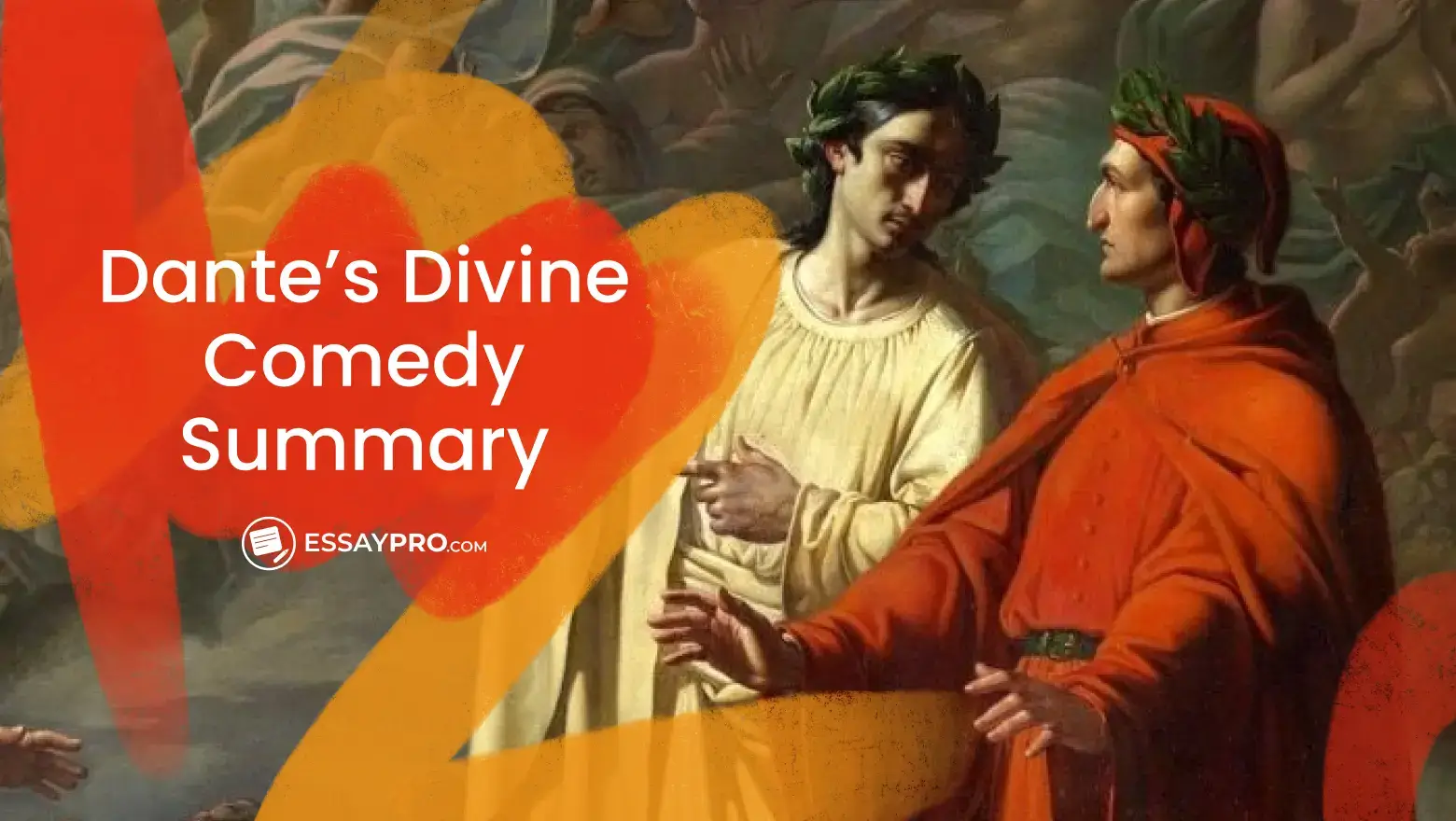
The Divine Comedy, or La Divina Commedia, is a narrative poem by the Italian poet Dante Alighieri. Dante came from Florence, a city full of political tension, religious argument, family rivalries, and public ambition. He was a poet, philosopher, theologian, and political figure, so his poem comes from a man who had watched his world break apart and then tried to understand the soul within that wreckage.
In this article, we will go through all three parts of the poem, with the closest attention on Dante’s Inferno. We will look at the journey, the main characters, the circles of Hell, and the meaning behind Dante’s encounters. You may also find it helpful to read more about symbolism and how it can give writing a deeper second layer.
The Story and Structure of The Divine Comedy
He began writing The Divine Comedy around 1308 and finished it in 1321. Long before that, in 1274, Dante saw Beatrice, the woman who would follow him through his imagination for the rest of his life. Their real connection was brief, but in his writing, Beatrice becomes memory, grace, moral beauty, and the voice that calls him toward salvation. Dante had already honored her in La Vita Nuova, and in The Divine Comedy, he gives her a place no ordinary love interest could hold.
In the Middle Ages, major poetry was usually written in Latin. That choice kept literature close to educated readers and far from many ordinary people. Dante went against that tradition by writing in the Tuscan dialect, an early form of Italian. It was a bold literary decision. He took a story about the divine and wrote it in daily language. The Italian dialect gave the poem a life that Latin would not.
Modern readers are often mislead by the title “comedy.” The Divine Comedy does not mean that it is funny, but it’s used in the older literary sense, according to which a comedy begins in suffering and ends in restoration. Dante starts in fear and confusion. By the end, he reaches a vision of God. The movement of the poem is upward, even though it begins by going down.
The poem has three parts: Inferno, Purgatorio, and Paradiso. In Inferno, Dante sees Hell and the souls fixed forever within their sins. In Purgatorio, he climbs a mountain where souls suffer in order to be cleansed. In Paradiso, he rises through Heaven and approaches divine truth. Each part has thirty-three cantos, with one opening canto before them, which gives the poem one hundred cantos in total.
Numbers are not accidental in Dante’s poem. The number three returns again and again because of the Christian Trinity: the Father, the Son, and the Holy Spirit. Inferno includes three beasts, the three-headed Cerberus, and the three-faced Satan. The number seven appears through the seven deadly sins and the seven terraces of Purgatorio. The number nine appears in the nine circles of Hell and the nine spheres of Heaven. Dante builds the poem so that structure and belief keep answering each other.
Struggling to Decode Dante’s Allegories?
Our literature specialists can write a deep, flawless analysis of The Divine Comedy.

Dante’s Divine Comedy Summary
At the beginning of The Divine Comedy, Dante is lost in a dark forest. He does not know how he arrived there, but he understands that he has wandered away from the right path. He tries to move upward toward a mountain, but he cannot reach it by willpower alone. Something in him is broken, and the poem begins with that frightening recognition.
Virgil appears as Dante’s guide. He cannot take Dante straight to Heaven, because Dante first has to see what sin does to the soul. The journey begins by descending into Inferno, where Dante and Virgil pass through the nine circles of Hell. Each circle punishes a different kind of sin, and the punishment reflects the inner damage that sin created.
Purgatorio changes the direction of the journey. Dante and Virgil climb the mountain of Purgatory, where each terrace is connected to one of the seven deadly sins. The souls there suffer, but they are not hopeless. Their pain has purpose because it prepares them for Heaven.
In Paradiso, Beatrice replaces Virgil as Dante’s guide. This change is important because human reason can guide Dante only so far. To enter Heaven, he needs divine grace and spiritual love. Beatrice leads him through the nine celestial spheres, where the poem turns away from punishment and moves toward virtue, wisdom, and the final vision of God. That ending explains why the whole work is called a divine comedy.
Don’t forget that if you want a more profound discussion of the poem, you can send us your ‘pay someone to write my paper’ request to get professional help in no time!
Inferno Summary
Inferno opens with Dante alone in a dark forest, halfway through life and unable to find the right road. The famous opening lines place the reader in a crisis before anything has been explained:
“When I had journeyed half of our life’s way,
I found myself within a shadowed forest,
for I had lost the path that does not stray.”
[Canto 1]
Dante is the main character in all three parts of the poem, but he is also a version of the human soul in danger. His journey can be read as spiritual autobiography, yet it becomes much larger than one man’s private fear. Through him, readers meet historical figures, political enemies, mythological creatures, and sinners whose punishments reveal the moral order of Hell.
What makes Dante interesting as a traveler is that he does not walk through Hell like a judge who already understands everything. He is scared. He asks questions. He feels pity when he sees suffering, even when the souls he meets are guilty. Sometimes that pity is humane. Sometimes it is misplaced. Part of his education is learning the difference.
His horror comes through strongly when he tries to describe the violence shown to him:
“Who, though with words unshackled from the rhymes,
Could yet tell full the tale of wounds and blood
Now shown me, let him try ten thousand times?”
[Canto 28]
The line feels overwhelmed because Dante himself is overwhelmed. Hell is not frightening only because it contains monsters and punishments. It is frightening because the punishments belong to people, and Dante keeps seeing traces of human feeling within divine judgment.
Before entering Hell, Dante tries to climb a mountain, but three beasts block him: a leopard, a lion, and a wolf. The direct road upward is closed. He needs another guide, and that is when Virgil appears. Virgil was an ancient Roman poet best known for the Aeneid. In Dante’s poem, he stands for human reason, wisdom, and the power of poetry to guide a lost mind through terror.
Virgil leads Dante through Hell and later through Purgatory. He knows when to comfort him and when to correct him. When demons threaten them, Virgil speaks with authority. When Dante becomes too soft toward the damned, Virgil reminds him that pity without moral understanding can blur justice. He is not merely a companion. He is the teacher Dante needs before Beatrice can lead him higher.
At one point, Virgil tells him:
“Be as a tower, that, firmly set,
Shakes not its top for any blast that blows!”
[Canto 5]
Virgil was sent by Beatrice, Dante’s beloved. The real Beatrice died young, but in the poem she becomes the force behind Dante’s rescue. She sees his danger and sends Virgil because Dante cannot save himself. Her role gives the journey an emotional center: before Dante can understand grace, grace has already begun moving toward him.
Dante and Virgil reach the entrance to Hell and first see the souls who refused to choose a moral side in life. They belonged fully to neither good nor evil, so now neither Heaven nor Hell truly receives them. From there, the travelers must cross the river Acheron. Charon, the old ferryman, carries dead souls across the water. He resists taking Dante because Dante is still alive, but Virgil explains that the journey has been ordered from above.
At the gate of Hell, Dante reads the line that removes every false comfort:
“Abandon all hope, ye who enter here.”
[Canto 3]
First Circle: Limbo
The first circle of Hell is Limbo, and it does not hold ordinary sinners. It holds souls who were not baptized, either because they lived before Christianity or because they never received baptism. Their punishment is not physical torture. They live in a beautiful castle with seven gates, which connect to the seven virtues, but they can never reach God.
This is one of the most painful ideas in Inferno because the people here are noble, intelligent, and often admirable. Dante and Virgil meet famous figures from Greek and Roman culture, including Homer, Ovid, Socrates, Cicero, and Julius Caesar. Virgil belongs here too, and he explains why:
“They sinned not; yet their merit lacked its chiefest
Fulfillment, lacking baptism, which is
The gateway to the faith which thou believest;
Or, living before Christendom, their knees
Paid not aright those tributes that belong
To God; and I myself am one of these.”
[Canto 4]
Limbo shows a hard part of Dante’s theology: greatness, wisdom, and virtue are still incomplete without Christian salvation.
Second Circle: Lust
The second circle feels much closer to the usual image of Hell. It is dark, violent, and filled with cries of suffering. At its entrance stands Minos, the monstrous judge who decides where each soul must go for punishment.
This circle holds the lustful, people who allowed desire to rule their lives. Their punishment is to be thrown endlessly by fierce winds. See the metaphor? In life, they were carried by uncontrolled passion, and in death, they can no longer stand still.
Here, Dante and Virgil see figures from history, myth, and literature, including Cleopatra, Tristan, and Helen of Troy. They also meet Paolo and Francesca da Rimini, lovers condemned for adultery. Francesca describes the force that pulled them together:
“Love, which quickly arrests the gentle heart,
Seized him with my beautiful form
That was taken from me, in a manner which still grieves me.”
[Canto 5]
Dante is so moved by their story that he faints. When he wakes, he has already reached the third circle.
Third Circle: Gluttony
The third circle punishes gluttony. Here, indulgence loses every trace of pleasure. The souls lie in filthy slush while icy rain pours over them without end. They cannot rise above it. Cerberus, the monstrous three-headed guardian, watches over them and adds to their misery.
Dante’s punishment for gluttony is deliberately ugly. These souls once lived through appetite, excess, and bodily comfort. Now their bodies are trapped in cold waste. The sin that once promised pleasure leaves them degraded and powerless.
In this circle, Dante meets Ciacco, a Florentine soul who speaks about politics and conflict in Florence. The meeting reminds readers that Dante’s Hell is never detached from the real world. Even among the dead, Florence keeps appearing.
Fourth Circle: Greed
The fourth circle is guarded by Pluto, a figure linked to wealth and the underworld. Here, Dante sees two kinds of greed punished together: those who hoarded money and those who wasted it without control.
Their punishment is exhausting and absurd. They push heavy weights against one another, rolling them back and forth without progress. The labor reflects the emptiness of their lives. In life, they treated money as the center of existence. In Hell, that same obsession becomes endless, useless effort.
Dante recognizes many religious figures here, including clergymen, popes, and cardinals. That detail is not accidental. He is making a sharp point about corruption within institutions that were supposed to guide people toward spiritual good.
Fifth Circle: Anger
The fifth circle belongs to wrath. Dante and Virgil find the angry souls in the black waters of the river Styx. Some fight on the surface, tearing at one another as they did in life. Others sink beneath the water, choking and gurgling in hidden resentment.
Here, anger is shown in two forms: explosive violence and swallowed bitterness. Both destroy the soul. Dante meets Filippo Argenti, a political enemy from Florence who had helped confiscate his property after exile. When Filippo tries to climb into the travelers’ boat, he is pushed away.
Phlegyas carries Dante and Virgil across the river, but their path soon becomes dangerous. Fallen angels block them, and the Furies threaten to summon Medusa, who could turn Dante to stone. An angel arrives and opens the gate, reminding readers that Dante’s journey continues only because Heaven permits it.
Sixth Circle: Heresy
The sixth circle punishes heresy, especially the refusal to accept Christian truth about the soul and the afterlife. The souls here lie in burning tombs, trapped within the false beliefs they held while alive.
Dante speaks with Farinata degli Uberti, a powerful Florentine political leader, and meets other figures associated with disbelief or opposition to Church doctrine. Epicurus appears here, along with Holy Roman Emperor Frederick II and Pope Anastasius II.
The burning tombs carry a precise meaning. These souls denied the eternal life of the soul, so Dante places them in graves that do not end their suffering. Death, which they misunderstood, becomes the setting of their punishment.
Seventh Circle: Violence
The entrance to the seventh circle is blocked by the Minotaur, the half-man, half-bull creature from mythology. Virgil provokes him into rage, and while the monster loses control, Dante and Virgil slip past. That entrance fits the circle perfectly because this entire region is built around violence.
The seventh circle is divided into three rings. In the first, souls guilty of violence against others suffer in boiling blood. Nessus, a centaur, helps guide Dante through this area. In another ring, Dante enters a forest where harpies feed on twisted trees. When Dante breaks a branch, the tree cries out in pain. It is the soul of Pier della Vigna, who died by suicide after being accused of betraying the emperor.
The image is brutal because the punishment removes the human body from those who rejected their own. The souls have become trees, and the harpies tear their leaves, causing constant pain.
To leave the seventh circle, Dante and Virgil need the help of Geryon, the monstrous figure of fraud. He has wings, a dragon-like body, lion’s paws, and a human face, which makes him the perfect guide toward the next circle. Fraud often looks human before its danger appears.
Eighth Circle: Fraud
The eighth circle punishes fraud and is divided into ten Bolgias, or ditches, connected by bridges around a deep central well. The structure feels complex because fraud itself takes many forms. It can flatter, deceive, advise wrongly, corrupt public life, or twist language until truth becomes hard to recognize.
Malacoda guards part of this circle and lies to Dante and Virgil, proving the sin of the place through his own behavior. Their path becomes dangerous because even guidance cannot be trusted here.
Dante explains why fraud is punished so deeply:
“Of all malicious wrong that earns Heaven’s hate
The end is injury; all such ends are won
Either by force or fraud. Both perpetrate
Evil to others; but since man alone
Is capable of fraud, God hates that worst;
The fraudulent lie lowest, then, and groan.”
[Canto 11]
In this circle, Dante and Virgil meet panderers, seducers, sorcerers, false prophets, corrupt politicians, hypocrites, thieves, evil counselors, alchemists, counterfeiters, and perjurers. Pope Boniface VIII, one of Dante’s political enemies, is also placed among the damned through Dante’s bitter imagination.
To reach the final circle, they receive help from Antaeus, a giant who lowers them into the well leading to the ninth circle.
Ninth Circle: Treachery
The ninth circle is the lowest part of Hell, and it is made of ice. This may surprise readers who expect fire at the center, but Dante’s choice is powerful. Treachery is cold. It destroys trust, loyalty, and human connection, so its punishment is frozen stillness rather than flame.
The sinners are trapped in the frozen lake Cocytus, with only parts of their bodies visible. Dante sees Bocca degli Abati, a Florentine traitor who does not want to reveal his name because his shame still follows him.
At the center of the lake stands Lucifer, fixed in ice. He is enormous, grotesque, and powerless, the Prince of Hell reduced to a trapped figure. He has three mouths, and each one chews a famous traitor: Judas, Brutus, and Cassius.
“Each mouth devoured a sinner clenched within,
Frayed by the fangs like flax beneath a brake;
Three at a time he tortured them for sin.”
[Canto 34]
To leave Hell, Dante and Virgil climb down Lucifer’s body, pass through the center of the earth, and emerge beneath the stars near Mount Purgatory. That final image ends Inferno: after all the horror, Dante is finally moving upward.
If you also study other humanitarian subjects besides literature, you can use our psychology essay writing service for help with your assignments.
Purgatorio Summary
At the beginning of Purgatorio, Dante and Virgil step out of Hell into dawn. The change is immediate. After the darkness and terror of Inferno, the second part begins near the shore, where souls arrive by boat, carried by an angel. These souls are not damned. They are preparing to climb Mount Purgatory, suffer through purification, and eventually reach Heaven.
Mount Purgatory was created, in Dante’s Christian imagination, when Satan’s fall displaced the earth and opened the pit of Hell on the opposite side. Now Dante must climb it. Unlike the souls around him, he is still alive, so his journey moves differently. At one point, he has to spend the night outside Purgatory because the other souls cannot travel after sunset. When Dante falls asleep, St. Lucia carries him to the gates, and Virgil explains what happened when he wakes.
Before Dante enters, an angel marks seven letters “P” on his forehead. They stand for the seven deadly sins. Each time Dante passes one terrace and learns its lesson, one of the marks is removed. The climb is not only physical. It is a gradual cleaning of the soul.
The first terrace is devoted to pride. Here, the penitents carry heavy stones that bend them toward the ground. The punishment teaches humility by forcing the proud to lower themselves:
“Whatever makes them suffer their
heavy torment bends them to the ground;
at first I was unsure of what they were.
But look intently there, and let your eyes
unravel what’s beneath those stones: you can
already see what penalty strikes each.”
[Canto 10]
The second terrace punishes envy. The penitents have their eyelids sewn shut with iron wire, which turns their attention away from the jealous watching that ruled them in life. Around them, voices call out examples of punished envy, making the lesson impossible to avoid.
On the third terrace, the sin is wrath. The souls move through thick black smoke that blinds them. The punishment fits the sin because anger clouds judgment. In life, wrath made them unable to see clearly. In Purgatory, that inner blindness becomes their physical experience.
The fourth terrace belongs to sloth. Here, the penitents must run without rest. Their punishment corrects the spiritual laziness that kept them from pursuing good with energy and discipline.
On the fifth terrace, greedy and avaricious souls lie face down, tied by their hands and feet. They once clung too tightly to possessions, so now they are pressed against the ground. To purify themselves, they shout examples of poverty and generosity.
The sixth terrace is for gluttony. The souls suffer intense hunger and thirst. Their old dependence on bodily appetite is burned away through deprivation, so desire no longer rules them.
The seventh and final terrace purifies lust. The penitents walk through flames while calling out examples of virtue. Lust, which once turned love into disorder, is corrected through fire and self-command.
At sunset, Dante reaches the end of the last terrace, and the final “P” is removed from his forehead. One last obstacle remains: a wall of flames between Purgatory and Paradise. Dante is terrified to enter it. Virgil urges him forward by reminding him that Beatrice waits on the other side. That promise gives Dante the courage to pass through.
After crossing the flames, Dante falls asleep. When he wakes the next morning, he is ready to move toward Paradiso. He reaches the banks of the river Lethe, where Virgil suddenly disappears. The loss hits hard. Virgil has guided him through terror, correction, and doubt, and now Dante must continue without him.
Beatrice appears in Virgil’s place. She is not gentle in the way Dante might hope. She is wise, strict, and spiritually demanding because her role is different from Virgil’s. Virgil represents human reason, but Beatrice represents divine knowledge and grace. She believes Dante can still be saved, but she also makes him face the sins that pulled him away from God.
Beatrice rebukes him with painful directness:
“What trenches did you meet, what chains or rope
Did you find barring you from passing on,
That you should have divested all your hope?”
[Canto 30]
Dante confesses. Afterward, Matilda helps wash him in the river Lethe, which removes the memory of sin. Then Dante is placed in the river Eunoe, which restores the memory of good. Only after both experiences is he ready to rise toward Heaven with Beatrice.
Read also our article on character analysis example, one of the types of literary papers, which may be of interest to you.
Paradiso Summary
Paradiso follows Dante’s journey through the nine heavenly spheres. The tone changes again. Hell showed sin fixed forever. Purgatory showed the soul being cleansed. Heaven shows Dante moving through divine order, where every soul has a place in God’s design.
- The first sphere is the Moon. Beatrice explains the structure of the universe, and Dante meets souls who broke their vows. Their failure was not simple dishonesty. They lacked the courage to hold firm when pressure came, so the Moon becomes the sphere of unstable commitment.
- The second sphere is Mercury. Here, Dante and Beatrice meet Justinian, who tells the history of Ancient Rome. Mercury is close to the Sun, and this closeness reflects souls who performed good deeds but were too concerned with fame and glory. Their actions were noble, yet their motives were not fully purified.
- The third sphere is Venus, linked with love. Dante meets Charles Martel of Anjou, who speaks about human difference and social harmony. His conversation suggests that society needs varied talents and backgrounds to function well. For Dante, Heaven is not sameness. It is order with difference placed rightly inside it.
- The fourth sphere is the Sun. Dante meets St. Thomas Aquinas and eleven other wise souls. They teach him about prudence, humility, and the danger of judging too quickly. This sphere glows with intellect, but Dante does not present intelligence as cold. True wisdom leads toward God.
- The fifth sphere is Mars, where Dante encounters warriors who died for their faith. He meets Cacciaguida, his ancestor, who speaks about Florence’s nobler past and Dante’s future mission. Cacciaguida tells Dante that his writing must carry the truth of what he has seen back to the living, even when that truth offends powerful people.
- The sixth sphere is Jupiter, the home of just rulers. A giant eagle speaks to Dante about divine justice and the kings of history, including Constantine and Trajan. The image of the eagle turns many individual souls into one voice, suggesting that real justice serves something higher than personal power.
- The seventh sphere is Saturn, associated with contemplation and spiritual discipline. Dante sees souls moving on a golden ladder. Here, he meets St. Peter Damian, who criticizes corruption in the clergy and speaks about predestination. The discussion turns Heaven’s gaze back toward earthly institutions that have failed their spiritual purpose.
- The eighth sphere is the Fixed Stars. Dante and Beatrice encounter the Virgin Mary and biblical figures such as Adam, St. Peter, St. James, and St. John. Dante is examined on faith, hope, and love. The sphere prepares him for the highest vision by testing whether he understands the virtues that brought him this far.
- The ninth sphere is the Primum Mobile, the outermost moving sphere. It is governed directly by God and gives motion to the lower spheres. Beatrice explains the creation of the universe and the order of the angels. Dante’s vision becomes more difficult to describe because he is moving beyond ordinary human experience.
Finally, Dante and Beatrice ascend to the Empyrean, the highest level of Heaven. There, Dante is surrounded by divine light and allowed to see God and the Holy Trinity. The journey ends with the realization that God’s love holds the universe together. Dante cannot explain every part of the mystery in ordinary language, but he understands what the whole journey has been leading toward.
The Divine Comedy is complex because it does several things at once. It follows one man through Hell, Purgatory, and Heaven, but it also gathers theology, politics, history, myth, and personal memory into one spiritual journey. Dante fills the afterlife with real people, legendary creatures, saints, sinners, friends, and enemies. The afterlife may be cosmic, but the questions are deeply human.
Perhaps you need help editing or a complete rewrite of a finished essay? Contact our service to get your task proofread and edited, or to buy online essay.
Need Help With an Essay?
It might be difficult to comprehend all of the events surrounding The Divine Comedy in a single article.
Final Thoughts
The Divine Comedy follows Dante through Hell’s punishments, Purgatory’s cleansing terraces, and Heaven’s ordered spheres. In Inferno, he sees sin stripped of excuse. In Purgatorio, punishment becomes repair. In Paradiso, Beatrice leads him past human reason toward God. The Divine Comedy lasts because Dante turns theology into a human story about fear, guilt, memory, justice, and the hard climb back toward grace.

Adam Jason
is an expert in nursing and healthcare, with a strong background in history, law, and literature. Holding advanced degrees in nursing and public health, his analytical approach and comprehensive knowledge help students navigate complex topics. On EssayPro blog, Adam provides insightful articles on everything from historical analysis to the intricacies of healthcare policies. In his downtime, he enjoys historical documentaries and volunteering at local clinics.

.webp)